E-bok, Engelska, 2011
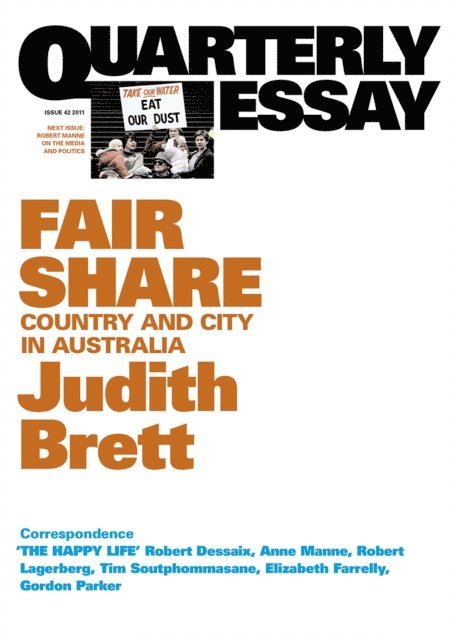
Quarterly Essay 42 Fair Share
Av Judith Brett
137 kr
Läs direkt i Bokus Reader – eller ladda ned till din enhet
Beskrivning
Once the country believed itself to be the true face of Australia: sunburnt men and capable women raising crops and children, enduring isolation and a fickle environment, carrying the nation on their sturdy backs. For almost 200 years after white settlement began, city Australia needed the country: to feed it, to earn its export income, to fill the empty land, to provide it with distinctive images of the nation being built in the great south land. But Australia no longer rides on the sheep’s back, and since the 1980s, when “economic rationalism” became the new creed, the country has felt abandoned, its contribution to the nation dismissed, its historic purpose forgotten.
In Fair Share, Judith Brett argues that our federation was built on the idea of a big country and a fair share, no matter where one lived. We also looked to the bush for our legends and we still look to it for our food. These are not things we can just abandon. In late 2010, with the country independents deciding who would form federal government, it seemed that rural and regional Australia’s time had come again. But, as Murray-Darling water reform shows, the politics of dependence are complicated. The question remains: what will be the fate of the country in an era of user-pays, water cutbacks, climate change, droughts and flooding rains? What are the prospects for a new compact between country and city in Australia in the twenty-first century?
Once the problems of the country were problems for the country as a whole. But then government stepped back … The problems of the country were seen as unfortunate for those affected but not likely to have much impact on the rest of Australia. The agents of neoliberalism cut the country loose from the city and left it to fend for itself. —Judith Brett, Fair Share
‘Brett is one of our most experienced and sober commentators on currents in the conservative/rural stream, and always deserves a hearing. Fair Share gives a clear and solid account on how we have come to focus on the Big Country as a problem.’ —Canberra Times
‘A clear and compelling account of how the country went from being a key source of the nation’s economy, pride and sense of self, to a problem that needs to be addressed.’ —the Week
‘An unalloyed expose of the plight of those who live in the countryside.’ —Ross Fitzgerald, the Australian
Judith Brett is professor of politics at La Trobe University and one of Australia’s leading political thinkers. She is a former editor of Meanjin and columnist for the Age. She is the author of the award-winning Robert Menzies’ Forgotten People and Australian Liberals and the Moral Middle Class: From Alfred Deakin to John Howard (2003), which was shortlisted for the Queensland premier’s prize for non-fiction.
In Fair Share, Judith Brett argues that our federation was built on the idea of a big country and a fair share, no matter where one lived. We also looked to the bush for our legends and we still look to it for our food. These are not things we can just abandon. In late 2010, with the country independents deciding who would form federal government, it seemed that rural and regional Australia’s time had come again. But, as Murray-Darling water reform shows, the politics of dependence are complicated. The question remains: what will be the fate of the country in an era of user-pays, water cutbacks, climate change, droughts and flooding rains? What are the prospects for a new compact between country and city in Australia in the twenty-first century?
Once the problems of the country were problems for the country as a whole. But then government stepped back … The problems of the country were seen as unfortunate for those affected but not likely to have much impact on the rest of Australia. The agents of neoliberalism cut the country loose from the city and left it to fend for itself. —Judith Brett, Fair Share
‘Brett is one of our most experienced and sober commentators on currents in the conservative/rural stream, and always deserves a hearing. Fair Share gives a clear and solid account on how we have come to focus on the Big Country as a problem.’ —Canberra Times
‘A clear and compelling account of how the country went from being a key source of the nation’s economy, pride and sense of self, to a problem that needs to be addressed.’ —the Week
‘An unalloyed expose of the plight of those who live in the countryside.’ —Ross Fitzgerald, the Australian
Judith Brett is professor of politics at La Trobe University and one of Australia’s leading political thinkers. She is a former editor of Meanjin and columnist for the Age. She is the author of the award-winning Robert Menzies’ Forgotten People and Australian Liberals and the Moral Middle Class: From Alfred Deakin to John Howard (2003), which was shortlisted for the Queensland premier’s prize for non-fiction.
Produktinformation
- Utgivningsdatum: 2011-06-01
- Språk: Engelska
- Filformat: EPUB
- Kopieringsskydd: LCP
- ISBN: 9781921870323
- Förlag: Schwartz Books Pty. Ltd.
Utforska kategorier
- Inga kategorier tillgängliga.
Betyg & recensioner
0 recensioner
Inga recensioner tillgängliga.