• Fri frakt över 249 kr
  • •
  • Snabba leveranser
  • •
  • Billiga böcker
Kundservice

Du är på sajten för privatpersoner.

Företag, bibliotek eller offentlig verksamhet?

Du handlar på classic.bokus.com, där alla dina funktioner finns intakta.
Till classic.bokus.com
Bokus logotyp. Gå till startsidan.
  • Erbjudanden
  • Nyheter
  • Student
  • Topplistor
  • Barn & ungdom
  • Bokus Play
  • E-böcker
  • Pocketböcker
  • Spel & pussel

10% rabatt på allt med kod NYSTART10 →

Sidfot

Mina sidor

    Hjälp

    • Kundservice
    • Vanliga frågor och svar
    • Frakt och leverans
    • Retur vid ångerrätt
    • Reklamera vara
    • Betalning
    • Köpvillkor
    • Allmänna villkor
    • Information om webbplatsens tillgänglighet

    Om Bokus

    • Om oss
    • Pressrum
    • För studenter
    • För företag
    • För bibliotek och offentlig verksamhet
    • För leverantörer
    • Hållbarhet

    Populärt

    • Aktuella erbjudanden
    • Presentkort
    • Studentlitteratur
    • Nya böcker
    • Topplistor
    • Signerade böcker
    • Engelska böcker

    Inspiration

    • Boktips
    • BookTok
    • Populära bokserier
    • Barnbokskaraktärer
    • Populära författare
    Logotyp för Bokus
    Följ oss på Facebook (extern länk)Följ oss på Instagram (extern länk)Följ oss på YouTube (extern länk)Följ oss på TikTok (extern länk)
    bokus @ CookiesAnpassa cookiesIntegritetspolicyKöpvillkor
    Till Citymail hemsida (extern länk)Till Budbee hemsida (extern länk)Till Postnord hemsida (extern länk)Till Schenker hemsida (extern länk)Till Early Bird hemsida (extern länk)Till Walleys hemsida (extern länk)
    1. Naturvetenskap och teknik
    2. Teknik och industri
    3. Energiteknik

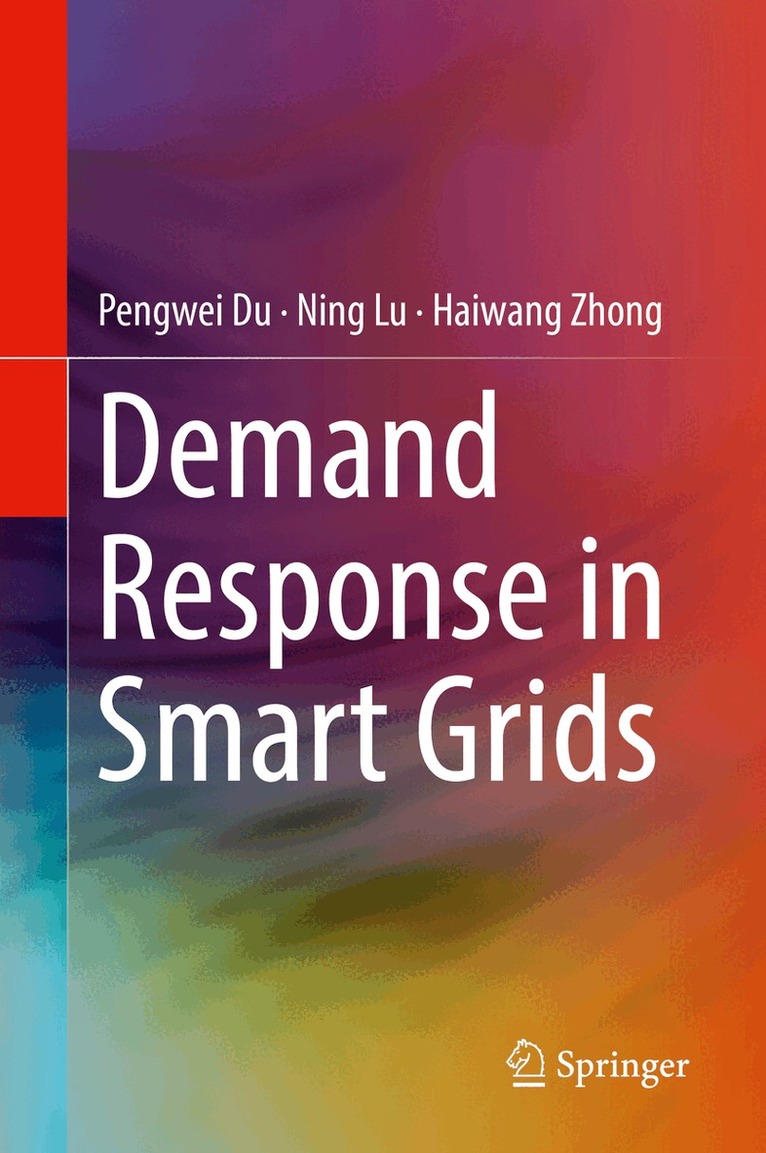
    Demand Response in Smart Grids

    AvPengwei Du,Ning Lu

    Inbunden, Engelska, 2019

    1 517 kr

    Beställningsvara. Skickas inom 10-15 vardagar. Fri frakt över 249 kr.

    Fler format och utgåvor

    Häftad

    1 517 kr

    Beskrivning

    This book is the first of its kind to comprehensively describe the principles of demand response. This allows consumers to play a significant role in the operation of the electric grid by reducing or shifting their electricity usage in response to the grid reliability need, time-based rates or other forms of financial incentives. The main contents of the book include modeling of demand response resources, incentive design, scheduling and dispatch algorithms, and impacts on grid operation and planning. Through case studies and illustrative examples, the authors highlight and compare the advantages, disadvantages and benefits that demand response can have on grid operations and electricity market efficiency.First book of its kind to introduce the principles of demand response;Combines theory with real-world applications useful for both professionals and academic researchers;Covers demand response in the context of power system applications.

    Produktinformation

    • Utgivningsdatum:2019-07-16
    • Mått:155 x 235 x 21 mm
    • Vikt:582 g
    • Format:Inbunden
    • Språk:Engelska
    • Antal sidor:260
    • Upplaga:19001
    • Förlag:Springer Nature Switzerland AG
    • ISBN:9783030197681

    Utforska kategorier

    • Energiteknik inom Naturvetenskap och teknik

    Mer om författaren

    Dr. Pengwei Du is Lead Engineer-Renewable Integration with the Electric Reliability Council of Texas (ERCOT). Prior to this, he was a senior research engineer with Pacific Northwest National Laboratory (PNNL). Dr. Du has extensive experiences in simulation, modeling, protection and control of power systems, renewable energy integration, microgrid, and cyber security. He has been vice-chair for Bulk Power System Planning Subcommittee at IEEE Power & Energy Society since 2016. He is a subject editor of IET Generation Transmission & Distribution and an editor for IEEE Transactions on Power Systems. Dr. Du is the recipient of IEEE PES Power System Dynamic Performance Committee Best Paper Prize in 2016. He graduated from Rensselaer Polytechnic Institute with a Ph.D. in Electrical Engineering.Dr. Lu is an Associate Professor at the ECE Department of North Carolina State University and has over 20 years of experience in electric power engineering. She receivedbachelor's degree from Harbin Institute of Technology in 1993 and Ph.D. degree from Rensselaer Polytechnic Institute in 2002. From1993 to1998, she was a power system design engineer with Shenyang Electric Power Bureau.  From 2003 to 2012, Dr. Ning Lu was a senior research engineer with Pacific Northwest National Laboratory.  Dr Lu's research interests include modeling and analysis of power system load behaviors, energy management systems development, renewable integration, microgrid modeling and control, and power system data analytics. Dr. Lu is a senior member of the Institute of Electrical and Electronics Engineers. She has authored or co-authored more than 100 publications, including journal articles, conference proceedings, and technical reports.  Dr. Haiwang Zhong received both the B.S. and Ph.D. degrees from the Department of Electrical Engineering, Tsinghua University in 2008 and 2013, respectively. Currently, he is an Associate Professor at Tsinghua University. His research interests include power system operations and planning, electricity markets and demand response. He developed the generation scheduling software that has been applied in 10+ provincial power dispatch centers in China. He currently serves as the Vice Chair of the IEEE PES WG on Demand Response, Secretary of the Architecture Subcommittee under the IEEE PES Smart Building and Load Control Committee. He serves as the Editor for International Transactions on Electrical Energy Systems, Journal of Modern Power System and Clean Energy, and CSEE Journal of Power and Energy Systems. He was awarded the ProSPER.Net Young Scientist Award. He was awarded 2 Provincial Awards. He won the Gold Medal in 44th Geneva International Invention Exhibition in 2016.

    Innehållsförteckning

    • Chapter 1. Overview of Demand Response.- Chapter 2.-Modeling Demand Response Resources.- Chapter 3.Basic Control Approach for Aggregated Demand Response Programs.- Chapter 4. Demand Responses in ERCOT.- Chapter 5. Integrated Demand Response in the Multi-Energy System.- Chapter 6. Coupon Incentive-Based Demand Response.- Chapter 7. Distributed Real-Time Demand Response based on Lagrangian Multiplier Optimal Selection Approach.- Chapter 8. Load Resources to Provide Primary Frequency Reserve Service.- Chapter 9. Optimal Response of Residential House Load.