• Fri frakt över 249 kr
  • •
  • Snabba leveranser
  • •
  • Billiga böcker
Kundservice

Du är på sajten för privatpersoner.

Företag, bibliotek eller offentlig verksamhet?

Du handlar på classic.bokus.com, där alla dina funktioner finns intakta.
Till classic.bokus.com
Bokus logotyp. Gå till startsidan.
  • Erbjudanden
  • Nyheter
  • Student
  • Topplistor
  • Barn & ungdom
  • Bokus Play
  • E-böcker
  • Pocketböcker
  • Spel & pussel

10% rabatt på allt med kod NYSTART10 →

Sidfot

Mina sidor

    Hjälp

    • Kundservice
    • Vanliga frågor och svar
    • Frakt och leverans
    • Retur vid ångerrätt
    • Reklamera vara
    • Betalning
    • Köpvillkor
    • Allmänna villkor
    • Information om webbplatsens tillgänglighet

    Om Bokus

    • Om oss
    • Pressrum
    • För studenter
    • För företag
    • För bibliotek och offentlig verksamhet
    • För leverantörer
    • Hållbarhet

    Populärt

    • Aktuella erbjudanden
    • Presentkort
    • Studentlitteratur
    • Nya böcker
    • Topplistor
    • Signerade böcker
    • Engelska böcker

    Inspiration

    • Boktips
    • BookTok
    • Populära bokserier
    • Barnbokskaraktärer
    • Populära författare
    Logotyp för Bokus
    Följ oss på Facebook (extern länk)Följ oss på Instagram (extern länk)Följ oss på YouTube (extern länk)Följ oss på TikTok (extern länk)
    bokus @ CookiesAnpassa cookiesIntegritetspolicyKöpvillkor
    Till Citymail hemsida (extern länk)Till Budbee hemsida (extern länk)Till Postnord hemsida (extern länk)Till Schenker hemsida (extern länk)Till Early Bird hemsida (extern länk)Till Walleys hemsida (extern länk)
    1. Naturvetenskap och teknik
    2. Teknik och industri
    3. Energiteknik

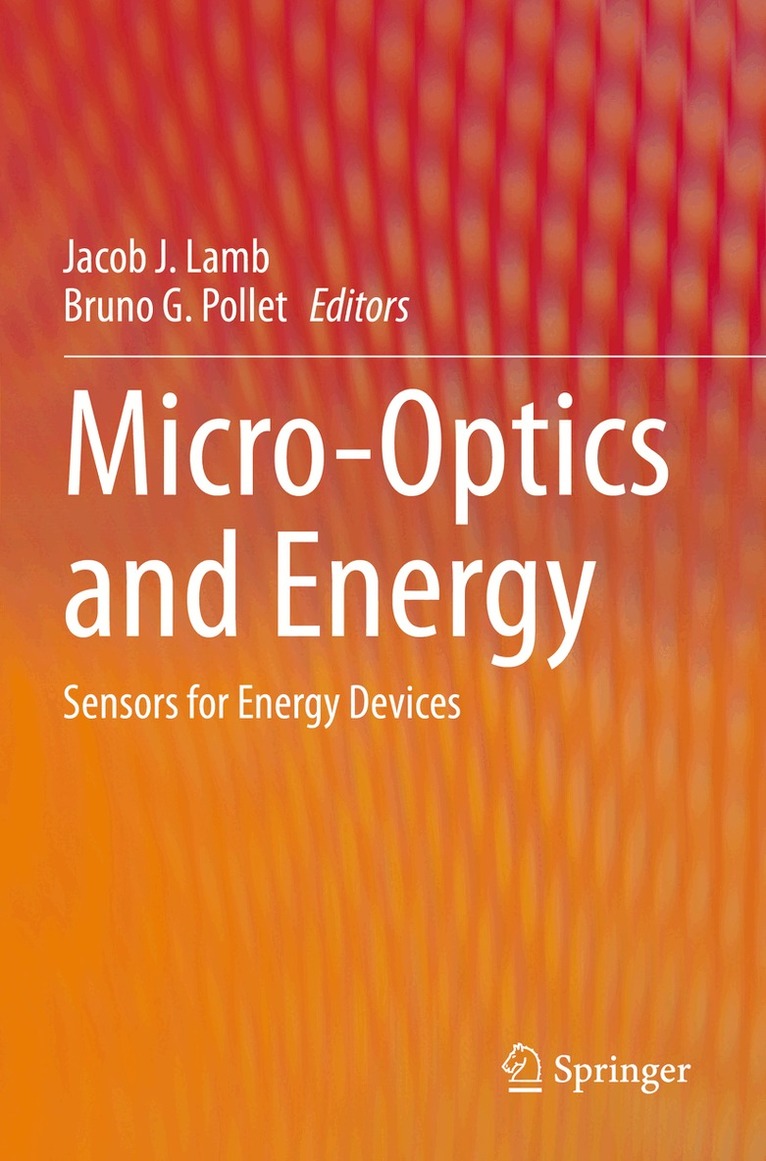
    Micro-Optics and Energy

    Sensors for Energy Devices

    AvJacob J. Lamb,Bruno G. Pollet

    Häftad, Engelska, 2021

    1 625 kr

    Beställningsvara. Skickas inom 10-15 vardagar. Fri frakt över 249 kr.

    Beskrivning

    This book provides a brief research source for optical fiber sensors for energy production and storage systems, discussing fundamental aspects as well as cutting-edge trends in sensing. This volume provides industry professionals, researchers and students with the most updated review on technologies and current trends, thus helping them identify technology gaps, develop new materials and novel designs that lead to commercially viable energy storage systems.

    Produktinformation

    • Utgivningsdatum:2021-06-12
    • Mått:155 x 235 x 13 mm
    • Vikt:347 g
    • Format:Häftad
    • Språk:Engelska
    • Antal sidor:207
    • Förlag:Springer Nature Switzerland AG
    • ISBN:9783030436780

    Utforska kategorier

    • Energiteknik inom Naturvetenskap och teknik
    • Fysikalisk kemi inom Naturvetenskap och teknik
    • Fysik inom Naturvetenskap och teknik

    Mer om författaren

    Bruno G. Pollet is a full Professor of Renewable Energy at the Norwegian University of Science and Technology (NTNU) in Trondheim. He currently leads the "NTNU Team Hydrogen". He is a Fellow of the Royal Society of Chemistry (RSC, UK), an Associate Fellow of the Institution of Chemical Engineers (IChemE, UK) and Board of Directors’ member of the International Association for Hydrogen Energy (IAHE). He is currently Visiting Professors (VP) at the University of Ulster (UK) and the University of the Western Cape (RSA), and was “Professeur des Universités Invité” at the Université de Franche-Comté (France) and a VP at the University of Yamanashi, Professor Watanabe’s labs (Japan). His research covers a wide range of areas in Electrochemistry, Electrochemical Engineering, Electrochemical Energy Conversion and Sono-electrochemistry (Power Ultrasound in Electrochemistry) from the development of novel hydrogen & fuel cell materials, CO2 conversion, to water treatment/disinfection demonstrators & prototypes. He was a full Professor of Energy Materials and Systems at the University of the Western Cape (RSA) and R&D Director of the National Hydrogen South Africa (HySA) Systems Competence Centre. He was also a Research Fellow and Lecturer in Chemical Engineering at The University of Birmingham (UK) as well as a co-founder and an Associate Director of the Birmingham Centre for Hydrogen and Fuel Cell Research. He has worked for Johnson Matthey Fuel Cells Ltd (UK) and other various industries worldwide as Technical Account Manager, Project Manager, Research Manager, R&D Director, Head of R&D and Chief Technology Officer. He was awarded a Diploma in Chemistry and Material Sciences from the Université Joseph Fourier (Grenoble, France), a BSc (Hons) in Applied Chemistry from Coventry University (UK) and an MSc in Analytical Chemistry from The University of Aberdeen (UK). He also gained his PhD in Physical Chemistry in the field of Electrochemistry and Sonochemistry under the supervision of Professors J. Phil Lorimer & Tim J. Mason at the Sonochemistry Centre of Excellence, Coventry University. He undertook his PostDoc in Electrocatalysis at the Liverpool University Electrochemistry group led by Professor David J. Schiffrin.AffiliationsHydrogen Energy and Sonochemistry research group, Department of Energy and Process Engineering, Faculty of Engineering & NTNU Team Hydrogen, Norwegian University of Science and Technology (NTNU), Trondheim, NorwayJacob J. Lamb obtained both his B.Sc. and M.Sc. in Biochemistry at the University of Otago, New Zealand, where he worked in a research laboratory with Associate Professor Julian Eaton-Rye and Associate Professor Martin Hohmann-Marriott. He moved to Norway in 2013 to undertake a PhD in Biotechnology under the supervision of Associate Professor Martin Hohmann-Marriott, which he completed in June 2016. From 2016 to 2018, he undertook postdoctoral research in biogas and sensor technologies with Professor Dag R. Hjelme and Associate Professor Kristian M. Lien at NTNU. Since 2018, he has worked as a senior researcher at NTNU on a variety of projects within the fields of biology, bioenergy, renewable energy, sensor technologies and energy storage His areas of expertise include photosynthesis, microbiology, biological and biochemical techniques, electronics and programming, renewable energy, energy storage, sensor technologies, optical spectroscopy and process engineering. His research motivation is to improve renewable energy sources, increase sustainability within agricultural and aqua cultural industries, develop technologies for climate change mitigation as well as develop ways to measure, analyse, and optimize biological processes.AffiliationsDepartment of Electronic Systems & Department of Energy and Process Engineering & ENERSENSE NTNU

    Innehållsförteckning

    • Section 1: Optical Properties for Sensors.- Chapter 1.1: Introduction to Optical Sensors.- Chapter 1.2: Light Properties and Sensors.- Section 2: Optical Sensor Measurements.- Chapter 2.1: Temperature and Humidity Measurements.- Chapter 2.2: Hydrogen Gas Measurements.- Chapter 2.3: Sensor Fusion.- Section 3: Energy Production and Storage.- Chapter 3.1: Hydrogen Fuel Cells and Water Electrolysers.- Chapter 3.2: Ultrasound-Assisted Electrolytic Hydrogen Production.- Chapter 3.3: Low Grade Waste Heat to Hydrogen.- Chapter 3.4: Liquid Air Energy Storage.- Chapter 3.5: Hydrogen and Biogas.- Chapter 3.6: Lifetime Expectancy of Lithium-ion Batteries.- Section 4: Micro-Optical Sensors in Energy Systems.- Chapter 4.1: Thermal Management of Lithium Ion Batteries.- Chapter 4.2: Reverse Electrodialysis Cells.- Acknowledgements.