• Fri frakt över 249 kr
  • •
  • Snabba leveranser
  • •
  • Billiga böcker
Kundservice

Du är på sajten för privatpersoner.

Företag, bibliotek eller offentlig verksamhet?

Du handlar på classic.bokus.com, där alla dina funktioner finns intakta.
Till classic.bokus.com
Bokus logotyp. Gå till startsidan.
  • Erbjudanden
  • Nyheter
  • Student
  • Topplistor
  • Barn & ungdom
  • Bokus Play
  • E-böcker
  • Pocketböcker
  • Spel & pussel

10% rabatt på allt med kod: NYSTART10 →

Sidfot

Mina sidor

    Hjälp

    • Kundservice
    • Vanliga frågor och svar
    • Frakt och leverans
    • Retur vid ångerrätt
    • Reklamera vara
    • Betalning
    • Köpvillkor
    • Allmänna villkor
    • Information om webbplatsens tillgänglighet

    Om Bokus

    • Om oss
    • Pressrum
    • För studenter
    • För företag
    • För bibliotek och offentlig verksamhet
    • För leverantörer
    • Hållbarhet

    Populärt

    • Aktuella erbjudanden
    • Presentkort
    • Studentlitteratur
    • Nya böcker
    • Topplistor
    • Signerade böcker
    • Engelska böcker

    Inspiration

    • Boktips
    • BookTok
    • Populära bokserier
    • Barnbokskaraktärer
    • Populära författare
    Logotyp för Bokus
    Följ oss på Facebook (extern länk)Följ oss på Instagram (extern länk)Följ oss på YouTube (extern länk)Följ oss på TikTok (extern länk)
    bokus @ CookiesAnpassa cookiesIntegritetspolicyKöpvillkor
    Till Citymail hemsida (extern länk)Till Budbee hemsida (extern länk)Till Postnord hemsida (extern länk)Till Schenker hemsida (extern länk)Till Early Bird hemsida (extern länk)Till Walleys hemsida (extern länk)
    1. Naturvetenskap och teknik
    2. Geovetenskap
    3. Geovetenskap

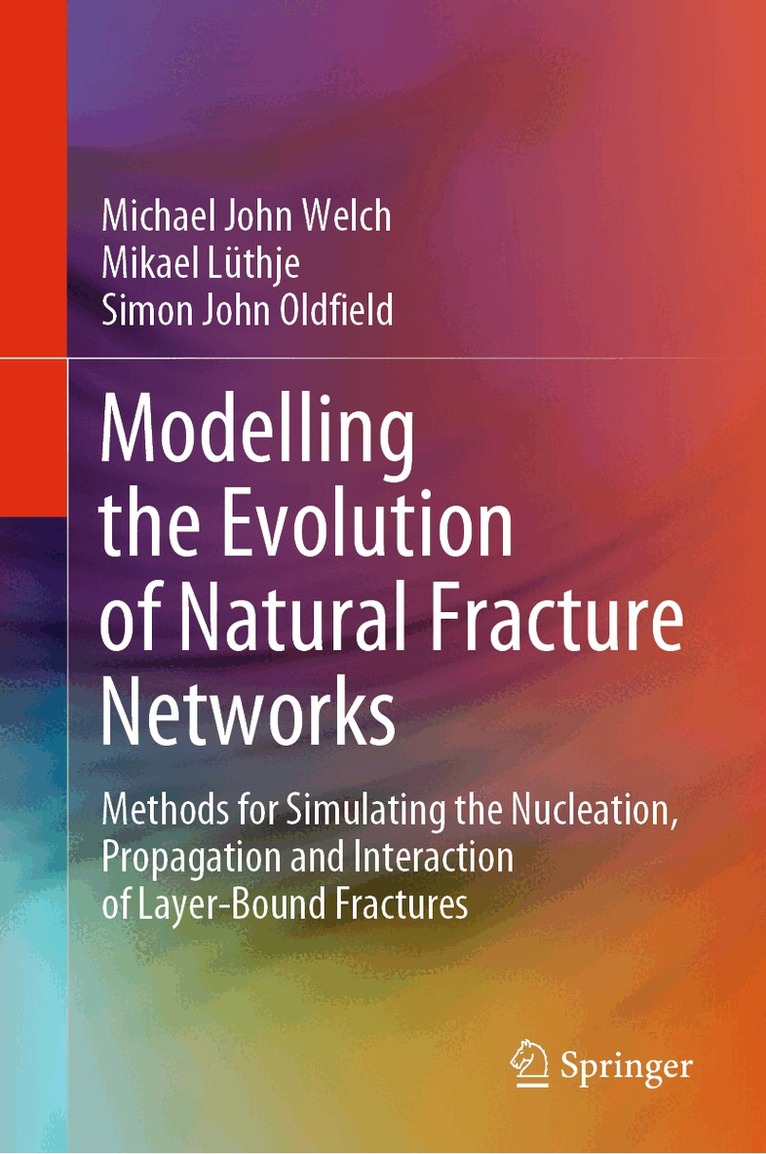
    Modelling the Evolution of Natural Fracture Networks

    Methods for Simulating the Nucleation, Propagation and Interaction of Layer-Bound Fractures

    AvMichael John Welch,Mikael Lüthje

    Inbunden, Engelska, 2020

    1 518 kr

    Beställningsvara. Skickas inom 10-15 vardagar. Fri frakt över 249 kr.

    Fler format och utgåvor

    Häftad

    1 518 kr

    Beskrivning

    This book presents and describes an innovative method to simulate the growth of natural fractural networks in different geological environments, based on their geological history and fundamental geomechanical principles.The book develops techniques to simulate the growth and interaction of large populations of layer-bound fracture directly, based on linear elastic fracture mechanics and subcritical propagation theory. It demonstrates how to use these techniques to model the nucleation, propagation and interaction of layer-bound fractures in different orientations around large scale geological structures, based on the geological history of the structures. It also explains how to use these techniques to build more accurate discrete fracture network (DFN) models at a reasonable computational cost. These models can explain many of the properties of natural fracture networks observed in outcrops, using actual outcrop examples. Finally, the book demonstrates how it can be incorporated into flow modelling workflows using subsurface examples from the hydrocarbon and geothermal industries.Modelling the Evolution of Natural Fracture Networks will be of interest to anyone curious about understanding and predicting the evolution of complex natural fracture networks across large geological structures. It will be helpful to those modelling fluid flow through fractures, or the geomechanical impact of fracture networks, in the hydrocarbon, geothermal, CO2 sequestration, groundwater and engineering industries.

    Produktinformation

    • Utgivningsdatum:2020-09-19
    • Mått:155 x 235 x 20 mm
    • Vikt:541 g
    • Format:Inbunden
    • Språk:Engelska
    • Antal sidor:230
    • Förlag:Springer Nature Switzerland AG
    • ISBN:9783030524135

    Utforska kategorier

    • Geovetenskap inom Naturvetenskap och teknik
    • Geologi inom Naturvetenskap och teknik
    • Energiteknik inom Naturvetenskap och teknik

    Mer om författaren

    Since completing his PhD at Birmingham University in 1997, Michael Welch has worked as an applied structural geologist in various consultancies and academic positions. His focus has always been on applied research in structural geology, developing new tools and techniques to solve specific problems, and working with industry to apply those techniques. This work has aimed to understanding and predicting the occurrence and effects of fractures and faults in the subsurface, mostly, but not exclusively, in the hydrocarbon industry. He has presented much of this work in publications and international conference presentations. Mikael Lüthje did his PhD in geophysics and applied mathematics at Cambridge University, Technical University of Denmark and UCL in 2005. He has since then worked within academia, R&D and in the industry mostly with fractured reservoirs. He has also worked extensively with climate research, CO2 sequestration and fluid flow modelling.Simon Oldfield is a structural geologist with a background in geological modelling and model validation. Having previously worked in the mining and hydrocarbon industries, he undertook his PhD at the University of Leeds investigating the uncertainty of how seismic imaging represents different structural geometries observed in the field. Since 2019, he has worked with DHRTC calibrating and validating fracture modelling outputs against natural outcrops and considering the implications for subsurface fluid flow.The Danish Hydrocarbon Research and Technology Centre, based at the Technical University of Denmark, was set up in 2015 with funding from the hydrocarbon industry with a remit to carry out research to benefit the Danish offshore hydrocarbon industry. For the past 3 years, Michael and Mikael have been working on this project to develop new techniques to simulate natural fracture networks, for use in building improved fluid flow models of hydrocarbon fields. They have been working closely with Total E&P Denmark to apply these techniques to Danish offshore oil and gas fields, and have also applied them to several outcrops and a geothermal prospect. The techniques have potential applications in all fractured reservoirs and aquifers across industries including hydrocarbon extraction, geothermal energy, CO2 sequestration and underground storage.

    Innehållsförteckning

    • Introduction.- Conceptual Model.- Modelling Microfractures.- Modelling Macrofractures.- Active and Static Fractures.- Elastic Moduli and Stress.- Controls on Fracture Evolution.- Some Outcrop Examples.- Application to the Subsurface.- Conclusions and Further Work.