• Fri frakt över 249 kr
  • •
  • Snabba leveranser
  • •
  • Billiga böcker
Kundservice

Du är på sajten för privatpersoner.

Företag, bibliotek eller offentlig verksamhet?

Du handlar på classic.bokus.com, där alla dina funktioner finns intakta.
Till classic.bokus.com
Bokus logotyp. Gå till startsidan.
  • Erbjudanden
  • Nyheter
  • Student
  • Topplistor
  • Barn & ungdom
  • Bokus Play
  • E-böcker
  • Pocketböcker
  • Spel & pussel

10% studentrabatt med kod TERM26

Sidfot

Mina sidor

    Hjälp

    • Kundservice
    • Vanliga frågor och svar
    • Frakt och leverans
    • Retur vid ångerrätt
    • Reklamera vara
    • Betalning
    • Köpvillkor
    • Allmänna villkor
    • Information om webbplatsens tillgänglighet

    Om Bokus

    • Om oss
    • Pressrum
    • För studenter
    • För företag
    • För bibliotek och offentlig verksamhet
    • För leverantörer
    • Hållbarhet

    Populärt

    • Aktuella erbjudanden
    • Presentkort
    • Studentlitteratur
    • Nya böcker
    • Topplistor
    • Signerade böcker
    • Engelska böcker

    Inspiration

    • Boktips
    • BookTok
    • Populära bokserier
    • Barnbokskaraktärer
    • Populära författare
    Logotyp för Bokus
    Följ oss på Facebook (extern länk)Följ oss på Instagram (extern länk)Följ oss på YouTube (extern länk)Följ oss på TikTok (extern länk)
    bokus @ CookiesAnpassa cookiesIntegritetspolicyKöpvillkor
    Till Citymail hemsida (extern länk)Till Budbee hemsida (extern länk)Till Postnord hemsida (extern länk)Till Schenker hemsida (extern länk)Till Early Bird hemsida (extern länk)Till Walleys hemsida (extern länk)
    1. Ekonomi och Ledarskap
    2. Nationalekonomi

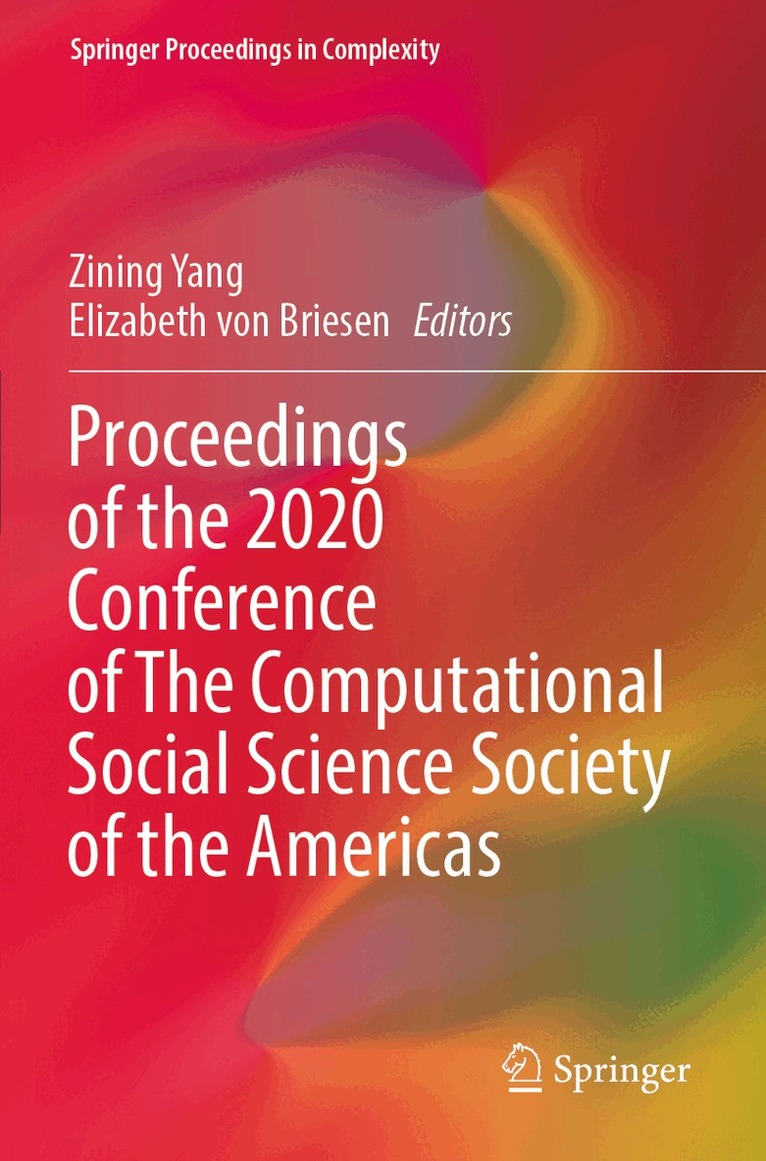
    Proceedings of the 2020 Conference of The Computational Social Science Society of the Americas

    AvZining Yang,Elizabeth von Briesen

    Häftad, Engelska, 2023

    Del i serien Springer Proceedings in Complexity

    1 743 kr

    Beställningsvara. Skickas inom 10-15 vardagar. Fri frakt över 249 kr.

    Beskrivning

    This book is comprised of the latest research into CSS methods, uses, and results, as presented at the 2020 annual conference of the Computational Social Science Society of the Americas (CSSSA). Computational social science (CSS) is the science that investigates social and behavioral dynamics through social simulation, social network analysis, and social media analysis. The CSSSA is a professional society that aims to advance the field of computational social science in all areas, including basic and applied orientations, by holding conferences and workshops, promoting standards of scientific excellence in research and teaching, and publishing research findings and results. The above-mentioned conference was held virtually, October 8 – 11, 2020. What follows is a diverse representation of new results and approaches to using the tools of CSS and agent-based modeling (ABM) in exploring complex phenomena across many different domains.  Readers will therefore not only have the results of these specific projects upon which to build, along with a wealth of case-study examples that can serve as meaningful exemplars for new research projects and activities, they will also gain a greater appreciation for the broad scope of CSS.

    Produktinformation

    • Utgivningsdatum:2023-01-07
    • Mått:155 x 235 x 16 mm
    • Vikt:446 g
    • Format:Häftad
    • Språk:Engelska
    • Serie:Springer Proceedings in Complexity
    • Antal sidor:279
    • Förlag:Springer Nature Switzerland AG
    • ISBN:9783030834203

    Utforska kategorier

    • Nationalekonomi inom Ekonomi och Ledarskap
    • Systemvetenskap och AI inom Data och IT
    • Referensverk och tvärvetenskap inom Samhälle och politik

    Mer om författaren

    Dr. Zining Yang is Senior Manager at Southern California Edison. She also works as Clinical Professor at Claremont Graduate University and Associate Director at the TransResearch Consortium. She sits on the Board of the Computational Social Science Society of the Americas (CSSSA), and serves as Scientific Advisory Board Member for Human Factors and Simulations. Dr. Yang received her Ph.D. in Computational and Applied Mathematics and Political Economy from Claremont Graduate University in 2015. Her research interests include Data Analytics, Machine Learning, Modeling and Simulation, Complex Adaptive Systems, Agent-Based Models, and Network Analysis. Dr. Yang has been published numerous times in the fields of Computer Science, Economics, Public Policy, and Political Science. She has been identified as an outstanding researcher by the government, worked on a National Science Foundation-sponsored project, and won multiple awards from various organizations, including the Ministryof Education of the People’s Republic of China; International Social Computing, Behavioral Modeling and Prediction; and the International Institute of Informatics and Systemics.Dr. Elizabeth von Briesen is an Assistant Professor of Computer Science at Elon University, and is a member of the board of the Computational Social Science Society of the Americas. She received her Ph.D. in Computing & Informatics from the University of North Carolina at Charlotte in 2020. Her research interests are focused on the study of complex adaptive systems using computational techniques, particularly with respect to social systems experiencing identity-based conflict. She primarily works with agent-based models, and performs data mining and sentiment analysis to inform those simulations. Finally, in her current position, Dr. von Briesen strives to contribute toward an evolving undergraduate computer science experience through research, service, and high-quality, innovative teaching.

    Innehållsförteckning

    • Chapter 1 - Creating Intelligent Agents: Combining Agent-Based Modeling with Machine Learning (Dale Brearcliffe and Andrew Crooks).- Chapter 2 - Envy splits societies into a lower and a upper class (Claudius Gros).- Chapter 3 - Effects of Non-Cognitive Factors on Post-Secondary Persistence of Deaf Students: An Agent-Based Modeling Approach (Marie Alaghband and Ivan Garibay).- Chapter 4 - Comparing Agent-Based Modeling to Cooperative Game Theory and Human Behavior (Andrew Collins).- Chapter 5 -  Analyzing transnational narratives in Twitter: an unsupervised approach using PARAFAC (Peter Chew and Jonathan Chew).- Chapter 6 - In-Silico models with greater fidelity to social processes: towards ABM platforms with realistic concurrency (Santiago Núñez-Corrales, Milton Friesen, Srikanth Mudigonda, Rajesh Venkatachalapathy and Jeffrey Graham).- Chapter 7 - Dynamics of Information Perception in Management of Commons (Saeed Langarudi, Carlos Silva and Sam Fernald).- Chapter 8 - Psychology from Stigmergy (H. Van Dyke Parunak).- Chapter 9 - CD-SEIZ: Cognition-Driven SEIZ Compartmental Model for the Prediction of Information Cascades on Twitter (Ece Mutlu, Ivan Garibay and Amirarsalan Rajabi).- Chapter 10 - Cultural Drift, Indirect Minority Influence, Network Structure and Their Impacts on Cultural Change and Diversity (Jiin Jung, Aaron Bramson, William Crano, Scott Page and John Miller).- Chapter 11 - An agent-based model to evaluate the perception of safety in informal settlements (Leticia Izquiero, Gamaliel Palomo, Arnaud Grignard, Luis Alonso, Mario Siller and Kent Larson).- Chapter 12 - Study of Altruism as a Behavioral Trait in Game Theory Network Dynamics with Prisoner Dilemma Games (William Leibzon).- Chapter 13 - Analyzing the potential impact of nonpharmaceutical interventions on the spread of COVID-19  (COVID-19 work in progress) (Matthew Koehler, David Slater, Garry Jacyna and James Thompson).-Chapter 14 - An Agent-Based Model of Infectious Diseases that Incorporates the Role of Immune Cells and Antibodies (Shigeaki Ogibayashi).- Chapter 15 - Heterogeneity in populations and behaviors: An agent-based model of the social spread of COVID-19  (Nicholas Willems, Cale Reeves, Vivek Shastry and Varun Rai).- Chapter 16 - Work In Progress: COVID-19 Policy Evaluation (CoPE) Tool: An agent-based model for ex-ante evaluation of policy designs and behavioral responses to COVID-19 (Vivek Shastry, Cale Reeves, Nicholas Willems and Varun Rai).- Chapter 17 - Investigating dynamics of COVID-19 spread and containment with agent-based modelling (Amirarsalan Rajabi, Alexander Mantzaris, Ece Mutlu and Ivan Garibay).- Chapter 18 - Purchasing Power to the People: An Agent-Based Simulation of Pandemic Economic Recovery (Youngsun Hwang, Joseph Immormino and Glenn-Iain Steinback).- Chapter 19 - Agent-based models of Quadratic Voting (Jacob Kelter, Andreas Bugler and Uri Wilensky).- Chapter 20 - Towards a model of the national market system: fragmented and heterogenous venues (Brian Tivnan, Carl Burke, Matthew Koehler, Matthew Mcmahon And Jason Veneman).- Chapter 21 - Online Rejection Influence on Behavior Deviancy and Radicalization: An Agent-Based Model Approach (Hanin Alhaddad, Nisha Baral and Ivan Garibay).- Chapter 22 - An agent-based model of digitally-mediated farmer transportation collaboration (Narjes Sadeghiamirshahidi, Anuj Mittal and Caroline Krejci).- Chapter 23 - Geometries of Desire: Simulating Rene Girard’s Mimetic Theory (Graham Sack).- Chapter 24 - Can Institutionalization Prevent the Depletion of Groundwater Resources? (Mehdi Moghadam Manesh, Saeed Langarudi and Birgit Kopainsky).