• Fri frakt över 249 kr
  • •
  • Snabba leveranser
  • •
  • Billiga böcker
Kundservice

Du är på sajten för privatpersoner.

Företag, bibliotek eller offentlig verksamhet?

Du handlar på classic.bokus.com, där alla dina funktioner finns intakta.
Till classic.bokus.com
Bokus logotyp. Gå till startsidan.
  • Erbjudanden
  • Student
  • Topplistor
  • Barn & ungdom
  • Bokus Play
  • E-böcker
  • Ljudböcker
  • Pocketböcker
  • Spel & pussel

10% rabatt på allt med kod NYSTART10 →

Sidfot

Mina sidor

    Hjälp

    • Kundservice
    • Vanliga frågor och svar
    • Frakt och leverans
    • Retur vid ångerrätt
    • Reklamera vara
    • Betalning
    • Köpvillkor
    • Allmänna villkor
    • Information om webbplatsens tillgänglighet

    Om Bokus

    • Om oss
    • Pressrum
    • För studenter
    • För företag
    • För bibliotek och offentlig verksamhet
    • För leverantörer
    • Hållbarhet

    Populärt

    • Aktuella erbjudanden
    • Presentkort
    • Studentlitteratur
    • Nya böcker
    • Topplistor
    • Signerade böcker
    • Engelska böcker

    Inspiration

    • Boktips
    • BookTok
    • Populära bokserier
    • Barnbokskaraktärer
    • Populära författare
    Logotyp för Bokus
    Följ oss på Facebook (extern länk)Följ oss på Instagram (extern länk)Följ oss på YouTube (extern länk)Följ oss på TikTok (extern länk)
    bokus @ CookiesAnpassa cookiesIntegritetspolicyKöpvillkor
    Till Citymail hemsida (extern länk)Till Budbee hemsida (extern länk)Till Postnord hemsida (extern länk)Till Schenker hemsida (extern länk)Till Early Bird hemsida (extern länk)Till Walleys hemsida (extern länk)
    1. Data och IT
    2. Systemvetenskap och AI

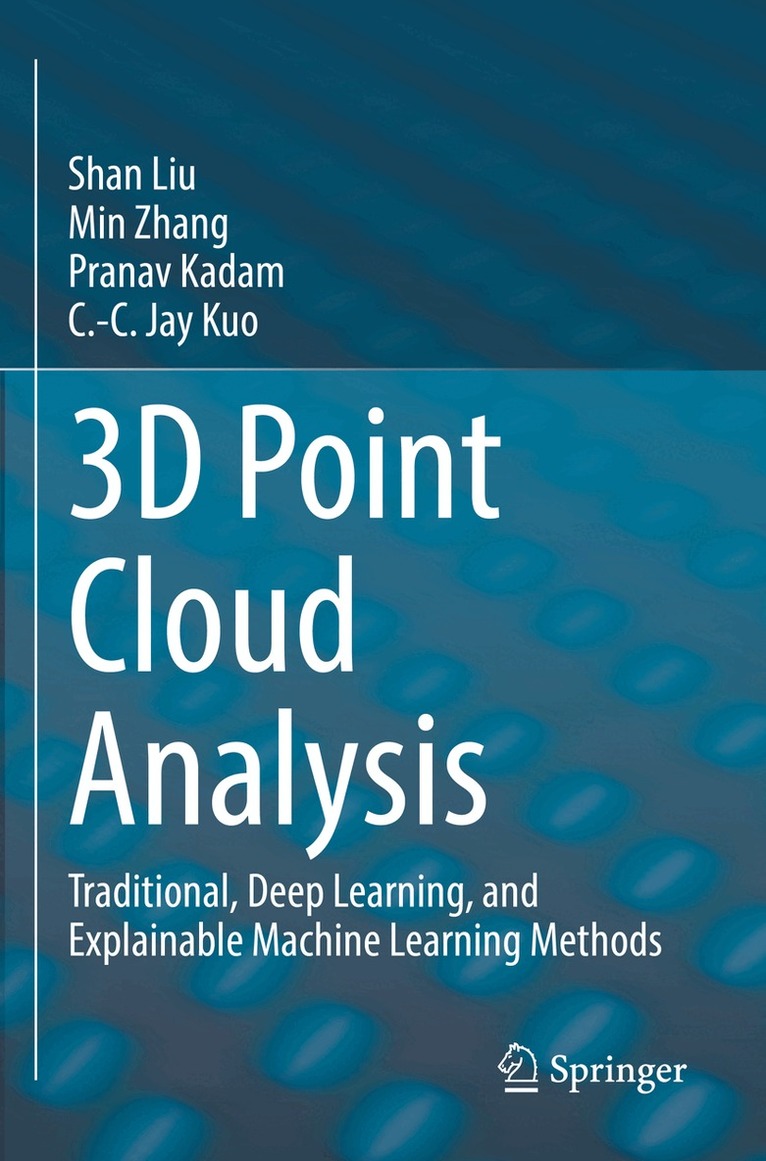
    3D Point Cloud Analysis

    Traditional, Deep Learning, and Explainable Machine Learning Methods

    AvShan Liu,Min Zhang

    Häftad, Engelska, 2022

    1 338 kr

    Beställningsvara. Skickas inom 10-15 vardagar. Fri frakt över 249 kr.

    Fler format och utgåvor

    Inbunden

    1 338 kr

    Beskrivning

    This book introduces the point cloud; its applications in industry, and the most frequently used datasets. It mainly focuses on three computer vision tasks -- point cloud classification, segmentation, and registration -- which are fundamental to any point cloud-based system. An overview of traditional point cloud processing methods helps readers build background knowledge quickly, while the deep learning on point clouds methods include comprehensive analysis of the breakthroughs from the past few years. Brand-new explainable machine learning methods for point cloud learning, which are lightweight and easy to train, are then thoroughly introduced. Quantitative and qualitative performance evaluations are provided. The comparison and analysis between the three types of methods are given to help readers have a deeper understanding.With the rich deep learning literature in 2D vision, a natural inclination for 3D vision researchers is to develop deep learning methods for point cloud processing. Deep learning on point clouds has gained popularity since 2017, and the number of conference papers in this area continue to increase. Unlike 2D images, point clouds do not have a specific order, which makes point cloud processing by deep learning quite challenging. In addition, due to the geometric nature of point clouds, traditional methods are still widely used in industry. Therefore, this book aims to make readers familiar with this area by providing comprehensive overview of the traditional methods and the state-of-the-art deep learning methods.A major portion of this book focuses on explainable machine learning as a different approach to deep learning. The explainable machine learning methods offer a series of advantages over traditional methods and deep learning methods. This is a main highlight and novelty of the book. By tackling three research tasks -- 3D object recognition, segmentation, and registration using our methodology -- readers will have a sense of how to solve problems in a different way and can apply the frameworks to other 3D computer vision tasks, thus give them inspiration for their own future research. Numerous experiments, analysis and comparisons on three 3D computer vision tasks (object recognition, segmentation, detection and registration) are provided so that readers can learn how to solve difficult Computer Vision problems.

    Produktinformation

    • Utgivningsdatum:2022-12-11
    • Mått:155 x 235 x 12 mm
    • Vikt:260 g
    • Format:Häftad
    • Språk:Engelska
    • Antal sidor:146
    • Förlag:Springer Nature Switzerland AG
    • ISBN:9783030891824

    Utforska kategorier

    • Systemvetenskap och AI inom Data och IT

    Mer om författaren

    Shan Liu received her B.Eng. degree in electronic engineering from Tsinghua University, and M.S. and Ph.D. degrees in electrical engineering from the University of Southern California, respectively. She is currently a Distinguished Scientist at Tencent and General Manager of Tencent Media Lab. She was formerly Director of Media Technology Division at MediaTek USA. She was also formerly with MERL and Sony, etc. Dr. Liu has been an active contributor to international standards for more than a decade. She has numerous technical proposals adopted into various standards, such as H.266/VVC, H.265/HEVC, OMAF, DASH, MMT, PCC, and served as an Editor of H.265/HEVC SCC and H.266/VVC standards. She is also heavily involved in multimedia technology productization and made instrumental contributions to several million-user products. Dr. Liu holds more than 200 granted patents and has published more than 100 technical papers. She was named “APSIPA Industrial Distinguished Leader” by Asia-Pacific Signal and Information Processing Association in 2018, and “50 Women in Tech” by Forbes China in 2020. She is on the Editorial Board of IEEE Transactions on Circuits and Systems for Video Technology (2018-present) and received the Best AE Award in 2019 and 2020, respectively. Her research interests include audio-visual, volumetric, immersive and emerging media compression, intelligence, transport and systems.Min Zhang received her B.E. degree from the School of Science, Nanjing University of Science and Technology, Nanjing, China and her M.S. degree from the Viterbi School of Engineering, University of Southern California (USC), Los Angeles, US, in 2017 and 2019, respectively. She joined Media Communications Laboratory (MCL) in 2018 summer and is currently a Ph.D. student in USC, guided by Prof. C.-C. Jay Kuo. Her research interests include point cloud processing and analysis related problems, i.e., point cloud classification, registration, and segmentation and detection, in the field of 3D computer vision, machine learning, and perception. Pranav Kadam received his MS degree in Electrical Engineering from the University of Southern California, Los Angeles, USA in 2020, and the Bachelor’s degree in Electronics and Telecommunication Engineering from Savitribai Phule Pune University, Pune, India in 2018. He is currently pursuing the PhD degree in Electrical Engineering from the University of Southern California. He is actively involved in research and development of methods for point cloud analysis and processing. His research interests include 3D computer vision, machine learning, and perception. C.-C. Jay Kuo received the Ph.D. degree in electrical engineering from the Massachusetts Institute of Technology, Cambridge in 1987. He is currently the holder of William M. Hogue Professorship, a Distinguished Professor of Electrical and Computer Engineering and Computer Science, and the Director of the USC Multimedia Communications Laboratory (MCL) at the University of Southern California. Dr. Kuo is a Fellow of the American Association for the Advancement of Science (AAAS), the Institute of Electrical and Electronics Engineers (IEEE), the National Academy of Inventors (NAI), and the International Society for Optical Engineers (SPIE). He has received several awards for his research contributions, including the 2010 Electronic Imaging Scientist of the Year Award, the 2010-11 Fulbright-Nokia Distinguished Chair in Information and Communications Technologies, the 2011 Pan Wen-Yuan Outstanding Research Award, the 2019 IEEE Computer Society Edward J. McCluskey Technical Achievement Award, the 2019 IEEE Signal Processing Society Claude Shannon-Harry Nyquist Technical Achievement Award, the 2020 IEEE TCMC Impact Award, the 72nd annual Technology and Engineering Emmy Award (2020), and the 2021 IEEE Circuits and Systems Society Charles A. Desoer Technical Achievement Award.

    Innehållsförteckning

    • I. Introduction.- II. Traditional point cloud analysis.- III. Deep-learning-based point cloud analysis.- IV. Explainable machine learning methods for point cloud analysis.- V. Conclusion and future work.