• Fri frakt över 249 kr
  • •
  • Snabba leveranser
  • •
  • Billiga böcker
Kundservice

Du är på sajten för privatpersoner.

Företag, bibliotek eller offentlig verksamhet?

Du handlar på classic.bokus.com, där alla dina funktioner finns intakta.
Till classic.bokus.com
Bokus logotyp. Gå till startsidan.
  • Erbjudanden
  • Nyheter
  • Student
  • Topplistor
  • Barn & ungdom
  • Bokus Play
  • E-böcker
  • Pocketböcker
  • Spel & pussel

10% rabatt på allt med kod: NYSTART10 →

Sidfot

Mina sidor

    Hjälp

    • Kundservice
    • Vanliga frågor och svar
    • Frakt och leverans
    • Retur vid ångerrätt
    • Reklamera vara
    • Betalning
    • Köpvillkor
    • Allmänna villkor
    • Information om webbplatsens tillgänglighet

    Om Bokus

    • Om oss
    • Pressrum
    • För studenter
    • För företag
    • För bibliotek och offentlig verksamhet
    • För leverantörer
    • Hållbarhet

    Populärt

    • Aktuella erbjudanden
    • Presentkort
    • Studentlitteratur
    • Nya böcker
    • Topplistor
    • Signerade böcker
    • Engelska böcker

    Inspiration

    • Boktips
    • BookTok
    • Populära bokserier
    • Barnbokskaraktärer
    • Populära författare
    Logotyp för Bokus
    Följ oss på Facebook (extern länk)Följ oss på Instagram (extern länk)Följ oss på YouTube (extern länk)Följ oss på TikTok (extern länk)
    bokus @ CookiesAnpassa cookiesIntegritetspolicyKöpvillkor
    Till Citymail hemsida (extern länk)Till Budbee hemsida (extern länk)Till Postnord hemsida (extern länk)Till Schenker hemsida (extern länk)Till Early Bird hemsida (extern länk)Till Walleys hemsida (extern länk)
    1. Medicin
    2. Klinisk medicin och internmedicin
    3. Sjukdomar och rubbningar
    4. Onkologi

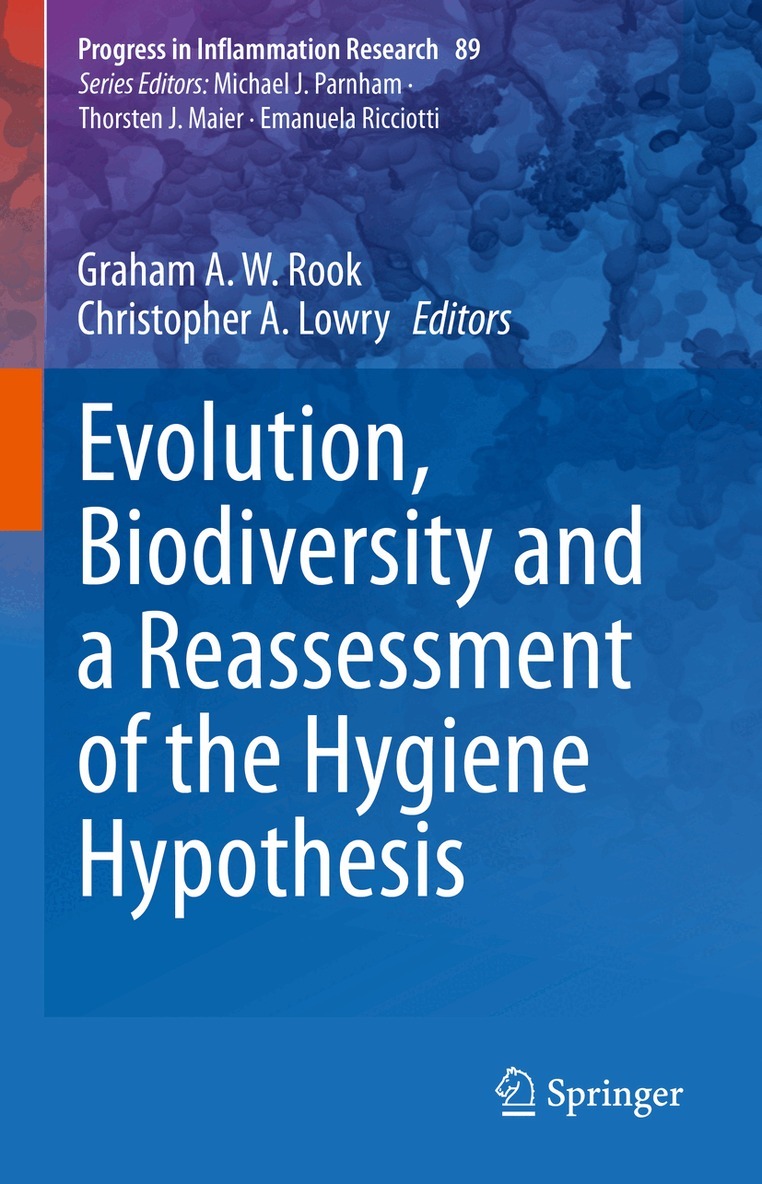
    Evolution, Biodiversity and a Reassessment of the Hygiene Hypothesis

    AvGraham A. W. Rook,Christopher A. Lowry

    Häftad, Engelska, 2023

    Del 89 i serien Progress in Inflammation Research

    2 008 kr

    Beställningsvara. Skickas inom 10-15 vardagar. Fri frakt över 249 kr.

    Beskrivning

    This edited collection of 12 chapters by research workers from a wide range of disciplines resolves the confusion that currently surrounds the “hygiene hypothesis” by considering the human need for exposure to microorganisms from an evolutionary point of view.  The book explains why we evolved a requirement for exposure to microbiota from our mothers, from other people, and from the natural environment. It also explains the physiological roles of these exposures, what goes wrong when the exposures are distorted and how human lifestyles and activities, including degradation of the natural environment, are leading to this distortion.  Particular attention is given to the range of pathologies associated with inappropriate microbial exposures and inappropriate colonization, including immunoregulatory problems such as allergies and autoimmunity, metabolic problems such as obesity and diabetes, and problems of central nervous system function and neurodegeneration.  This book is of profound relevance to most medical disciplines, but also to those concerned with preserving the natural environment and with developing healthier urbanisation.

    Produktinformation

    • Utgivningsdatum:2023-03-26
    • Mått:155 x 235 x 22 mm
    • Vikt:716 g
    • Format:Häftad
    • Språk:Engelska
    • Serie:Progress in Inflammation Research
    • Antal sidor:414
    • Förlag:Springer Nature Switzerland AG
    • ISBN:9783030910532

    Utforska kategorier

    • Onkologi inom Medicin

    Mer om författaren

    Graham A. W. Rook, BA MB BChir MD,  is emeritus Professor of Medical Microbiology at UCL (University College London). He was educated at the University of Cambridge and at St. Thomas’ Hospital London. He became professor of medical microbiology at UCL in 1994. The theme of his research was initially the immunopathology of tuberculosis, but in recent years GR’s focus has been the application of a Darwinian perspective to the effects on health of diminishing exposure to microorganisms from the natural environment, and of the changing composition of our commensal microbiota. GR coined the expression “Old Friends Hypothesis” to highlight a Darwinian re-interpretation of the hygiene hypothesis in 2003. Recently, in collaboration with neuroscientists and psychiatrists, this thinking has been applied to  psychiatric disorders that are accompanied by persistently raised biomarkers of inflammation and to the reduced stress resilience of people living in high-income countries. Thus GR’s approach is interdisciplinary, with emphasis on integrative physiology.Christopher A. Lowry, Ph.D. is an Associate Professor in the Department of Integrative Physiology, Center for Neuroscience, and Center for Microbial Exploration at the University of Colorado Boulder, with a secondary appointment in the Department of Physical Medicine and Rehabilitation (PM&R) and Center for Neuroscience, University of Colorado Anschutz Medical Campus, a Principal Investigator in the Department of Veterans Affairs Eastern Colorado Health Care System, VA Rocky Mountain Mental Illness Research, Education, & Clinical Center (MIRECC), director of the Behavioral Neuroendocrinology Laboratory at CU Boulder, Co-Director of the Military and Veteran Microbiome Consortium for Research and Education (MVM-CoRE), Senior Fellow and member of the Board of Directors of inVIVO Planetary Health, of the Worldwide Universities Network (WUN), and a member of the Board of Directors of Trails Please Foundation. Dr. Lowry’s research program focuses on understanding stress-related physiology and behavior with an emphasis on the microbiome-gut-brain axis.

    Innehållsförteckning

    • Chapter 1. From observing children in traditional upbringing to concepts of health.- Chapter 2. Human evolution, microorganisms, socioeconomic status and reconciling necessary microbial exposures with essential hygiene.- Chapter 3. Biodiversity, microbiomes, and human health.- Chapter 4. Regulation of host immunity by the gut microbiota.- Chapter 5. The gut microbiota and host metabolism.- Chapter 6. The impacts of the microbiota on animal development and physiology.- Chapter 7. The development of the gut microbiota in childhood, and its distortion by lifestyle changes.- Chapter 8. Distortion of the microbiota of the natural environment by human activities.- Chapter 9. The nature and functions of vertebrate skin microbiota.- Chapter 10. The influence of the microbiota on brain structure and function: Implications for stress-related neuropsychiatric disorders.- Chapter 11. Neurodegenerative diseases and the gut microbiota.- Chapter 12. Clinical application of the biodiversity hypothesisin the management of allergic disorders.