• Fri frakt över 249 kr
  • •
  • Snabba leveranser
  • •
  • Billiga böcker
Kundservice

Du är på sajten för privatpersoner.

Företag, bibliotek eller offentlig verksamhet?

Du handlar på classic.bokus.com, där alla dina funktioner finns intakta.
Till classic.bokus.com
Bokus logotyp. Gå till startsidan.
  • Erbjudanden
  • Nyheter
  • Student
  • Topplistor
  • Barn & ungdom
  • Bokus Play
  • E-böcker
  • Pocketböcker
  • Spel & pussel

10% rabatt på allt med kod NYSTART10 →

Sidfot

Mina sidor

    Hjälp

    • Kundservice
    • Vanliga frågor och svar
    • Frakt och leverans
    • Retur vid ångerrätt
    • Reklamera vara
    • Betalning
    • Köpvillkor
    • Allmänna villkor
    • Information om webbplatsens tillgänglighet

    Om Bokus

    • Om oss
    • Pressrum
    • För studenter
    • För företag
    • För bibliotek och offentlig verksamhet
    • För leverantörer
    • Hållbarhet

    Populärt

    • Aktuella erbjudanden
    • Presentkort
    • Studentlitteratur
    • Nya böcker
    • Topplistor
    • Signerade böcker
    • Engelska böcker

    Inspiration

    • Boktips
    • BookTok
    • Populära bokserier
    • Barnbokskaraktärer
    • Populära författare
    Logotyp för Bokus
    Följ oss på Facebook (extern länk)Följ oss på Instagram (extern länk)Följ oss på YouTube (extern länk)Följ oss på TikTok (extern länk)
    bokus @ CookiesAnpassa cookiesIntegritetspolicyKöpvillkor
    Till Citymail hemsida (extern länk)Till Budbee hemsida (extern länk)Till Postnord hemsida (extern länk)Till Schenker hemsida (extern länk)Till Early Bird hemsida (extern länk)Till Walleys hemsida (extern länk)
    1. Data och IT
    2. Systemvetenskap och AI

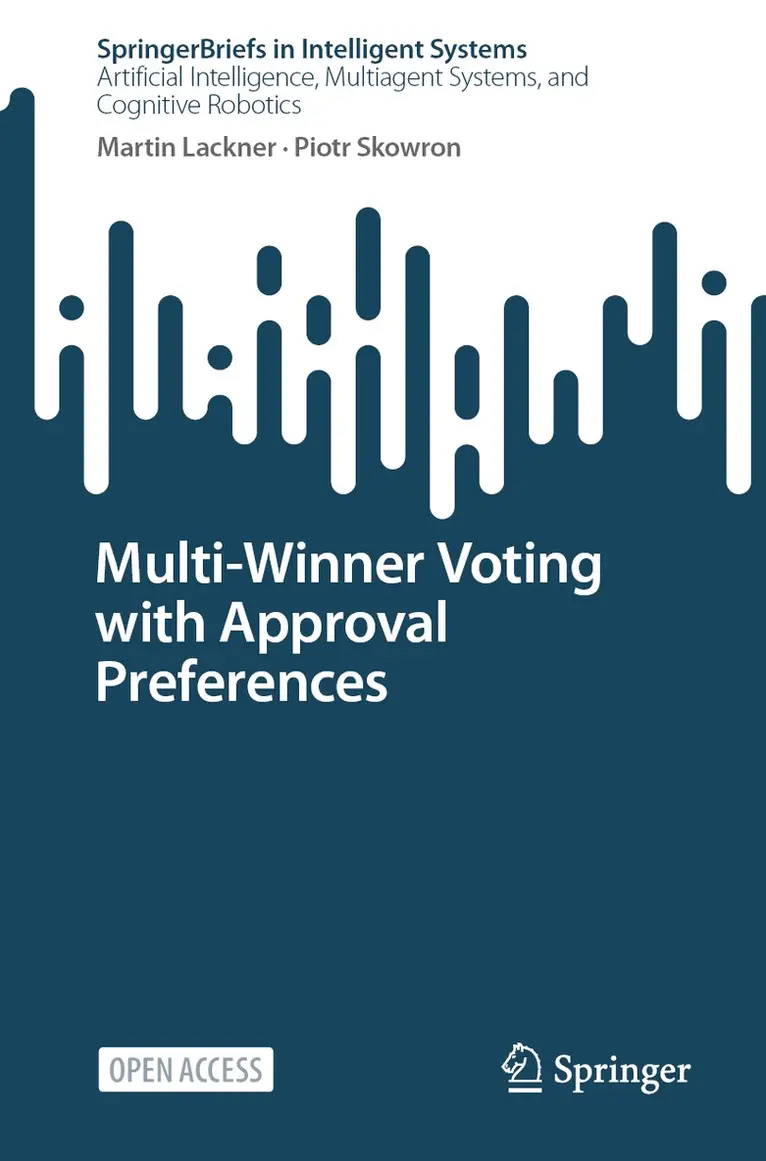
    Multi-Winner Voting with Approval Preferences

    AvMartin Lackner,Piotr Skowron

    Häftad, Engelska, 2022

    Del i serien SpringerBriefs in Intelligent Systems

    340 kr

    Beställningsvara. Skickas inom 10-15 vardagar. Fri frakt över 249 kr.

    Beskrivning

    From fundamental concepts and results to recent advances in computational social choice, this open access book provides a thorough and in-depth look at multi-winner voting based on approval preferences. The main focus is on axiomatic analysis, algorithmic results and several applications that are relevant in artificial intelligence, computer science and elections of any kind.What is the best way to select a set of candidates for a shortlist, for an executive committee, or for product recommendations? Multi-winner voting is the process of selecting a fixed-size set of candidates based on the preferences expressed by the voters. A wide variety of decision processes in settings ranging from politics (parliamentary elections) to the design of modern computer applications (collaborative filtering, dynamic Q&A platforms, diversity in search results, etc.) share the problem of identifying a representative subset of alternatives. The study of multi-winner voting provides the principled analysis of this task.Approval-based committee voting rules (in short: ABC rules) are multi-winner voting rules particularly suitable for practical use. Their usability is founded on the straightforward form in which the voters can express preferences: voters simply have to differentiate between approved and disapproved candidates. Proposals for ABC rules are numerous, some dating back to the late 19th century while others have been introduced only very recently. This book explains and discusses these rules, highlighting their individual strengths and weaknesses. With the help of this book, the reader will be able to choose a suitable ABC voting rule in a principled fashion, participate in, and be up to date with the ongoing research on this topic.

    Produktinformation

    • Utgivningsdatum:2022-11-18
    • Mått:155 x 235 x 17 mm
    • Vikt:222 g
    • Format:Häftad
    • Språk:Engelska
    • Serie:SpringerBriefs in Intelligent Systems
    • Antal sidor:121
    • Förlag:Springer International Publishing AG
    • ISBN:9783031090158

    Utforska kategorier

    • Systemvetenskap och AI inom Data och IT
    • Artificiell intelligens inom Data och IT

    Mer om författaren

    Martin Lackner works on artificial intelligence, specifically on computational social choice. His research deals with fundamental questions about fair collective decision making and how algorithms can support such decisions. Currently, he is principal investigator of the project “Algorithms for Sustainable Group Decision Making” at TU Wien. Before that, he was holding a postdoctoral researcher position at the University of Oxford. He obtained his doctoral degree from TU Wien and has published over 50 papers at top artificial intelligence and algorithms venues (and also in economics and philosophy journals).Piotr Skowron is an Assistant Professor at the University of Warsaw. He obtained his PhD from the University of Warsaw, followed by a postdoc position at the University of Oxford and a Humboldt fellowship for postdoctoral researchers at TU Berlin. His research mainly concerns the topic of computational social choice, specifically committee elections. His worklinks various ideas from computational social choice, game theory, resource allocation, and approximation algorithms. For his contribution to the literature on committee elections, he won the 2020 IJCAI Computers and Thought Award. He has published more than 70 articles and conference papers in the top venues on algorithmic game theory and artificial intelligence.

    Recensioner i media

    “The present document concerns the presentation of a special type of processes known as the multi-winner voting. … It is an interesting document, which may be a basic reference especially that in social sciences such as politics … . In its structure, the document is well organized. … The document is achieved with a technical Appendix designated to some useful proofs and counterexamples.” (Anouar Ben Mabrouk, zbMATH 1514.91004, 2023)

    Innehållsförteckning

    • Approval-Based Committee Voting.- Dramatis Personae: ABC Rules.- Basic Properties of ABC Rules.- Proportionality.- Algorithms and Computational Complexity.- Related Formalisms and Applications.- Outlook and Research Directions.- Additional Proofs.