• Fri frakt över 249 kr
  • •
  • Snabba leveranser
  • •
  • Billiga böcker
Kundservice

Du är på sajten för privatpersoner.

Företag, bibliotek eller offentlig verksamhet?

Du handlar på classic.bokus.com, där alla dina funktioner finns intakta.
Till classic.bokus.com
Bokus logotyp. Gå till startsidan.
  • Erbjudanden
  • Nyheter
  • Student
  • Topplistor
  • Barn & ungdom
  • Bokus Play
  • E-böcker
  • Pocketböcker
  • Spel & pussel

10% rabatt på allt med kod NYSTART10 →

Sidfot

Mina sidor

    Hjälp

    • Kundservice
    • Vanliga frågor och svar
    • Frakt och leverans
    • Retur vid ångerrätt
    • Reklamera vara
    • Betalning
    • Köpvillkor
    • Allmänna villkor
    • Information om webbplatsens tillgänglighet

    Om Bokus

    • Om oss
    • Pressrum
    • För studenter
    • För företag
    • För bibliotek och offentlig verksamhet
    • För leverantörer
    • Hållbarhet

    Populärt

    • Aktuella erbjudanden
    • Presentkort
    • Studentlitteratur
    • Nya böcker
    • Topplistor
    • Signerade böcker
    • Engelska böcker

    Inspiration

    • Boktips
    • BookTok
    • Populära bokserier
    • Barnbokskaraktärer
    • Populära författare
    Logotyp för Bokus
    Följ oss på Facebook (extern länk)Följ oss på Instagram (extern länk)Följ oss på YouTube (extern länk)Följ oss på TikTok (extern länk)
    bokus @ CookiesAnpassa cookiesIntegritetspolicyKöpvillkor
    Till Citymail hemsida (extern länk)Till Budbee hemsida (extern länk)Till Postnord hemsida (extern länk)Till Schenker hemsida (extern länk)Till Early Bird hemsida (extern länk)Till Walleys hemsida (extern länk)
    1. Data och IT
    2. Systemvetenskap och AI

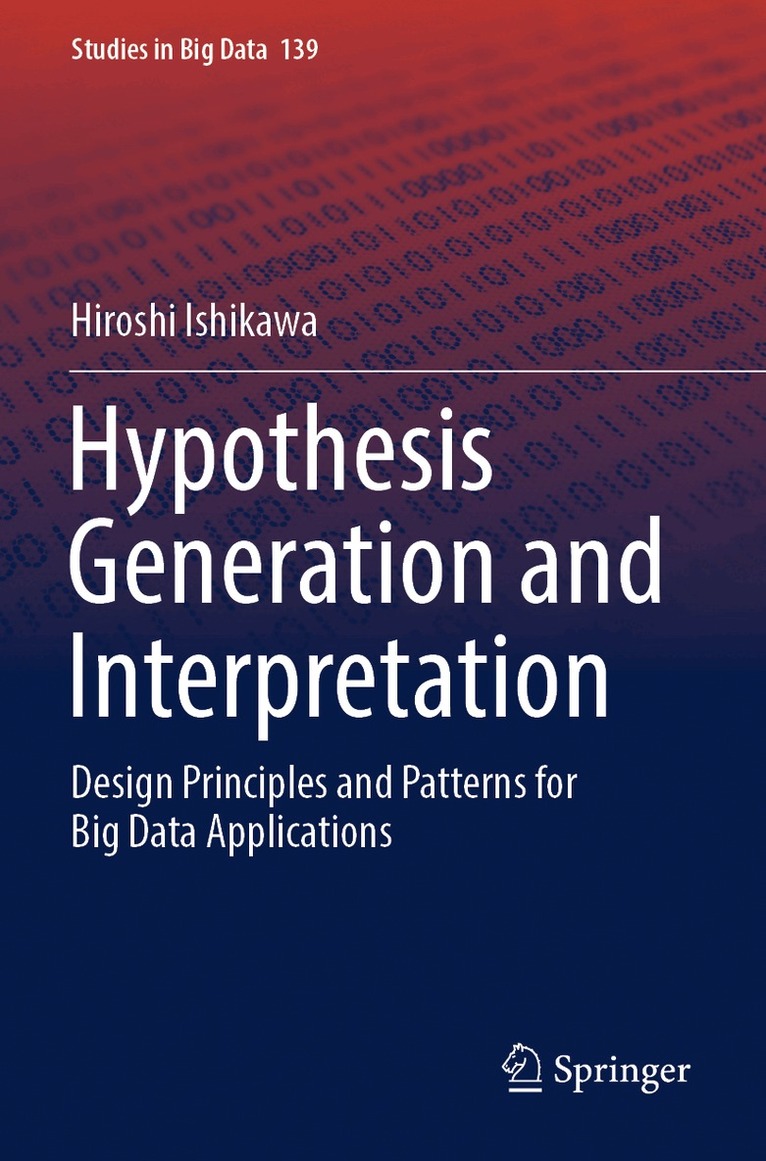
    Hypothesis Generation and Interpretation

    Design Principles and Patterns for Big Data Applications

    AvHiroshi Ishikawa

    Häftad, Engelska, 2025

    Del 139 i serien Studies in Big Data

    2 005 kr

    Beställningsvara. Skickas inom 10-15 vardagar. Fri frakt över 249 kr.

    Fler format och utgåvor

    Inbunden

    2 005 kr

    E-bok

    2 592 kr

    Beskrivning

    This book focuses in detail on data science and data analysis and emphasizes the importance of data engineering and data management in the design of big data applications. The author uses patterns discovered in a collection of big data applications to provide design principles for hypothesis generation, integrating big data processing and management, machine learning and data mining techniques.The book proposes and explains innovative principles for interpreting hypotheses by integrating micro-explanations (those based on the explanation of analytical models and individual decisions within them) with macro-explanations (those based on applied processes and model generation). Practical case studies are used to demonstrate how hypothesis-generation and -interpretation technologies work. These are based on “social infrastructure” applications like in-bound tourism, disaster management, lunar and planetary exploration, and treatment of infectious diseases.The novel methods and technologies proposed in Hypothesis Generation and Interpretation are supported by the incorporation of historical perspectives on science and an emphasis on the origin and development of the ideas behind their design principles and patterns. Academic investigators and practitioners working on the further development and application of hypothesis generation and interpretation in big data computing, with backgrounds in data science and engineering, or the study of problem solving and scientific methods or who employ those ideas in fields like machine learning will find this book of considerable interest.

    Produktinformation

    • Utgivningsdatum:2025-02-02
    • Mått:155 x 235 x 20 mm
    • Vikt:651 g
    • Format:Häftad
    • Språk:Engelska
    • Serie:Studies in Big Data
    • Antal sidor:372
    • Förlag:Springer International Publishing AG
    • ISBN:9783031435423

    Utforska kategorier

    • Systemvetenskap och AI inom Data och IT
    • Databaser inom Data och IT

    Mer om författaren

    ​Hiroshi Ishikawa received the B.S. and Ph.D degrees in Information Science from the University of Tokyo. After working for Fujitsu Laboratories and being a full professor of Shizuoka University, he was a full professor of Tokyo Metropolitan University (TMU) until March, 2021. He is now a distinguished leading professor and an emeritus professor of TMU. He is also the director of TMU Social Big Data Research Center. His research interests include databases, data mining, social media, and big data.He has published actively in international, refereed journals and conferences, such as ACM Transactions on Database Systems, IEEE Transactions on Knowledge and Data Engineering, The VLDB Journal, IEEE International Conference on Data Engineering, and ACM SIGSPATIAL and Management of Emergent Digital EcoSystems (MEDES). He has authored and co-authored a dozen books, including Social Big Data Mining (CRC, 2015) and Object-Oriented Database System (Springer-Verlag, 1993). He received the Sakai Memorial Distinguished Award from the Information Processing Society of Japan (IPSJ) in 1994, Commendation by the Director General of Science and Technology Agency of Japan in 1997, Commendation for Science and Technology by the Minister of Education, Culture, Sports, Science and Technology of Japan in 2021, and Commendation from the Database Society  of Japan in 2022. He was twice an invited professor at the Polytechnic School of the University of Nantes, France. He was a trustee board member of the Database Society of Japan, an editorial board member of The VLDB Journal, the chairman of the SIG on Database Systems of IPSJ, and an editor-in-chief of IPSJ Trans. on Databases. He is a co-founder of ACM MEDES conference. He is a Fellow of  the IPSJ and the Institute of Electronics, Information and Communication Engineers (IEICE) and a member of both the ACM and the IEEE.

    Innehållsförteckning

    • Basic Concept.- Hypothesis.- Science and Hypothesis.- Regression.- Machine Learning and Integrated Approach.- Hypothesis Generation by Difference.- Methods for Integrated Hypothesis Generation.- Interpretation.