• Fri frakt över 249 kr
  • •
  • Snabba leveranser
  • •
  • Billiga böcker
Kundservice

Du är på sajten för privatpersoner.

Företag, bibliotek eller offentlig verksamhet?

Du handlar på classic.bokus.com, där alla dina funktioner finns intakta.
Till classic.bokus.com
Bokus logotyp. Gå till startsidan.
  • Erbjudanden
  • Nyheter
  • Student
  • Topplistor
  • Barn & ungdom
  • Bokus Play
  • E-böcker
  • Pocketböcker
  • Spel & pussel

10% rabatt på allt med kod NYSTART10 →

Sidfot

Mina sidor

    Hjälp

    • Kundservice
    • Vanliga frågor och svar
    • Frakt och leverans
    • Retur vid ångerrätt
    • Reklamera vara
    • Betalning
    • Köpvillkor
    • Allmänna villkor
    • Information om webbplatsens tillgänglighet

    Om Bokus

    • Om oss
    • Pressrum
    • För studenter
    • För företag
    • För bibliotek och offentlig verksamhet
    • För leverantörer
    • Hållbarhet

    Populärt

    • Aktuella erbjudanden
    • Presentkort
    • Studentlitteratur
    • Nya böcker
    • Topplistor
    • Signerade böcker
    • Engelska böcker

    Inspiration

    • Boktips
    • BookTok
    • Populära bokserier
    • Barnbokskaraktärer
    • Populära författare
    Logotyp för Bokus
    Följ oss på Facebook (extern länk)Följ oss på Instagram (extern länk)Följ oss på YouTube (extern länk)Följ oss på TikTok (extern länk)
    bokus @ CookiesAnpassa cookiesIntegritetspolicyKöpvillkor
    Till Citymail hemsida (extern länk)Till Budbee hemsida (extern länk)Till Postnord hemsida (extern länk)Till Schenker hemsida (extern länk)Till Early Bird hemsida (extern länk)Till Walleys hemsida (extern länk)
    1. Data och IT
    2. Systemvetenskap och AI

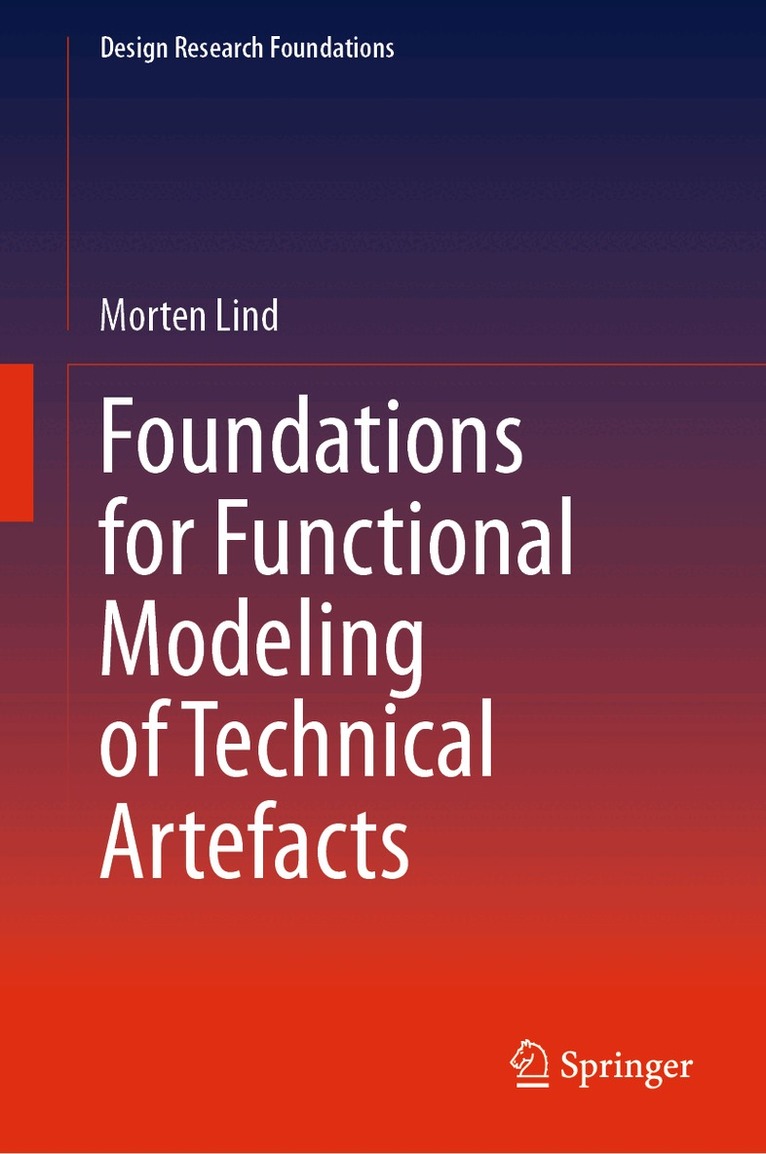
    Foundations for Functional Modeling of Technical Artefacts

    AvMorten Lind

    Inbunden, Engelska, 2023

    Del i serien Design Research Foundations

    1 733 kr

    Beställningsvara. Skickas inom 10-15 vardagar. Fri frakt över 249 kr.

    Fler format och utgåvor

    E-bok

    2 209 kr

    Häftad

    1 733 kr

    Beskrivning

    This monograph provides a new framework for modelling goals and functions of control systems. It demonstrates how to use means-end concepts and various aspects of action to describe the relations between the structure, dispositions, functions, and goals of technical systems and with human action.The author developed this approach as part of his research on Multilevel Flow Modelling (MFM). He based the framework on concepts of action and means-end analysis drawing on existing theories from several areas of study, including philosophical logic, semiotics, and phenomenological approaches to social science. Here, he applies it to three modeling situations related to the interaction of technical artefacts and humans. One involves the relation between designer and artefact, another the relation between technical artefact and its user, and the third the relation between a natural object and its user. All three are relevant for modelling complex automated processes interacting with human operators.The book also discusses challenges when applying the foundations for modelling of technical artefacts. Overall, it provides a cross disciplinary integration of several fields of knowledge. These disciplines include intelligent process control, human machine interaction, and process and automation design. As a result, researchers and graduate students in computer science, engineering, and philosophy of technology will find it a valuable resource.

    Produktinformation

    • Utgivningsdatum:2023-12-08
    • Mått:155 x 235 x 25 mm
    • Vikt:688 g
    • Format:Inbunden
    • Språk:Engelska
    • Serie:Design Research Foundations
    • Antal sidor:328
    • Förlag:Springer International Publishing AG
    • ISBN:9783031459177

    Utforska kategorier

    • Systemvetenskap och AI inom Data och IT
    • Informationsteknik: allmänt inom Data och IT
    • Naturvetenskapens filosofi inom Naturvetenskap och teknik

    Mer om författaren

    Morten Lind is Professor Emeritus at Department of Electrical and Photonics Engineering, DTU with more than 35 years of experience in the application of artificial intelligence and cognitive science research in automation and control of industrial processes. Prof. Lind has also a general interest in the foundations of engineering science. His main research contribution is the development of Multilevel Flow Modeling (MFM) which is a method for modeling goals and functions of complex automated processes within energy and chemical production. MFM has applications for knowledge based decision support in process and automation design, fault management, supervisory control and human machine interaction. Prof. Lind participated in several EU research programs within advanced information technology, in Nordic nuclear power research programs within automation and safety and in national funded basic research centers on Semiotics and Human Machine Interaction. He participated in the EcoGrid.dk project initiated by the Danish transmission system operator Energinet.dk. Prof. Lind had long term cooperation with the IFE Halden Reactor Project and has initiated research cooperation with Eldor Technology now: Kairos Technology, Norway and Danish Hydrocarbon Research and Technology Centre (DHRTC) now: Danish Offshore Technology Centre on MFM applications for decision support in the operation of oil and gas platforms in the North Sea.

    Innehållsförteckning

    • Part 1:Introduction.- CH1:Background.- CH2:Design and Operation of Complex Systems.- CH3:Modelling and Frameworks of Interpretation Key concepts: Action, Means-ends, goals, functions, dispositions and structure.- Part 2.- CH4:Concepts of Function.- CH5:Foundations in different scientific disciplines.- Part 3:Concept of Action.- CH6:Aspects of action.- CH7:Action types.- CH8:Action purposes.- CH9:Domains of action and dynamics.- CH10:Action roles.- CH11:Action phases.- CH12:Action and failure types.- CH13:Perception and action.- CH14:Control actions.- Part 4:Means and Ends.- CH15:Teleology and causality.- CH16:Means-End structure.- CH17:Types of Ends.- CH18:Means-ends and functions.- CH19:Means-end and action.- Part 5:Modeling Goals and Functions of Technical Artifacts.- CH20:Using foundations to design domain ontologies (MFM as case).- Bibliography.- Appendix: Summary of concepts.