• Fri frakt över 249 kr
  • •
  • Snabba leveranser
  • •
  • Billiga böcker
Kundservice

Du är på sajten för privatpersoner.

Företag, bibliotek eller offentlig verksamhet?

Du handlar på classic.bokus.com, där alla dina funktioner finns intakta.
Till classic.bokus.com
Bokus logotyp. Gå till startsidan.
  • Erbjudanden
  • Nyheter
  • Student
  • Topplistor
  • Barn & ungdom
  • Bokus Play
  • E-böcker
  • Pocketböcker
  • Spel & pussel

Må bättre, för mindre! Upp till 50% rabatt på hälsoböcker

Sidfot

Mina sidor

    Hjälp

    • Kundservice
    • Vanliga frågor och svar
    • Frakt och leverans
    • Retur vid ångerrätt
    • Reklamera vara
    • Betalning
    • Köpvillkor
    • Allmänna villkor
    • Information om webbplatsens tillgänglighet

    Om Bokus

    • Om oss
    • Pressrum
    • För studenter
    • För företag
    • För bibliotek och offentlig verksamhet
    • För leverantörer
    • Hållbarhet

    Populärt

    • Aktuella erbjudanden
    • Presentkort
    • Studentlitteratur
    • Nya böcker
    • Topplistor
    • Signerade böcker
    • Engelska böcker

    Inspiration

    • Boktips
    • BookTok
    • Populära bokserier
    • Barnbokskaraktärer
    • Populära författare
    Logotyp för Bokus
    Följ oss på Facebook (extern länk)Följ oss på Instagram (extern länk)Följ oss på YouTube (extern länk)Följ oss på TikTok (extern länk)
    bokus @ CookiesAnpassa cookiesIntegritetspolicyKöpvillkor
    Till Citymail hemsida (extern länk)Till Budbee hemsida (extern länk)Till Postnord hemsida (extern länk)Till Schenker hemsida (extern länk)Till Early Bird hemsida (extern länk)Till Walleys hemsida (extern länk)
    1. Skönlitteratur
    2. Litteraturvetenskap
    3. Litteraturvetenskap

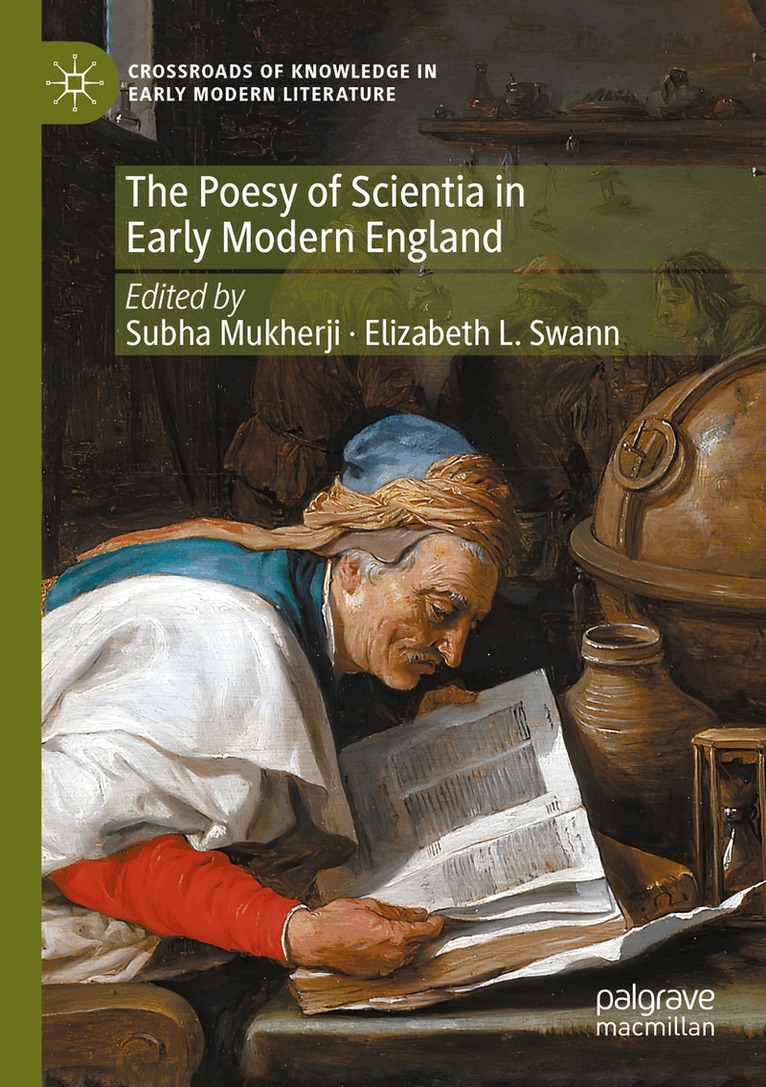
    Poesy of Scientia in Early Modern England

    AvSubha Mukherji,Elizabeth L. Swann

    Häftad, Engelska, 2025

    Del 3 i serien Crossroads of Knowledge in Early Modern Literature

    1 780 kr

    Beställningsvara. Skickas inom 10-15 vardagar. Fri frakt över 249 kr.

    Beskrivning

    This book explores interconnections between the modes of knowing that we now associate with the rubrics ‘literature’ and ‘science’ at a formative point in their early development. Rather than simply tracing lines of influence, it focuses on how both literary texts and natural philosophy engage with materiality, language, affect, and form. Some essays are invested in how early modern science adopts and actively experiments with rhetorical and poetic modes and expression, while others emphasize a shared investment in natural philosophical topics—alchemy, chance, or astrology for example—that move among the period’s observational texts and its literature, highlighting the participation of literary texts in the production of experimental knowledge. Organised around the broad themes of creation and transformation, mediation and communication, and interpretation and imaginative speculation, the essays collectively probe the presumed dichotomy between science’s schematizing and taxonomic ambitions, and the fertile and volatile creative energies of literary texts.

    Produktinformation

    • Utgivningsdatum:2025-07-13
    • Mått:148 x 210 x 21 mm
    • Vikt:501 g
    • Format:Häftad
    • Språk:Engelska
    • Serie:Crossroads of Knowledge in Early Modern Literature
    • Antal sidor:371
    • Förlag:Springer International Publishing AG
    • ISBN:9783031518027

    Utforska kategorier

    • Litteraturvetenskap inom Skönlitteratur
    • Litteraturvetenskap inom Skönlitteratur

    Mer om författaren

    Subha Mukherji is Professor of Early Modern Literature and Culture at the University of Cambridge, UK. She is Editor-in-Chief of the Palgrave mini-series Crossroads of Knowledge in Early Modern England, and was Principal Investigator of the 5-year interdisciplinary ERC project, Crossroads of Knowledge, out of which the series, and this volume, emerge. She has published widely on early modern drama and law, law and literature, the poetics of space, literary epistemologies and Shakespeare. Her most recent work is Crossings: Migrant Knowledge, Migrant Forms (co-edited with Natalya Din-Kariuki and Rowan Williams), forthcoming with punctum books in 2024. She is writing a book on Knowing Encounters and editing Shakespeare and Fletcher's Henry VIII for the Cambridge Shakespeare Editions series.  Elizabeth Swann is Assistant Professor of Interdisciplinary Literary Studies at Durham University, UK. Her previous publications include a monograph, Taste and Knowledge in Early Modern England (2020), and she has a new short book, Science as Child’s Play in Seventeenth-Century England: Innocence, Experience, and Experiment, forthcoming with Palgrave Pivot in 2024.

    Innehållsförteckning

    • Chapter 1- Poesy and Scientia: Matters of Fancy.- Part I -The Poetics of Alchemy: Making, Metaphor, Transmutation.- Chapter 2 - ‘Walking, talking minerals’: Men and Metals in King Lear and Bussy d’Ambois.- Chapter 3 - The Imperfect Circle: Hester Pulter’s Alchemical Forms.- Chapter 4 - From Philosopher’s Stone to Phosphorus: Robert Boyle’s Illuminating Experiments. -Part II -Forms of Fortune: Prognostication, Communication, Mercantilism.- Chapter 5 - Love Letters to Fortune: Queen Elizabeth’s Lottery of 1567-69.- Chapter 6 - ‘The Sunne and Moone of Knowledge’? Mathematical Astrology in Rollo, Duke of Normandy.- Chapter 7 - The Plain Style, Plane Chart Navigation, and the Paradox of Disinterestedness.- Chapter 8 - Commerce, Credit, and Transaction: The Rhetorical Origins of Big Science.- Part III - Reading Nature and Scripture: Interpretation, Speculation, Imagination.- Chapter 9 - Monsignore Agucchi Reads a Letter: Sunspots, Secrecy, and Scientia in the Early Seventeenth Century.- Chapter 10 - The Jobean Apophatic and the Symphonic Unknowability of the World.- Chapter 11- ‘Manure thyself’: The Poetics of Fertilisation in Early Modern English Religious Writing.- Chapter 12 -  ‘Instruments’ of the Body: The Conflicting Corporeal Hermeneutics of Francis Bacon’s Medical Art.- Chapter 13 -  ‘Pursued Thoughts’: Imagination, Raving and Meditation in the Early Boyle.- Chapter 14- Weaving a Web of Light: Science’s Poetics.