• Fri frakt över 249 kr
  • •
  • Snabba leveranser
  • •
  • Billiga böcker
Kundservice

Du är på sajten för privatpersoner.

Företag, bibliotek eller offentlig verksamhet?

Du handlar på classic.bokus.com, där alla dina funktioner finns intakta.
Till classic.bokus.com
Bokus logotyp. Gå till startsidan.
  • Erbjudanden
  • Nyheter
  • Student
  • Topplistor
  • Barn & ungdom
  • Bokus Play
  • E-böcker
  • Pocketböcker
  • Spel & pussel

10% rabatt på allt med kod NYSTART10 →

Sidfot

Mina sidor

    Hjälp

    • Kundservice
    • Vanliga frågor och svar
    • Frakt och leverans
    • Retur vid ångerrätt
    • Reklamera vara
    • Betalning
    • Köpvillkor
    • Allmänna villkor
    • Information om webbplatsens tillgänglighet

    Om Bokus

    • Om oss
    • Pressrum
    • För studenter
    • För företag
    • För bibliotek och offentlig verksamhet
    • För leverantörer
    • Hållbarhet

    Populärt

    • Aktuella erbjudanden
    • Presentkort
    • Studentlitteratur
    • Nya böcker
    • Topplistor
    • Signerade böcker
    • Engelska böcker

    Inspiration

    • Boktips
    • BookTok
    • Populära bokserier
    • Barnbokskaraktärer
    • Populära författare
    Logotyp för Bokus
    Följ oss på Facebook (extern länk)Följ oss på Instagram (extern länk)Följ oss på YouTube (extern länk)Följ oss på TikTok (extern länk)
    bokus @ CookiesAnpassa cookiesIntegritetspolicyKöpvillkor
    Till Citymail hemsida (extern länk)Till Budbee hemsida (extern länk)Till Postnord hemsida (extern länk)Till Schenker hemsida (extern länk)Till Early Bird hemsida (extern länk)Till Walleys hemsida (extern länk)
    1. Naturvetenskap och teknik
    2. Teknik och industri
    3. Elektronik och kommunikationer

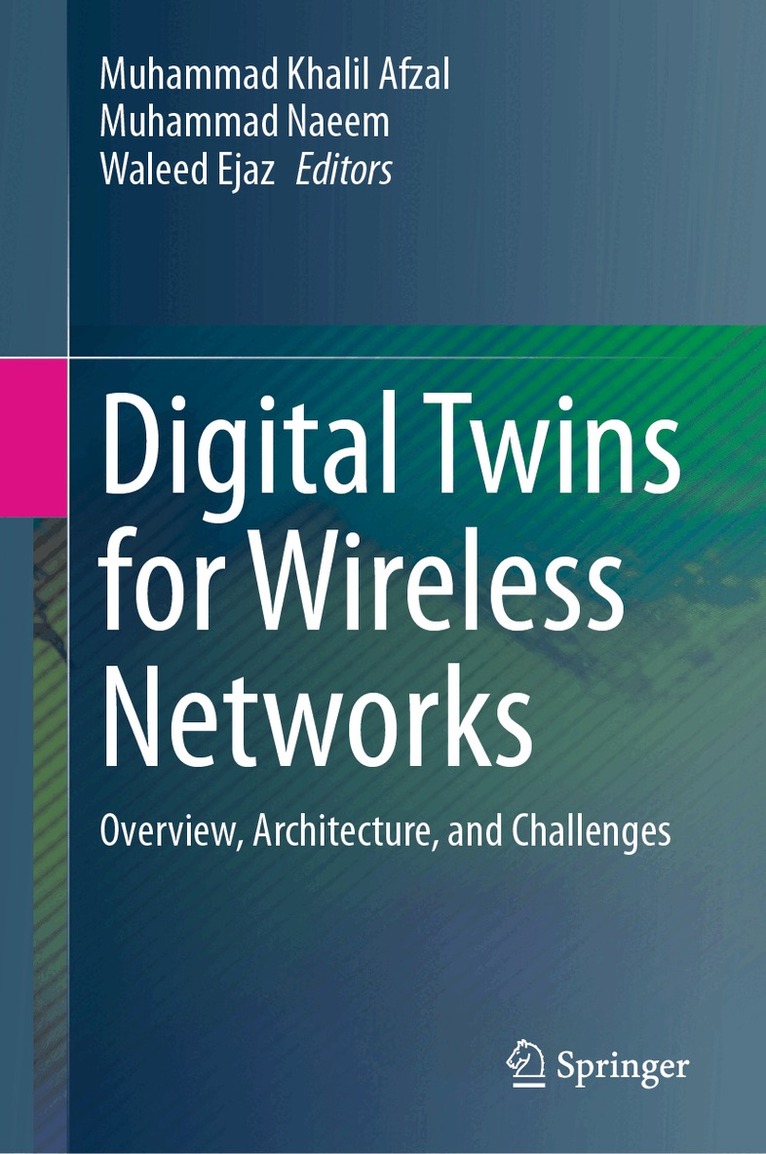
    Digital Twins for Wireless Networks

    Overview, Architecture, and Challenges

    AvMuhammad Khalil Afzal,Muhammad Naeem

    Inbunden, Engelska, 2024

    1 839 kr

    Beställningsvara. Skickas inom 10-15 vardagar. Fri frakt över 249 kr.

    Beskrivning

    The sixth-generation (6G) communication systems are anticipated to provide network connectivity for an extensive range of use cases in a variety of emerging vertical industries. Consequently, a new set of challenging requirements and more stringent key performance indicators have to be considered, a novel architecture has to be designed, and unique enabling technologies shall be developed in order to fulfil the technical, regulatory, and business demands of the communication service customers.6G networks are expected to offer even faster speeds, lower latency, and greater capacity compared to 5G networks, which will enable new applications and use cases that are currently not possible. Improved quality of life by enabling various applications (emerging Internet of everything applications) such as healthcare, brain-computer interactions, and extended reality is the main focus of future wireless services. Quality of experience, latency, and reliability are the key requirements of these applications. To meet these diverse requirements there is a need to assist wireless systems with unique technologies.  Self-sustaining wireless systems (intelligence, seamless and ubiquitous connectivity) and proactive-online-learning-enables systems (Intelligent analytics) are two trends in future wireless systems. The digital twin technology is one of the most promising technologies that can be instrumental in realizing the technical and business objectives of 6G communication systems.A digital twin is a virtual imitation of a physical object or system. In a wireless system, a digital twin can be used to model and analyse the behaviour of the network and its components, such as antennas, transmitters, receivers, sensors, and other devices in wireless networks. One of the key benefits of using a digital twin for a wireless system is that it can help network operators and engineers to optimize the performance of the wireless network by simulating different scenarios and configurations. Other benefits include improve efficiency, cost saving, and enhanced security. In 6G networks, a digital twin could be used to simulate and optimize the performance. This could include simulating different network topologies, testing the performance of different network protocols and algorithms, and optimizing the placement of network infrastructure.To create a digital twin of a wireless network, a detailed model of the network and its components must be developed, based on real-world data and conditions. This model can then be used to simulate the behaviour of the network under different conditions and settings and to visualize the results in real time.

    Produktinformation

    • Utgivningsdatum:2024-12-11
    • Mått:155 x 235 x 16 mm
    • Vikt:440 g
    • Format:Inbunden
    • Språk:Engelska
    • Antal sidor:159
    • Förlag:Springer International Publishing AG
    • ISBN:9783031736780

    Utforska kategorier

    • Elektronik och kommunikationer inom Naturvetenskap och teknik
    • Nätverk och kommunikation inom Data och IT
    • Hårdvara inom Data och IT

    Mer om författaren

    Muhammad Khalil Afzal (SM’16) received his MCS and M.S degrees in Computer Science from COMSATS Institute of Information Technology, Wah Campus, Pakistan in 2004 and 2007, respectively, and his Ph.D. Degree from the Department of Information and Communication Engineering, Yeungnam University, South Korea, in December 2014. He served as a lecturer from January 2008 to November 2009 at Bahauddin Zakariya University Multan Pakistan, and from December 2009 to June 2011 at King Khalid University Abha, Saudi Arabia. Currently, he is working as an Associate Professor (Tenured) in the Department of Computer Science at COMSATS, Wah Cantt Pakistan. He has served as a Guest Editor of IEEE Internet of Things Journal, Elsevier Computer Communication, IEEE Communication Magazine, Transactions for Emerging Telecommunications Technologies (ETT), Future Generation Computer Systems (Elsevier), IEEE ACCESS, Journal of Ambient Intelligence and Humanized Computing (Springer), MDPI Sensors Journal and reviewer for IEEE ACCESS, Computers and Electrical Engineering (Elsevier), Journal of Network and Computer Applications (Elsevier), FGCS, and IEEE transaction on Vehicular Technology. He is the recipient of the best paper awards of ACM 7th International Conference on Computing Communication and Networking Technologies and in International Conference on Green and Human Information Technology (ICGHIT-2018) and a fully funded scholarship for a Master and Ph.D. He is the recipient of research projects funded by the Higher Education Commission (HEC), Pakistan, the National Grassroots ICT Re-search Initiative, Ignite, Pakistan, the European Union’s Programme Horizon 2020, and the British Council UK. His research interest includes wireless sensor networks, ad hoc networks, Data-driven intelligence in wireless networks, Smart Cities, 5G, and IoT.Muhammad Naeem received the B.S. and M.S. degrees in electrical engineering from the University of Engineering and Technology, Taxi-la, Pakistan, in 2000 and 2005, respectively, and the Ph.D. degree from Simon Fraser University, Burnaby, BC, Canada, in 2011. From 2000 to 2005, he was a Senior Design Engineer with Comcept (Pvt) Ltd., Islamabad, Pakistan, where he participated in the design and development of smart card-based GSM and CDMA pay phones with the Department of Design. From 2012 to 2013, he was a Postdoctoral Research Associate with the Wireless Networks and Communications Research (WINCORE) Laboratory, at Ryerson University, Toronto, ON, Canada. Currently, he is a Professor with the Department of Electrical Engineering, COMSATS University Islamabad, Wah Campus, Wah, Pakistan. He is also a Microsoft Certified Solution Developer. His research interests include the optimization of wireless communication systems, non-convex optimization, re-source allocation in cognitive radio networks, and approximation algorithms for mixed integer programming in communication systems. He was a recipient of the NSERC CGS Scholarship.Waleed Ejaz (S’12-M’14-SM’16) is an Associate Professor in the Department of Electrical Engineering at Lakehead University, Barrie Campus, ON, Canada. He was an Assistant Professor in the Department of Engineering & Applied Science at Thompson Rivers University, Kamloops, BC, Canada from Sep. 2018 to Aug. 2020. Previously, he held academic and research positions at Ryerson University, Carleton University, and Queen’s University in Canada. He received the B.Sc. and M.Sc. degrees in Computer Engineering from the University of Engineering and Technology, Taxila, Pakistan, and the National University of Sciences and Technology, Islamabad, Pakistan, and a Ph.D. degree in Information and Communication Engineering from Sejong University, Republic of Korea, in 2014. He has co-authored over 90 papers in prestigious journals and conferences and 3 books. His current research interests include the Internet of Things (IoT), energy harvesting, 5G and beyond networks, and mobile edge computing. He is an Associate Editor of the IEEE Communications Magazine, IEEE Canadian Journal of Electrical and Computer Engineering, and the IEEE ACCESS. Dr. Ejaz completed certificate courses on “Teaching and Learning in Higher Education” from the Chang School at Ryerson University. He is a registered Professional Engineer (P.Eng.) in the province of Ontario, Canada.

    Innehållsförteckning

    • Chapter 1 Overview of Digital Twin, Architecture, and Applications.- Chapter 2 Dielectric and Path Loss Modeling to Support Simple and Fast Digital Twins for Wireless Human Body Area Network.- Chapter 3 ML for Digital Twin over Wireless Networks: Creation, Deployment, and Applications.- Chapter 4 Optimal Offloading in Digital Twin-assisted Multi-Stage Networks.- Chapter 5 Employing Federated Learning for the Implication of Digital Twin.- Chapter 6 Security Attacks in Digital Twin-Enabled Wireless System.- Chapter 7 Metaverse Enabled UAV in Disaster Scenario.- Chapter 8 Digital Twin for UAVs: Architecture, Framework, Challenges and Solutions.