• Fri frakt över 249 kr
  • •
  • Snabba leveranser
  • •
  • Billiga böcker
Kundservice

Du är på sajten för privatpersoner.

Företag, bibliotek eller offentlig verksamhet?

Du handlar på classic.bokus.com, där alla dina funktioner finns intakta.
Till classic.bokus.com
Bokus logotyp. Gå till startsidan.
  • Erbjudanden
  • Student
  • Topplistor
  • Barn & ungdom
  • Bokus Play
  • Bokus Play
  • E-böcker
  • Ljudböcker
  • Pocketböcker
  • Spel & pussel

10% rabatt på allt med kod NYSTART10 →

Sidfot

Mina sidor

    Hjälp

    • Kundservice
    • Vanliga frågor och svar
    • Frakt och leverans
    • Retur vid ångerrätt
    • Reklamera vara
    • Betalning
    • Köpvillkor
    • Allmänna villkor
    • Information om webbplatsens tillgänglighet

    Om Bokus

    • Om oss
    • Pressrum
    • För studenter
    • För företag
    • För bibliotek och offentlig verksamhet
    • För leverantörer
    • Hållbarhet

    Populärt

    • Aktuella erbjudanden
    • Presentkort
    • Studentlitteratur
    • Nya böcker
    • Topplistor
    • Signerade böcker
    • Engelska böcker

    Inspiration

    • Boktips
    • BookTok
    • Populära bokserier
    • Barnbokskaraktärer
    • Populära författare
    Logotyp för Bokus
    Följ oss på Facebook (extern länk)Följ oss på Instagram (extern länk)Följ oss på YouTube (extern länk)Följ oss på TikTok (extern länk)
    bokus @ CookiesAnpassa cookiesIntegritetspolicyKöpvillkor
    Till Citymail hemsida (extern länk)Till Budbee hemsida (extern länk)Till Postnord hemsida (extern länk)Till Schenker hemsida (extern länk)Till Early Bird hemsida (extern länk)Till Walleys hemsida (extern länk)
    1. Naturvetenskap och teknik
    2. Teknik och industri
    3. Elektronik och kommunikationer

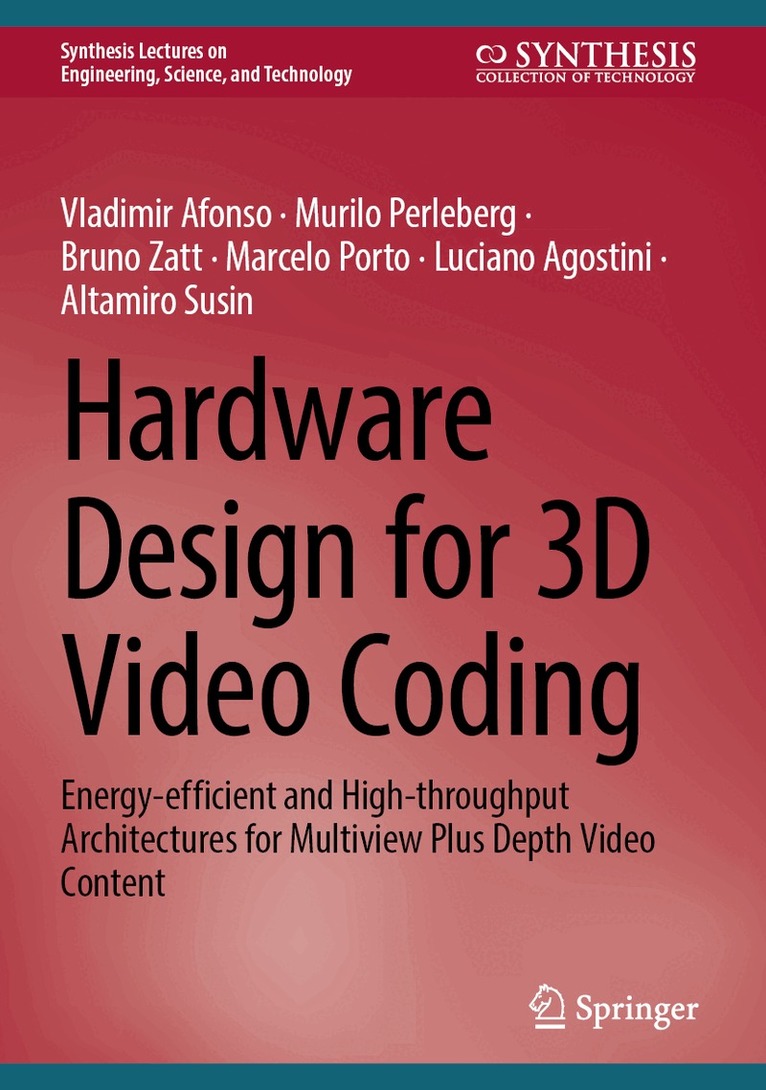
    Hardware Design for 3D Video Coding

    Energy-efficient and High-throughput Architectures for Multiview Plus Depth Video Content

    AvVladimir Afonso,Murilo Perleberg

    Inbunden, Engelska, 2025

    Del i serien Synthesis Lectures on Engineering, Science, and Technology

    547 kr

    Beställningsvara. Skickas inom 10-15 vardagar. Fri frakt över 249 kr.

    Fler format och utgåvor

    Häftad

    547 kr

    Beskrivning

    This book focuses on the research and development challenges posed by 3D video systems based on multi-view plus depth (MVD) technology. This technology can produce a realistic immersive experience generating synthetic video views on the decoder side, reducing the amount of information on the encoder side. The discussion presented in this book explores the MVD characteristics to propose high-throughput and energy-efficient architectures/systems, focusing on 3D-HEVC, the state-of-the-art standard for exploiting the MVD concept. The book includes an extensive discussion of the 3D-HEVC video encoding, followed by an in-depth evaluation of the 3D-HEVC reference software behavior. Then, the book presents in detail a set of high-throughput and energy-efficient architectures targeting the three main prediction steps inside the 3D-HEVC: intra-frame prediction, inter-frame prediction, and inter-view prediction.

    Produktinformation

    • Utgivningsdatum:2025-02-20
    • Mått:168 x 240 x 19 mm
    • Vikt:647 g
    • Format:Inbunden
    • Språk:Engelska
    • Serie:Synthesis Lectures on Engineering, Science, and Technology
    • Antal sidor:218
    • Förlag:Springer International Publishing AG
    • ISBN:9783031802317

    Utforska kategorier

    • Elektronik och kommunikationer inom Naturvetenskap och teknik
    • Systemvetenskap och AI inom Data och IT
    • Hårdvara inom Data och IT

    Mer om författaren

    Vladimir Afonso received the B.S. degree in industrial automation from the Sul-rio-grandense Federal Institute (IFSul), Pelotas, RS, Brazil, in 2008, the M.S. degree in computer science from the Federal University of Pelotas (UFPel), RS, Brazil, in 2013, and the Ph.D. degree on microelectronics from the Federal University of Rio Grande do Sul (UFRGS), Porto Alegre, RS, Brazil, in 2019. He is a Professor since 2009 at the IFSul and a researcher with the Video Technology Research Group (ViTech) at the UFPel. His research interests include 2D/3D video-coding algorithms, and FPGA-based and VLSI designs for video coding. Murilo Perleberg received the B.S. degree in computer engineering and the M.S. degree in computer science from the Federal University of Pelotas (UFPel), Brazil, in 2018 and 2020, respectively. He is currently pursuing the Ph.D. degree in computer science at UFPel. He is a member of the Video Technology Research Group, UFPel. His research interests include VLSI design for video coding. Bruno Zatt received his B.E. and M.S. in Computer Engineering from the Federal University of Rio Grande do Sul (UFRGS), Porto Alegre, Brazil, in 2006 and 2008, respectively. He received his Ph.D. degree in Microelectronics from the PGMICRO (Graduate Program on Microelectronics) at the same university in 2012 with "summa cum laude" distinction. Currently, Bruno Zatt is a Professor at the Federal University of Pelotas (UFPel), Pelotas, Brazil, and a member of the Group of Architectures and Integrated Circuits (GACI) and the Video Technology Research Group (ViTech). He has 19+ years of research experience os digital signal processing including 3 years as an intern researcher at the Karlsruhe Institute of Technology (KIT), Karlsruhe, Germany, 1-year experience as a visiting professor at the University of California, Irvine, USA, and as visiting professor at the Università di Torino, Turin, Italy. He has published over 190+ papers in international journals/conferences and one book entitled "3D Video Coding for Embedded Devices". His expertise includes visual signal processing and coding standards such as 2D video coding (H.264, HEVC, AV1, VVC), multiview video coding (MVC), 3D video coding (3D-HEVC), and Light Fields coding (JPEG Pleno). He holds the status of IEEE Senior Member (since 2016) and CNPq (National Council for Scientific and Technological Development) productivity research fellow (since 2017). He has coordinated several research projects funded by public (FAPERGS, CNPq, CAPES) and private funding agencies (Instituto Serrapilheira). Prof. Zatt also contributes as a member of the Brazilian Committee on Audio, Image, Multimedia and Hypermedia Coding (under ABNT - Brazilian Association of Technical Standards), a member of the Brazilian Microelectronics Society (SBMICRO) council, and a member of IEEE CASS Visual Signal Processing and Communication Technical Committee (VSPC-TC). He served for four years as an adjunct coordinator and two years as coordinator of the Graduate Program in Computing at UFPel. Prof. Zatt also contributes as Coeditor of the Journal of Integrated Circuits and Systems (JICS), Associate Editor for the IEEE Open Journal of Signal Processing (OJ-SP), and Senior Associate Editor for the IEEE Transaction on Circuits and Systems for Video Technology (TCSVT). Marcelo Schiavon Porto is a Brazilian Distinguished Researcher holding a CNPq PQ-1D grant. He received the M.S. and Ph.D. degrees in computer science from Federal University of Rio Grande do Sul (UFRGS), Brazil, in 2008 and 2012, respectively. He is currently a Professor with the Federal University of Pelotas (UFPel), Brazil, and a member of the Video Technology Research Group (ViTech) and the Group of Architectures and Integrated Circuits (GACI). He is currently a permanent member and advisor of doctor and master's students at the Graduate Program in Computing (PPGC) of UFPel. He also has been holding the status of CNPq (National Council for Scientific and Technological Development) Productivity Research Fellow, since 2016. His research interests include video coding, motion estimation algorithms, point cloud compression, coding complexity reduction, and energy-efficient VLSI design for video coding. Prof. Porto is a Senior Member of IEEE and member of SBC and SBMicro Brazilian societies. Luciano Volcan Agostini is a Full Professor at the Federal University of Pelotas (UFPel), where he has been a faculty member since 2002. Currently, he is a CNPq Productivity Research Fellow (PQ) in category 1C and serves as Vice-President of the Brazilian Microelectronics Society (SBMicro). He founded and leads the Video Technology Research Group (ViTech) at UFPel. From 2017 to 2018, he conducted postdoctoral research at the University of Lisbon. He earned his Ph.D. (2007) and M.Sc. (2002) in Computer Science from the Federal University of Rio Grande do Sul (UFRGS). Agostini previously served as UFPel’s Vice-President for Research and Graduate Studies (2013-2017) and as President of the Pelotas Municipal Council of Science and Technology (2013-2017). His work has earned him numerous best paper awards, and he has played an active role in organizing events internationally. He is an Associate Editor for IEEE Transactions on Circuits for Video Technology (TCSVT), IEEE Open Journal of Circuits and Systems (OJCAS), and Frontiers in Imaging. His research focuses on hardware design for image and video compression, machine learning-based video compression algorithms, and AV1, VVC, VP9, HEVC, and H.264/AVC encoders. He also investigates 3D, 360, light fields, and point clouds coding, as well as digital design with FPGAs, ASICs, and microelectronics. Agostini is a Senior Member of both the IEEE and ACM societies, and an active member of SBMicro and Brazilian Computer Society (SBC) societies. Altamiro Amadeu Susin was born in Vacaria-RS (Brazil) in 1945. He holds a degree in Electrical Engineering and a master's degree from the Federal University of Rio Grande do Sul (UFRGS) in 1972 and 1977, respectively, and a PhD in Computer Engineering - Microelectronics from the Institut National Polytechnique de Grenoble-France in 1981. He spent one year at McGill University, Montreal-Canada (1997/8) as a researcher in the mixed-signal group. He is a professor, now retired, in the Department of Electrical Engineering at UFRGS, responsible for the disciplines of Analog and Digital Electronics in the graduate and undergraduate courses, where he worked for over 40 years. He is also or was a member of the Graduate Programs in Computer Science, Electrical Engineering and Microelectronics at UFRGS. His main research interests are Integrated Circuit Architecture, Systems on Chip and Networks on Chip for complex multi-core systems and Signal Processing with over 50 technical papers published in these areas. He is/was responsible for several publicly and/or industrially funded R&D projects covering electronic instrumentation, audio and image processing, digital TV and computer vision for medical instrumentation, robotics and driving assistance and has supervised over a hundred graduate and undergraduate students. He has also designed and organized conferences and workshops on the above mentioned topics. He was vice-president and president of the Brazilian Society of Microelectronics and has participated as a member of committees of several research funding entities.

    Innehållsförteckning

    • Chapter 1: Introduction.- 3D-HEVC Overview.- 3D-HEVC Reference Software Evaluations.- Intra-Frame Prediction Architectures.- Inter-Frames and Inter-View Predictions Architectures.- Conclusions.