• Fri frakt över 249 kr
  • •
  • Snabba leveranser
  • •
  • Billiga böcker
Kundservice

Du är på sajten för privatpersoner.

Företag, bibliotek eller offentlig verksamhet?

Du handlar på classic.bokus.com, där alla dina funktioner finns intakta.
Till classic.bokus.com
Bokus logotyp. Gå till startsidan.
  • Erbjudanden
  • Nyheter
  • Student
  • Topplistor
  • Barn & ungdom
  • Bokus Play
  • E-böcker
  • Pocketböcker
  • Spel & pussel

10% rabatt på allt med kod: NYSTART10 →

Sidfot

Mina sidor

    Hjälp

    • Kundservice
    • Vanliga frågor och svar
    • Frakt och leverans
    • Retur vid ångerrätt
    • Reklamera vara
    • Betalning
    • Köpvillkor
    • Allmänna villkor
    • Information om webbplatsens tillgänglighet

    Om Bokus

    • Om oss
    • Pressrum
    • För studenter
    • För företag
    • För bibliotek och offentlig verksamhet
    • För leverantörer
    • Hållbarhet

    Populärt

    • Aktuella erbjudanden
    • Presentkort
    • Studentlitteratur
    • Nya böcker
    • Topplistor
    • Signerade böcker
    • Engelska böcker

    Inspiration

    • Boktips
    • BookTok
    • Populära bokserier
    • Barnbokskaraktärer
    • Populära författare
    Logotyp för Bokus
    Följ oss på Facebook (extern länk)Följ oss på Instagram (extern länk)Följ oss på YouTube (extern länk)Följ oss på TikTok (extern länk)
    bokus @ CookiesAnpassa cookiesIntegritetspolicyKöpvillkor
    Till Citymail hemsida (extern länk)Till Budbee hemsida (extern länk)Till Postnord hemsida (extern länk)Till Schenker hemsida (extern länk)Till Early Bird hemsida (extern länk)Till Walleys hemsida (extern länk)
    1. Naturvetenskap och teknik
    2. Matematik och naturvetenskap
    3. Kemi
    4. Fysikalisk kemi

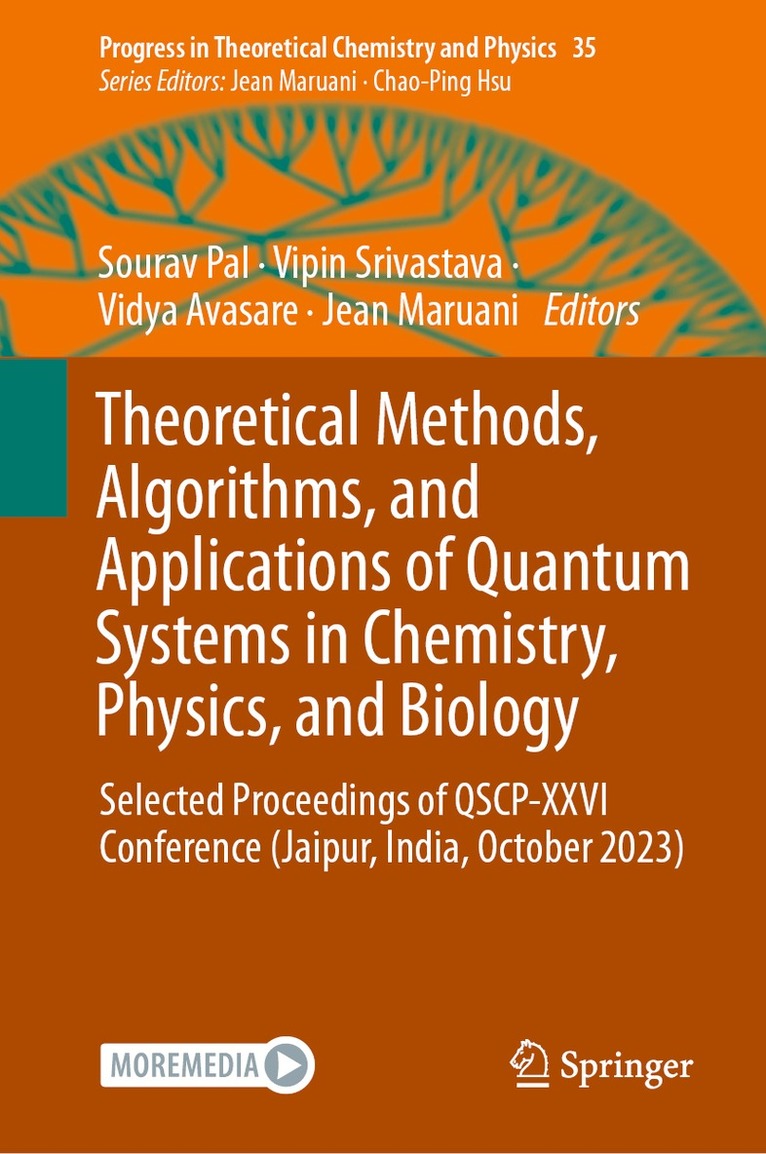
    Theoretical Methods, Algorithms, and Applications of Quantum Systems in Chemistry, Physics, and Biology

    Selected Proceedings of QSCP-XXVI Conference (Jaipur, India, October 2023)

    AvSourav Pal,Vipin Srivastava

    Inbunden, Engelska, 2025

    Del i serien Progress in Theoretical Chemistry and Physics

    2 381 kr

    Beställningsvara. Skickas inom 10-15 vardagar. Fri frakt över 249 kr.

    Beskrivning

    This volume contains peer-reviewed contributions based on talks presented at the 26th International Workshop on Quantum Systems in Chemistry, Physics, and Biology held in Jaipur, India, in October 2023. It provides an in-depth discussion of methodological approaches that are relevant across various length scales, elucidating their applications in diverse chemical and biological systems, such as catalysis and materials. Authored by experts in their respective fields, each chapter showcases recent developments and offers insights into the latest research trends. This book is aimed at advanced graduate students, academics, and researchers, both in university and corporation laboratories, interested in state-of-the-art and novel trends in quantum chemistry, physics, and biology, and their applications.

    Produktinformation

    • Utgivningsdatum:2025-08-22
    • Mått:155 x 235 x 24 mm
    • Vikt:762 g
    • Format:Inbunden
    • Språk:Engelska
    • Serie:Progress in Theoretical Chemistry and Physics
    • Antal sidor:341
    • Förlag:Springer International Publishing AG
    • ISBN:9783031851667

    Utforska kategorier

    • Fysikalisk kemi inom Naturvetenskap och teknik
    • Fysik inom Naturvetenskap och teknik

    Mer om författaren

    Sourav Pal, currently Professor and Head of Chemistry at Ashoka University, is a distinguished theoretical chemist renowned for his contributions to many-body electronic structure theory, chemical reactivity, and computational material science. With a career spanning over four decades, he served as Director of NCL (2010–2015) and IISER Kolkata (2017–2022) and was a professor at IIT Bombay and other esteemed institutions globally. A pioneer in ab-initio coupled-cluster theory, he has published over 300 research papers, guided 45+ Ph.D. theses, and authored influential works, including Mathematics in Chemistry. Prof. Pal is a Fellow of several prestigious academies and has received numerous accolades, including the Shanti Swarup Bhatnagar Award (2000) and the SASTRA-CNR Rao Award (2014). His leadership extends to key scientific councils and editorial boards, shaping global chemical research and education.Vipin Srivastava, born on May 2 1952, in India, pursued his Bachelor’s and Master’s in Physics at the University of Allahabad and completed Doctoral work on the Theory of Electron States in Disordered Condensed Matter Systems at the University of Roorkee (now an IIT) in 1976. He then proceeded to the Heriot-Watt University in Edinburgh (UK) to work on the challenging subject of Electron Localization. He started his career in teaching and research at the University of Hyderabad in 1980, where he rose to professorship in 1990 and superannuated in 2017. In this course, he held various administrative positions, including those of Dean and Pro Vice Chancellor. His research comprises a wide spectrum of areas like electron localization, quantum percolation, quantum Hall effect, self-avoiding and continuous time random walks, modelling brain functions and neural networks, cognitive learning and memory, and some areas in geophysics. He has supervised research, published about 200 research papers, edited 4 scientific volumes, served on editorial boards and as guest editor, and organised eight international meetings. He has travelled extensively for collaboration, conferences, and to occupy visiting positions, most notably at the University of Cambridge (UK), International Centre for Theoretical Physics, Trieste (Italy), University of Uppsala, NORDITA and Niels Bohr Institute, Copenhagen, Trinity College, Dublin, Georg-August-Universität, Göttingen, INPE Sao Paulo, and ITP, Beijing.Vidya Avasare completed her post-graduation in Organic Chemistry at Savitribai Phule Pune University, after which she joined SP College, Pune, as a faculty member in the Chemistry department and worked there until August 17, 2023. In 2009, she completed her PhD in Organometallics from IIT Bombay, where she worked under the guidance of Professor Pardeep Mathur. Her doctoral research focused on studying the interactions between metal-carbonyl complexes and small organic molecules. While working at SP College, she developed a strong interest in computational catalysis to investigate complex catalytic processes. She recognized that understanding these processes and the structure-activity relationships of catalysts is crucial for developing efficient and sustainable catalytic systems and that DFT and ML models would play a key role in achieving this. On August 18, 2023, she moved to Ashoka University as a professor in the Department of Chemistry. At Ashoka University, she is now engaged in both computational and experimental catalysis research. Her main research interest is focused on CO2 capture and utilization and development of sustainable catalytic technologies for CO2 activation, green hydrogen production, cross coupling reactions and C-H activations for commercial applications. She has been honored as one of the  “She Is:75 Women in Chemistry, India" and is a recipient of the Indian National Science Academy's National Teacher Award 2021.Jean Maruani, born on December 28, 1937, in Tunis to a middle-class Sephardic family, pursued versatile studies in Paris, obtaining a Doctorat ès-Sciences Physiques at Sorbonne in 1966 under the supervision of Pr Roland Lefebvre. After collaborating with institutions like the CEA, Pasteur Institute, and LCIE, he spent two years in Charles McDowell's group at UBC in Vancouver. In 1968, he secured a permanent position at CMOA of CNRS, directed by Pr Raymond Daudel. Jean Maruani, a prolific researcher, has authored around 150 papers on the Structure and Dynamics of Molecular Systems, particularly in Magnetic Resonance and Photoelectron Spectroscopy. His contributions include solving pending problems in these fields, introducing novel concepts for non-rigid and approximate symmetries, and delving into Dirac electron properties and a quantum theory of biological evolution. He has co-organized about 30 scientific meetings, co-edited about 50 volumes, and founded a scientific journal and book series. He has also created the CMOA Prize and Medal, respectively, for junior and senior scientists. In spite of retirement in 2005, he remains very active, organizing annual QSCP meetings around the world. Jean Maruani is honoured with a Doctorate Honoris Causa from the University of Sofia, a Golden Medal from the City of Paris, and titles like Chevalier des Palmes Académiques and Corresponding Member of the European Academy. He also engages in classical singing and philosophical talks. He married composer and pianist Marja Rantanen in 1969, and they have three children and six grandchildren.

    Innehållsförteckning

    • Part I. General Theory and Methodology.- Open Systems and the Laws of Thermodynamics.- Numerical Tensor Methods with Explicitly Correlated Wave Functions for Bound-State Stability of Coulomb Three-Body Systems.- P,T-Odd Sensitivity Parameters in Open-Shell Molecules from Relativistic Coupled-Cluster Theory.- Hypotheses on Many-Body Quantum Effects in Photosynthesis.- Revisiting Noble-Gas Adsorption on Graphene Using Continuum and Atomistic Descriptions.- From Quantum Connectivity to Biological Networks: A Portrait of Protein Structure seen through the Lens of Side Chain Network.- Part II. Computational Quantum Chemistry.- Insight into the Structural, Electronic, and Magnetic Properties of Mn, Fe, and Co-doped bilayerborophene.- Deciphering the Mechanisms and Reactivity of Metalloenzymes and Biomimetic Models Using Computational Methods.- Dispersion effects on the computed geometries and properties of hydroxybenzenes dimmers.- Towards ML- and QML-Accelerated Discovery of Catalytic Materials and Mechanisms: A Progress Review.- Part III.  Reaction Mechanisms.- Exploring the Competition between Energy Transfer and Reaction Rate in Post-TS Dynamics of Catechol's Ozonolysis.- Radical Pair Mechanism in Biological Systems.- Part IV. Biological Applications.- The Changing Face of Drug and Materials Discovery.- Understanding the Melanin Spectra and Photophysics.- Computational analysis of mutation effect on SARS-CoV-2 spike protein structures.