• Fri frakt över 249 kr
  • •
  • Snabba leveranser
  • •
  • Billiga böcker
Kundservice

Du är på sajten för privatpersoner.

Företag, bibliotek eller offentlig verksamhet?

Du handlar på classic.bokus.com, där alla dina funktioner finns intakta.
Till classic.bokus.com
Bokus logotyp. Gå till startsidan.
  • Erbjudanden
  • Nyheter
  • Student
  • Topplistor
  • Barn & ungdom
  • Bokus Play
  • E-böcker
  • Pocketböcker
  • Spel & pussel

10% rabatt på allt med kod: NYSTART10 →

Sidfot

Mina sidor

    Hjälp

    • Kundservice
    • Vanliga frågor och svar
    • Frakt och leverans
    • Retur vid ångerrätt
    • Reklamera vara
    • Betalning
    • Köpvillkor
    • Allmänna villkor
    • Information om webbplatsens tillgänglighet

    Om Bokus

    • Om oss
    • Pressrum
    • För studenter
    • För företag
    • För bibliotek och offentlig verksamhet
    • För leverantörer
    • Hållbarhet

    Populärt

    • Aktuella erbjudanden
    • Presentkort
    • Studentlitteratur
    • Nya böcker
    • Topplistor
    • Signerade böcker
    • Engelska böcker

    Inspiration

    • Boktips
    • BookTok
    • Populära bokserier
    • Barnbokskaraktärer
    • Populära författare
    Logotyp för Bokus
    Följ oss på Facebook (extern länk)Följ oss på Instagram (extern länk)Följ oss på YouTube (extern länk)Följ oss på TikTok (extern länk)
    bokus @ CookiesAnpassa cookiesIntegritetspolicyKöpvillkor
    Till Citymail hemsida (extern länk)Till Budbee hemsida (extern länk)Till Postnord hemsida (extern länk)Till Schenker hemsida (extern länk)Till Early Bird hemsida (extern länk)Till Walleys hemsida (extern länk)
    1. Data och IT
    2. Databaser

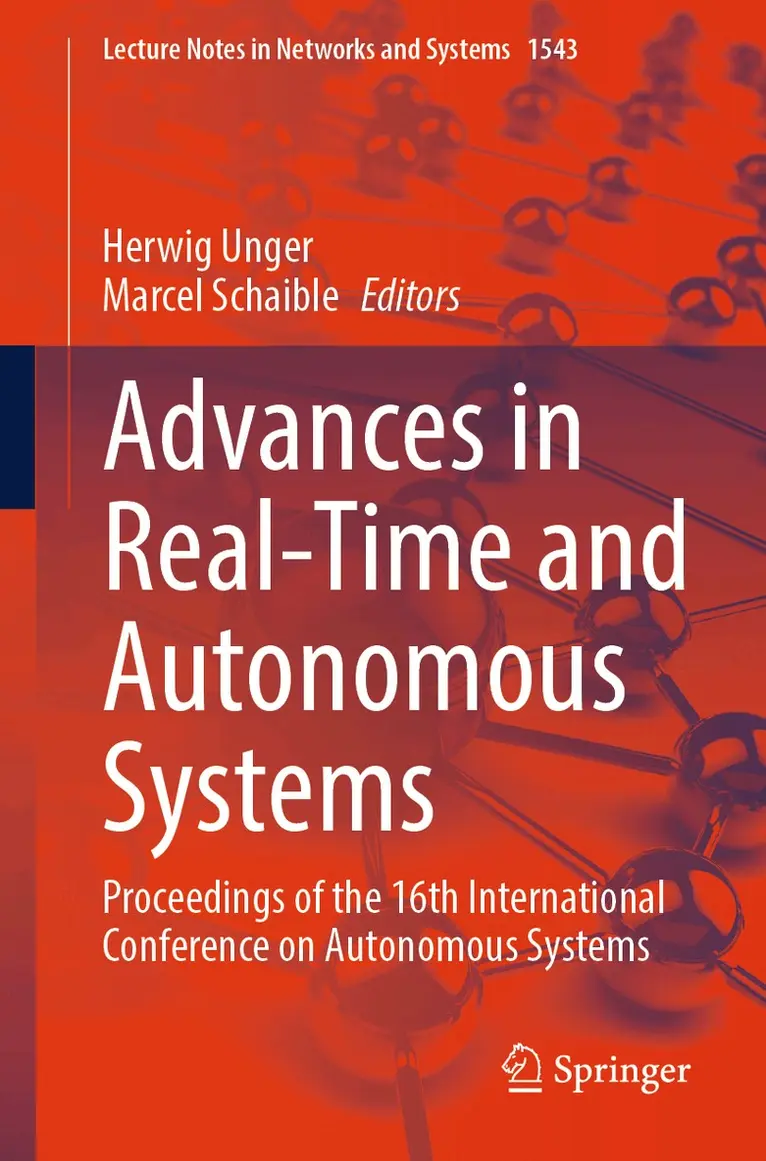
    Advances in Real-Time and Autonomous Systems

    Proceedings of the 16th International Conference on Autonomous Systems

    AvHerwig Unger,Marcel Schaible

    Häftad, Engelska, 2025

    Del 1543 i serien Lecture Notes in Networks and Systems

    2 229 kr

    Beställningsvara. Skickas inom 10-15 vardagar. Fri frakt över 249 kr.

    Beskrivning

    This book serves as both a cutting-edge reference and a practical guide to building AI systems that are transparent, trustworthy, and tuned for real-world impact, featuring contributors from three continents and backed by leading institutions.Unlock the next wave of graph-based artificial intelligence, fuzzy logic, and human-centric machine learning with this authoritative Springer proceedings book. Twenty-four rigorously peer-reviewed chapters—spanning semantic similarity in Wikipedia, sparse distributed representations, explainable image generation, privacy-preserving mobility analytics, sentiment mining in public transport, counterfeit-banknote detection, 5G network capacity planning, and mixed-order traffic prediction—provide a panoramic view of state-of-the-art research that turns theory into deployable solutions.Readers gain step-by-step methodologies for building restricted Boltzmann machines enhanced with fuzziness, dual-graph semantic extractors, Bloom-filter variants, and the versatile GraphLearner simulator. Each contribution includes reproducible workflows, comparative baselines, and publicly available code or datasets—accelerating adoption in academia and industry alike.Highlights include a blueprint for emotion-aware AI agents, a cloud-intelligence framework that empowers SMEs with decision support, and an adaptive metric for privacy-preserving urban-mobility sharing that balances usability and anonymity.

    Produktinformation

    • Utgivningsdatum:2025-10-10
    • Mått:155 x 235 x 21 mm
    • Vikt:703 g
    • Format:Häftad
    • Språk:Engelska
    • Serie:Lecture Notes in Networks and Systems
    • Antal sidor:404
    • Förlag:Springer International Publishing AG
    • ISBN:9783031986963

    Utforska kategorier

    • Databaser inom Data och IT
    • Tillämpad datateknik inom Data och IT
    • Artificiell intelligens inom Data och IT

    Mer om författaren

    Prof. Dr.-Ing. habil. Dr. h.c. Herwig Unger is Professor of communication networks at FernUniversität in Hagen, Germany. He studied automation engineering at the Technical University of Ilmenau, where he earned his diploma in 1991 and his doctorate with distinction in 1994 for work on Petri-net models in multiprocessor systems. He completed his habilitation on distributed systems at the University of Rostock in 2000 and was appointed as Professor there before joining FernUniversität in 2006.Prof. Unger’s research focuses on self-organizing communication systems, adaptive algorithms, data-intensive simulations, and intelligent distributed architectures. He has led national and international projects supported by the DFG and EU and is active in interdisciplinary collaborations in Europe and Asia. His academic contributions include over 250 publications and several monographs. He has supervised numerous doctoral theses and served as Visiting Scholar in the USA, Canada, Thailand, Japan, and Vietnam.Marcel Schaible is Senior Computer Scientist at the Chair of Communication Networks, FernUniversität in Hagen. He holds a degree in computer science with a minor in electrical engineering from the Technical University of Munich. His professional background spans over 30 years in embedded real-time systems, compiler design, and distributed software architectures.Before transitioning to academia in 2019, he held multiple senior positions in industry, where he contributed to the development of JavaCard-based smartcard systems, fault-tolerant computing platforms, and embedded control software. His professional experience also includes work as Senior Software Engineer in the USA.His academic research under Prof. Herwig Unger focuses on graph-based NLP, adaptive text mining, and scalable classification systems. He is Co-Editor of the Springer book series Echtzeit and Active Member of the German Informatics Society’s technical committees on real-time and embedded systems.

    Innehållsförteckning

    • The importance of being fuzzy.- Artificial emotion: The research on making machines more human-like.- Construction and comparison of linkage-graph-based representations with co-occurrence graphs and word2Vec embeddings: A case study on English Wikipedia articles - Efficient generation of sparse distributed representations (SDRS) with singular value decomposition (SVD).- Word embedding through a spring-force system.- Dual graph representation for semantic extraction.- Academic paper recommendation using co-occurrence graphs.- Sentiment analysis in public transport: A comparative study of machine learning and deep learning models.- The GraphLearner as a high order Markov chain simulator.- Edge decisions and N-Gram midpoints with the GraphLearner.- Empirical comparison of different bloom filter variants.- Learn, predict and generate note sequences.- Empowering non-experts with interactive graph visualization in generative AI: The case of GraphLearner.- The psychological background of the emotional machine.- Designing an emotion-based motivation model for adaptive AI agents.- Personalised cloud-intelligence: AI-driven decision making for small businesses.- Mixed-order spatio-temporal representation learning for traffic prediction.- The role of entropy-based features in classifying tor traffic using machine learning.- An adaptive metric-based method for privacy-preserving sharing of anonymized urban mobility data.- Explainable prompt-based image generation: developing transparent generative models.- Enhancing mobile network capacity planning with emerging technologies: A system dynamics and machine learning-based approach.- Counterfeit Thai banknote detection using deep learning.- StepIn: A context-aware decentralized social networking system.- Conceptual design of intelligent services in decentralized social networks.- Enhancing web crawling efficiency with adaptive scheduling algorithms and chatgpt integration.