• Fri frakt över 249 kr
  • •
  • Snabba leveranser
  • •
  • Billiga böcker
Kundservice

Du är på sajten för privatpersoner.

Företag, bibliotek eller offentlig verksamhet?

Du handlar på classic.bokus.com, där alla dina funktioner finns intakta.
Till classic.bokus.com
Bokus logotyp. Gå till startsidan.
  • Erbjudanden
  • Nyheter
  • Student
  • Topplistor
  • Barn & ungdom
  • Bokus Play
  • E-böcker
  • Pocketböcker
  • Spel & pussel

10% rabatt på allt med kod: NYSTART10 →

Sidfot

Mina sidor

    Hjälp

    • Kundservice
    • Vanliga frågor och svar
    • Frakt och leverans
    • Retur vid ångerrätt
    • Reklamera vara
    • Betalning
    • Köpvillkor
    • Allmänna villkor
    • Information om webbplatsens tillgänglighet

    Om Bokus

    • Om oss
    • Pressrum
    • För studenter
    • För företag
    • För bibliotek och offentlig verksamhet
    • För leverantörer
    • Hållbarhet

    Populärt

    • Aktuella erbjudanden
    • Presentkort
    • Studentlitteratur
    • Nya böcker
    • Topplistor
    • Signerade böcker
    • Engelska böcker

    Inspiration

    • Boktips
    • BookTok
    • Populära bokserier
    • Barnbokskaraktärer
    • Populära författare
    Logotyp för Bokus
    Följ oss på Facebook (extern länk)Följ oss på Instagram (extern länk)Följ oss på YouTube (extern länk)Följ oss på TikTok (extern länk)
    bokus @ CookiesAnpassa cookiesIntegritetspolicyKöpvillkor
    Till Citymail hemsida (extern länk)Till Budbee hemsida (extern länk)Till Postnord hemsida (extern länk)Till Schenker hemsida (extern länk)Till Early Bird hemsida (extern länk)Till Walleys hemsida (extern länk)
    1. Naturvetenskap och teknik
    2. Geovetenskap
    3. Geovetenskap

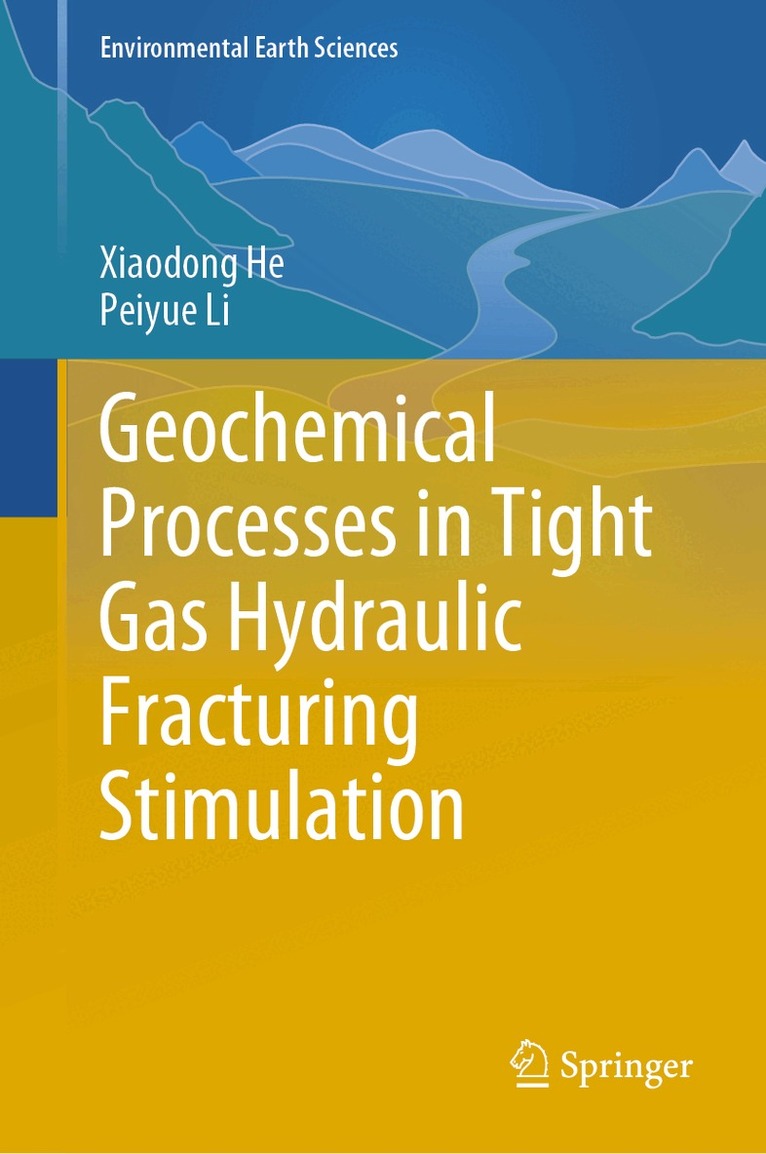
    Geochemical Processes in Tight Gas Hydraulic Fracturing Stimulation

    AvXiaodong He,Peiyue Li

    Inbunden, Engelska, 2026

    Del i serien Environmental Earth Sciences

    2 165 kr

    Beställningsvara. Skickas inom 10-15 vardagar. Fri frakt över 249 kr.

    Beskrivning

    This book examines the Sulige Gas Field—China’s largest natural gas field—as a case study. Drawing on field hydraulic fracturing data and laboratory water–rock interaction experiments, it systematically investigates the geochemical processes occurring during hydraulic fracturing. These processes are analyzed using X-ray fluorescence spectroscopy (XRF), X-ray diffraction (XRD), scanning electron microscopy (SEM), geochemical modeling, end-member mixing analysis, and isotopic tracing.In addition, the book explores regional water environmental issues triggered by hydraulic fracturing, as well as strategies for managing and utilizing flowback water resources. The findings provide a theoretical foundation and technical support for the green and sustainable development of unconventional energy resources, while significantly advancing the understanding of geochemistry in deep subsurface environments.By bridging fundamental geochemistry and practical engineering, this book offers actionable insights for reservoir engineers, geochemists, and policymakers to address environmental and engineering challenges effectively.

    Produktinformation

    • Utgivningsdatum:2026-02-01
    • Mått:155 x 235 x 19 mm
    • Vikt:591 g
    • Format:Inbunden
    • Språk:Engelska
    • Serie:Environmental Earth Sciences
    • Antal sidor:233
    • Förlag:Springer Nature Switzerland AG
    • ISBN:9783032151797

    Utforska kategorier

    • Geovetenskap inom Naturvetenskap och teknik
    • Hydrologi inom Naturvetenskap och teknik
    • Energiteknik inom Naturvetenskap och teknik

    Mer om författaren

    Dr. Xiaodong He is an assistant professor at Chang’an University, China. He holds a Ph.D. in hydraulic engineering from Chang’an University and possesses extensive expertise in hydrogeochemistry, water-rock interactions, groundwater quality, and groundwater pollution. Dr. He has published over 30 scientific papers in renowned international journals. He has edited and co-edited 3 textbooks and academic monographs. In recent years, focusing on deep Earth geochemistry, he has led five research projects including “Formation and Evolution Mechanisms of Fracturing Flowback Fluids in Tight Gas Reservoirs Based on Isotopic Fingerprinting, and Their Application in Pollution Tracing”, “Formation and Evolution Mechanisms of Fracturing Flowback Fluids in Tight Gas Reservoirs Driven by Mixing Processes and Water-Rock Interactions”, and “Geochemical Processes and Mechanisms in Hydraulic Fracturing of Tight Gas Reservoirs”, with six peer-reviewed papers published in Journal of Hydrology, Geoenergy Science and Engineering, Chemosphere, and Environmental Earth Sciences. In recognition of his research excellence, he was selected as one of the Top 2% Top Scientists Worldwide by Stanford University in 2022 and 2025.Prof. Peiyue Li is a full professor in the field of hydrogeology and environmental sciences at Chang’an University, China. He serves as the Vice Dean of School of Water and Environment at this university. He has wide experience in groundwater quality assessment, hydrogeochemistry, and groundwater modeling. He has edited and co-edited 13 textbooks and academic monographs, and published over 220 articles in refereed journals. He at present serves as Associate Editors for Exposure and Health, Mine Water and the Environment, Archives of Environmental Contamination and Toxicology, Environmental Monitoring and Assessment, Human and Ecological Risk Assessment, and Applied Water Science. He is also book series editors for Springer Hydrogeology,Cave and Karst Systems of the World, Advances in Karst Science, and GeoHealth: The Impact of Geology on Environment and Human Health. He has been awarded one of the most highly cited researchers by Clarivate, Elsevier, and other organizations.

    Innehållsförteckning

    • Chapter 1.Introduction.- Chapter 2. Overview of the Study Area.- Chapter 3. Characteristics of Tight Gas Reservoirs.- Chapter 4. Hydraulic fracturing Experiment and Hydrochemistry of Flowback Water.- Chapter 5. Laboratory Experiment and Fracturing Fluid-Tight Sandstone Interactions.- Chapter 6. Geochemical Processes During Hydraulic Fracturing.- chapter 7. Formation Damage During Hydraulic Fracturing.- chapter 8. Environmental Problems in the Hydraulic Fracturing Areas.- Chapter 9. Flowback Water Management and Resources Utilization.- Chapter 10. Summary and Outlooks.