• Fri frakt över 249 kr
  • •
  • Snabba leveranser
  • •
  • Billiga böcker
Kundservice

Du är på sajten för privatpersoner.

Företag, bibliotek eller offentlig verksamhet?

Du handlar på classic.bokus.com, där alla dina funktioner finns intakta.
Till classic.bokus.com
Bokus logotyp. Gå till startsidan.
  • Erbjudanden
  • Student
  • Topplistor
  • Barn & ungdom
  • Bokus Play
  • E-böcker
  • Ljudböcker
  • Pocketböcker
  • Spel och pussel

5% studentrabatt – använd koden KURSBOK27 →

Sidfot

Mina sidor

    Hjälp

    • Kundservice
    • Vanliga frågor och svar
    • Frakt och leverans
    • Retur vid ångerrätt
    • Reklamera vara
    • Betalning
    • Köpvillkor
    • Allmänna villkor
    • Information om webbplatsens tillgänglighet

    Om Bokus

    • Om oss
    • Pressrum
    • För studenter
    • För företag
    • För bibliotek och offentlig verksamhet
    • För leverantörer
    • Hållbarhet

    Populärt

    • Aktuella erbjudanden
    • Presentkort
    • Studentlitteratur
    • Nya böcker
    • Topplistor
    • Signerade böcker
    • Engelska böcker

    Inspiration

    • Boktips
    • BookTok
    • Barnbokskaraktärer
    • Populära författare
    Logotyp för Bokus
    Följ oss på Facebook (extern länk)Följ oss på Instagram (extern länk)Följ oss på YouTube (extern länk)Följ oss på TikTok (extern länk)
    bokus @ CookiesAnpassa cookiesIntegritetspolicyKöpvillkor
    Till Citymail hemsida (extern länk)Till Budbee hemsida (extern länk)Till Postnord hemsida (extern länk)Till Schenker hemsida (extern länk)Till Early Bird hemsida (extern länk)Till Walleys hemsida (extern länk)
    1. Kultur
    2. Arkitektur

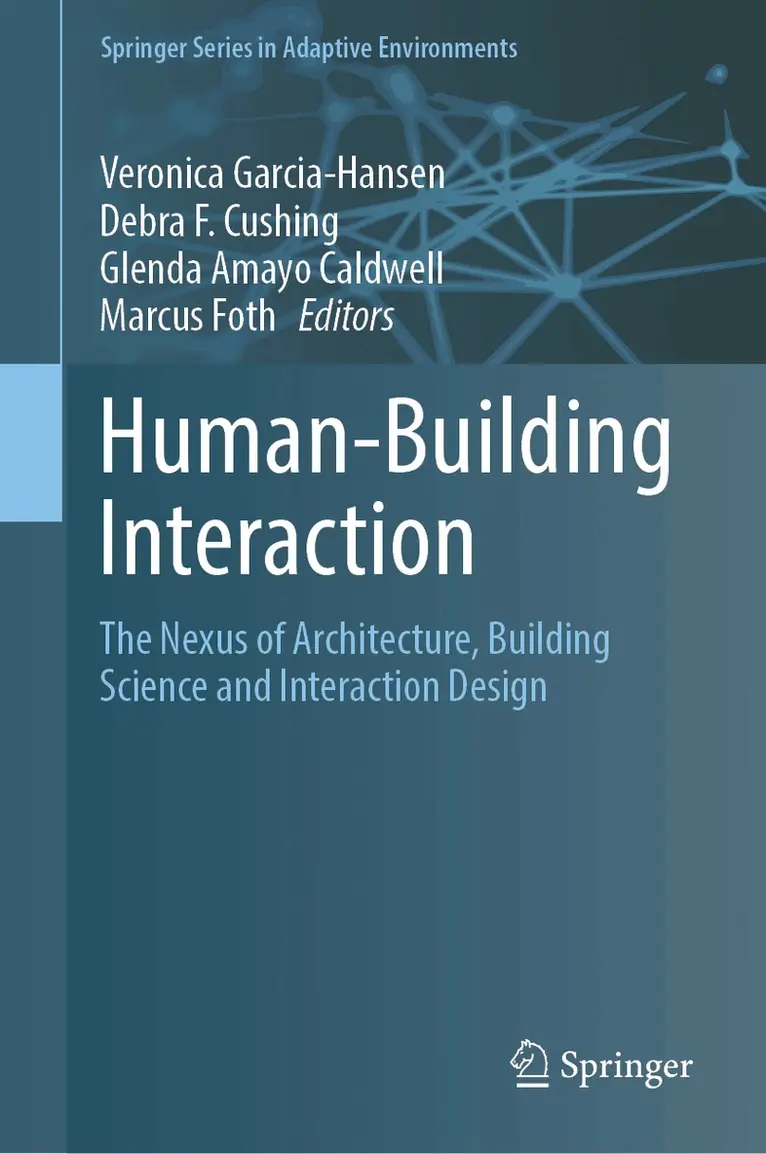
    Human-Building Interaction

    The Nexus of Architecture, Building Science and Interaction Design

    AvVeronica Garcia-Hansen,Debra F. Cushing

    Inbunden, Engelska, 2026

    Del i serien Springer Series in Adaptive Environments

    1 883 kr

    Beställningsvara. Skickas inom 10-15 vardagar. Fri frakt över 249 kr.

    Beskrivning

    This unique book advances the emerging field of human-building interaction (HBI), which examines how people experience, influence, and co-evolve with the buildings they inhabit. Moving beyond conventional notions of building performance and environmental control, the volume highlights HBI as a human-centred, interdisciplinary framework for designing responsive, equitable, and sustainable built environments.  It positions HBI as a vital transdisciplinary field for addressing twenty-first-century challenges related to climate resilience, human wellbeing, and technological change.Organised into three parts, the book first explores “Built Environments for Health and Wellbeing,” investigating how spatial, material, and digital conditions affect comfort, inclusivity, and everyday experiences. The second part, “Built Environments for Climate Action,” examines adaptive and resilient infrastructures that respond to climate imperatives—from thermally comfortable public spaces to climate-positive mega-events and AI-mediated community engagement. The final part, “Built Environments for Desirable Futures,” looks ahead to emergent design paradigms, workplace transformations, and intelligent environments that integrate ecological, social, and technological dimensions.  Across twelve chapters, contributors present original empirical research, conceptual frameworks, and design experiments that demonstrate how HBI can shape future-ready built environments. Case studies span diverse contexts—from Nordic Superblocks and Olympic stadia to post-occupancy workplaces and extended-reality archives—showcasing the breadth of HBI’s applications and its relevance to both research and practice.An invaluable collection, the book brings together contributions from international scholars and practitioners working at the intersection of architecture, building science, and interaction design.  It offers valuable insights for architects, designers, engineers, urban planners, and human-computer interaction researchers seeking to understand and design for the complex relationships between people, technology, and the built world.

    Produktinformation

    • Utgivningsdatum:2026-05-08
    • Mått:155 x 235 x 26 mm
    • Vikt:715 g
    • Format:Inbunden
    • Språk:Engelska
    • Serie:Springer Series in Adaptive Environments
    • Antal sidor:334
    • Förlag:Springer Nature Switzerland AG
    • ISBN:9783032168627

    Utforska kategorier

    • Arkitektur inom Kultur
    • Byggnadsteknik inom Naturvetenskap och teknik
    • Tillämpad datateknik inom Data och IT

    Mer om författaren

    Veronica Garcia-Hansen is an Associate Professor in the School of Architecture and Built Environment at the Queensland University of Technology, Australia. Her research focuses on the interplay between building design, building performance, human–building interaction, and occupants’ comfort and health. She employs innovative research methodologies that combine ubiquitous environmental sensing (lighting levels, brightness, temperature, air velocity, occupancy) with ethnographic approaches to study occupant behaviour and self-reported data (preferences, wellbeing). Through these integrated methods, she identifi es patterns and develops solutions using machine learning algorithms and optimisation procedures. Veronica is the founder and leader of the Human–Building Interaction Group at QUT, a transdisciplinary research team spanning architecture, design, human–computer interaction, environmental psychology, and engineering.Debra Flanders Cushing is an Associate Professor in Landscape Architecture, in the School of Architecture and Built Environment, Faculty of Engineering, at the Queensland University of Technology. Working in interdisciplinary teams, Debra’s research currently covers critical built environment topics including green infrastructure, wayfi nding, accessibility, heat and fl ood mitigation, and intergenerational outdoor public spaces to explore ways to improve health and wellbeing and the experience of place. She specifi cally focuses on creating more inclusive communities in which all people can thrive, including children, intergenerational groups and people experiencing disability.Glenda Amayo Caldwell is a Professor in Architecture and the Discipline Lead (Architecture, Interior Design, Landscape Architecture) in the School of Architecture & Built Environment, Faculty of Engineering at the Queensland University of Technology. Glenda is the Associate Director Research Training for the ARC Australian Cobotics Centre (2021-2026) and a Chief Investigator in the centre’s Designing Socio-Technical Robotic Systems program of research.Marcus Foth is a Professor of Urban Informatics in the School of Design, Faculty of Creative Industries, Education, and Social Justice, Queensland University of Technology, Brisbane, Australia. He is also a Chief Investigator in the QUT Digital Media Research Centre (DMRC) and a founding member of the More-than-Human Futures research group. For more than two decades, Marcus has led ubiquitous computing and interaction design research into interactive digital media, screen, mobile and smart city applications. Marcus founded the Urban Informatics Research Lab in 2006.

    Innehållsförteckning

    • Section 1: Built Environments for Health and Wellbeing.- Section 2: Built Environments for Climate Action.- Section 3: Built Environments for Education.- Section 4: Built Environments for Desirable Futures.