• Fri frakt över 249 kr
  • •
  • Snabba leveranser
  • •
  • Billiga böcker
Kundservice

Du är på sajten för privatpersoner.

Företag, bibliotek eller offentlig verksamhet?

Du handlar på classic.bokus.com, där alla dina funktioner finns intakta.
Till classic.bokus.com
Bokus logotyp. Gå till startsidan.
  • Erbjudanden
  • Nyheter
  • Student
  • Topplistor
  • Barn & ungdom
  • Bokus Play
  • E-böcker
  • Pocketböcker
  • Spel & pussel

10% rabatt på allt med kod: NYSTART10 →

Sidfot

Mina sidor

    Hjälp

    • Kundservice
    • Vanliga frågor och svar
    • Frakt och leverans
    • Retur vid ångerrätt
    • Reklamera vara
    • Betalning
    • Köpvillkor
    • Allmänna villkor
    • Information om webbplatsens tillgänglighet

    Om Bokus

    • Om oss
    • Pressrum
    • För studenter
    • För företag
    • För bibliotek och offentlig verksamhet
    • För leverantörer
    • Hållbarhet

    Populärt

    • Aktuella erbjudanden
    • Presentkort
    • Studentlitteratur
    • Nya böcker
    • Topplistor
    • Signerade böcker
    • Engelska böcker

    Inspiration

    • Boktips
    • BookTok
    • Populära bokserier
    • Barnbokskaraktärer
    • Populära författare
    Logotyp för Bokus
    Följ oss på Facebook (extern länk)Följ oss på Instagram (extern länk)Följ oss på YouTube (extern länk)Följ oss på TikTok (extern länk)
    bokus @ CookiesAnpassa cookiesIntegritetspolicyKöpvillkor
    Till Citymail hemsida (extern länk)Till Budbee hemsida (extern länk)Till Postnord hemsida (extern länk)Till Schenker hemsida (extern länk)Till Early Bird hemsida (extern länk)Till Walleys hemsida (extern länk)
    1. Medicin
    2. Andra medicinska specialiteter
    3. Idrottsmedicin och idrottsskador
    • Nyhet

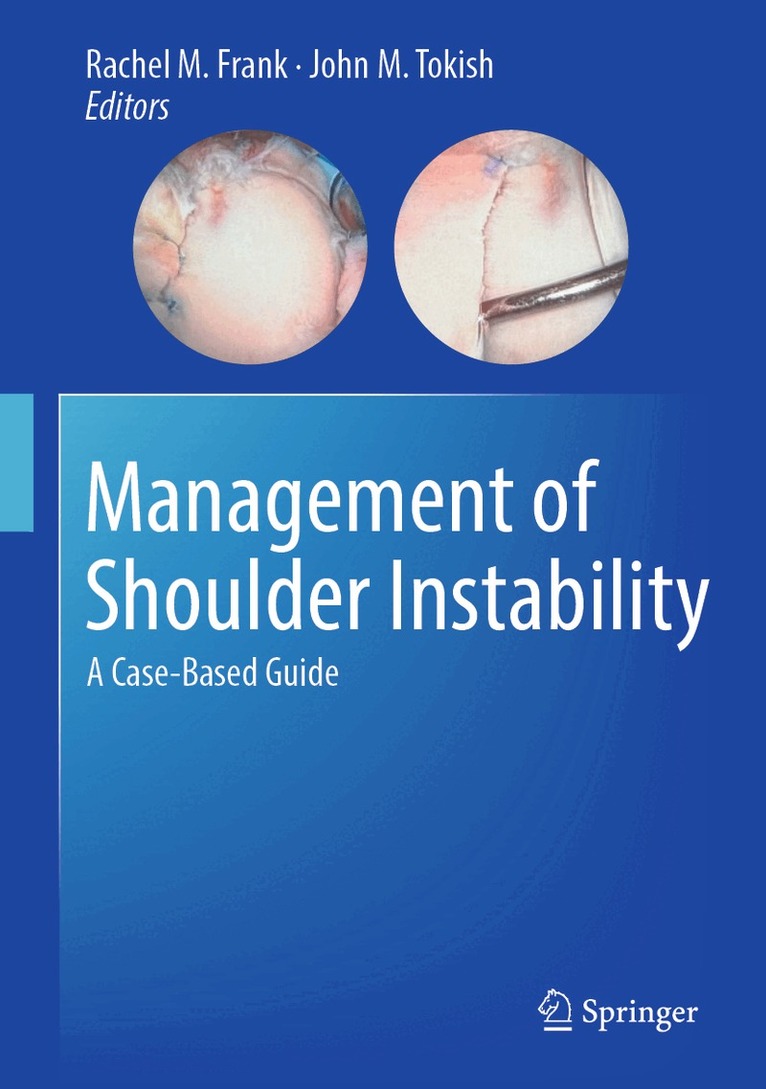
    Management of Shoulder Instability

    A Case-Based Guide

    AvRachel M. Frank,John M. Tokish

    Inbunden, Engelska, 2026

    1 562 kr

    Beställningsvara. Skickas inom 10-15 vardagar. Fri frakt över 249 kr.

    Beskrivning

    Utilizing a case-based format complemented with schematic figures and operative photographs, this book presents all aspects of the surgical management of shoulder instability, including instability with and without glenoid and/or humeral head bone loss.The first section covers the essentials of the anatomy, physical examination and imaging techniques for the shoulder. The following three sections, illustrated with unique clinical case material, present anterior, posterior and multidirectional instability respectively, discussing the decision-making process required for these challenging patients. Techniques described include arthroscopic and open soft tissue stabilization, arthroscopic and open Bankart and Latarjet techniques, and arthroscopic and open bone block techniques. Concluding sections present special cases, future directions and evolving concepts.With contributions from leaders in the field, Management of Shoulder Instability: A Case-Based Guide is a valuable resource for orthopedic and sports medicine surgeons, residents and fellows, as well as allied health care colleagues (PAs, NPs, ATCs) who specialize in the treatment of shoulder instability patients.

    Produktinformation

    • Utgivningsdatum:2026-07-28
    • Mått:178 x 254 x 32 mm
    • Vikt:1 272 g
    • Format:Inbunden
    • Språk:Engelska
    • Antal sidor:489
    • Förlag:Springer Nature Switzerland AG
    • ISBN:9783032180889

    Utforska kategorier

    • Idrottsmedicin och idrottsskador inom Medicin
    • Ortopedi och frakturer inom Medicin

    Mer om författaren

    Rachel M. Frank, MD, Department of Orthopedic Surgery, University of Colorado School of Medicine, Denver, CO, USAJohn M. Tokish, MD, Department of Orthopedic Surgery, Mayo Clinic, Phoenix, AZ, USA

    Innehållsförteckning

    • Part I: General Topics.- Chapter 1. Shoulder Anatomy and Biomechanics.- Chapter 2. Shoulder Arthroscopy – Patient Positioning and Portal Placement.- Chapter 3. Physical Examination and Classification of Shoulder Instability: A Case-based guide.- Chapter 4. Glenoid Bone Loss – How to Measure.- Chapter 5. Humeral Head bone loss – How to measure for treatment decisions.- Part II: Anterior shoulder instability.- Chapter 6. The Bankart repair in lateral decubitus: indications, technique, and limits.- Chapter 7. The Bankart repair in beach chair: indications, technique, and limits.-Chapter 8. The HAGL Lesion: Recognition and Arthroscopic Surgical Technique.- Chapter 9. The HAGL Lesion: when to go Open, and how to do it.- Chapter 10. THE HAGL LESION: RECOGNITION AND SURGICAL TECHNIQUE.- Chapter 11. The ASA procedure: partial subscapularis tenodesis with Bankart repair.- Chapter 12. The Bony Bankart: Strategies to Incorporate the Bone.- Chapter 13. The Remplissage: Indications and Surgical Technique.- Chapter 14. Treatment of Subcritical bone loss: The Distal Clavicle Autograft.- Chapter 15. The Open Bankart with a Lateral Capsular Shift.- Chapter 16. The Open Bankart Repair with a Medial Capsular Shift: Indications and Technical Tips.- Chapter 17. The Open Bankart: through a subscapular split.- Chapter 18. Glenoid bone loss: the Latarjet, the open approach.- Chapter 19. The arthroscopic Latarjet: Technical tips and keys to success.- Chapter 20. Glenoid Bone Loss: The Fresh Distal Tibial Allograft, Logistics, Graft Preparation, and Open Approach.- Chapter 21. The frozen distal tibial allograft: Justification and an all-arthroscopic approach.- Chapter 22. The Iliac crest J Bone graft: justification and technical pearls.- Chapter 23. Glenoid Fracture: Tips for Reduction and Fixation.- Chapter 24. The Deep Hill Sachs lesion: Open bone grafting with allograft.- Chapter 25. The Massive Hill Sachs Lesion: Metal Replacement. Part III: Posterior shoulder instability.- Chapter 26. Arthroscopic Posterior Bankart Repair in the Lateral Position.- Chapter 27. Posterior Bankart Repair in the Beach Chair Position.- Chapter 28. RHAGL: Arthroscopic Approach.- Chapter 29. Posterior Instability with the Reverse Hill-Sachs Lesion: The Arthroscopic McLaughlin (Reverse Remplissage) and Open Humeral Head Elliptical Osteochondral Allograft (Bio Humi).- Chapter 30. Posterior Shoulder Instability with Bone Deficiency: Distal Tibia/ Distal Clavicle/ ICBG/ Scapular Spine.- Chapter 31. Glenoid osteotomy for severe glenoid retroversion and posterior instability.- Chapter 32. Posterior Instability Outcomes Over the Last 20 years – Where Are We Now?.- Part IV: Multidirectional instability. - Chapter 33. The open inferior capsular shift for MDI (Multi-Directional Instability).- Chapter 34. The Arthroscopic Pan Capsular Plication for Multidirectional Shoulder Instability.- Chapter 35. Allograft Additions to the Multidirectional Shoulder.- Part V: Special Cases.- Chapter 36. Instability Due to Subscapularis Deficiency: Reconstructive Options.- Chapter 37. Subscapularis Deficiency: Anterior Capsular Reconstruction.- Part VI: Future Directions.- Chapter 38. Evolving Concepts in the Treatment of Glenohumeral Instability and Glenoid Bone Loss.- Chapter 39. Epilogue_What the Future Holds: Controversies for the Next Edition.