• Fri frakt över 249 kr
  • •
  • Snabba leveranser
  • •
  • Billiga böcker
Kundservice

Du är på sajten för privatpersoner.

Företag, bibliotek eller offentlig verksamhet?

Du handlar på classic.bokus.com, där alla dina funktioner finns intakta.
Till classic.bokus.com
Bokus logotyp. Gå till startsidan.
  • Erbjudanden
  • Nyheter
  • Student
  • Topplistor
  • Barn & ungdom
  • Bokus Play
  • E-böcker
  • Pocketböcker
  • Spel & pussel

10% rabatt på allt med kod: NYSTART10 →

Sidfot

Mina sidor

    Hjälp

    • Kundservice
    • Vanliga frågor och svar
    • Frakt och leverans
    • Retur vid ångerrätt
    • Reklamera vara
    • Betalning
    • Köpvillkor
    • Allmänna villkor
    • Information om webbplatsens tillgänglighet

    Om Bokus

    • Om oss
    • Pressrum
    • För studenter
    • För företag
    • För bibliotek och offentlig verksamhet
    • För leverantörer
    • Hållbarhet

    Populärt

    • Aktuella erbjudanden
    • Presentkort
    • Studentlitteratur
    • Nya böcker
    • Topplistor
    • Signerade böcker
    • Engelska böcker

    Inspiration

    • Boktips
    • BookTok
    • Populära bokserier
    • Barnbokskaraktärer
    • Populära författare
    Logotyp för Bokus
    Följ oss på Facebook (extern länk)Följ oss på Instagram (extern länk)Följ oss på YouTube (extern länk)Följ oss på TikTok (extern länk)
    bokus @ CookiesAnpassa cookiesIntegritetspolicyKöpvillkor
    Till Citymail hemsida (extern länk)Till Budbee hemsida (extern länk)Till Postnord hemsida (extern länk)Till Schenker hemsida (extern länk)Till Early Bird hemsida (extern länk)Till Walleys hemsida (extern länk)
    1. Medicin
    2. Medicin: allmänt

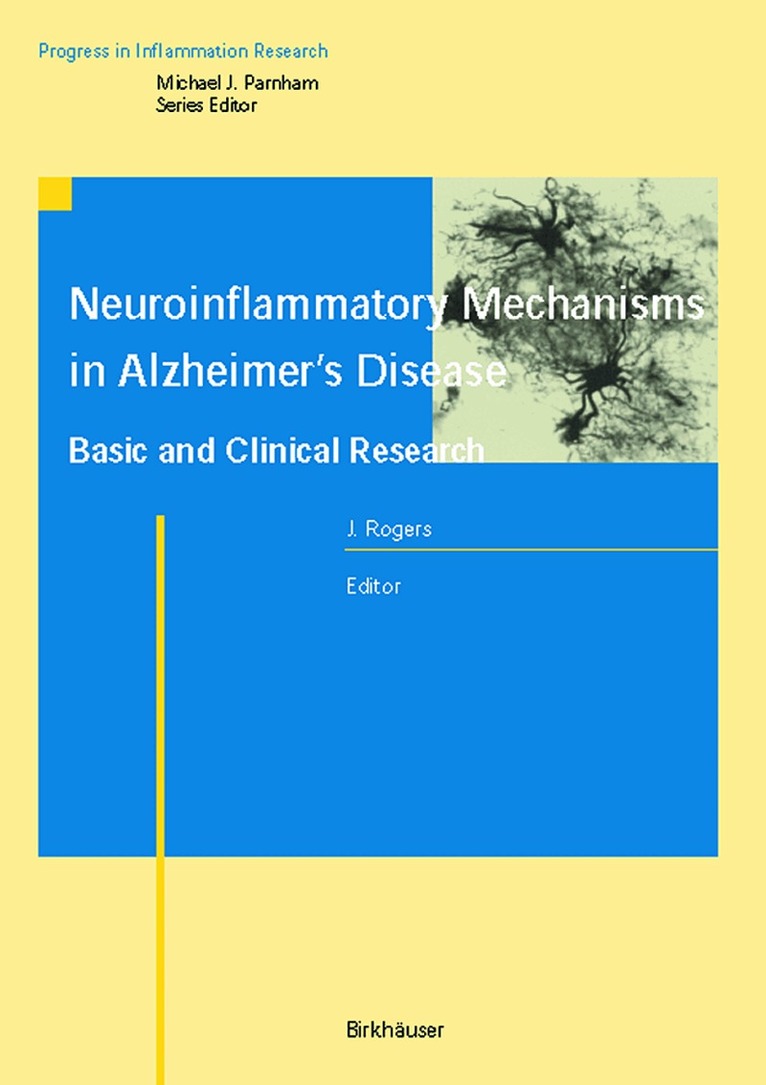
    Neuroinflammatory Mechanisms in Alzheimer’s Disease

    Basic and Clinical Research

    AvJoseph Rogers

    Häftad, Engelska, 2012

    Del i serien Progress in Inflammation Research

    563 kr

    Beställningsvara. Skickas inom 10-15 vardagar. Fri frakt över 249 kr.

    Beskrivning

    Research into inflammatory mechanisms that may cause damage to the Alzheimer's disease (AD) brain has now been ongoing for nearly two decades. Some two dozen clinical studies have strongly suggested that conventional anti-inflammatory drugs may be useful to delay the onset or slow the progression of the disorder. Moreover, virtually all the major systems of the innate immune response appear to be present, and most are upregulated, in pathologically-vulnerable regions of the AD brain. These new findings are described in this volume - first in overview form, followed by chapters on topics of special interest. In many ways, to understand AD brain inflammation, one need only review a text on peripheral inflammation biology, leaving out the chapters on humoral medi­ ators and substituting microglia for macrophages. In several other key respects, however, AD brain inflammation is unique, due primarily to idiosyncratic interac­ tions of inflammatory mediators and mechanisms with classical AD pathology: amyloid ~ peptide(A~) deposits and neurofibrillary tangles (NFTs). For this reason, some key concepts about the inflammation that occurs in AD may warrant discus­ sion in preparation for the more detailed chapters that follow.

    Produktinformation

    • Utgivningsdatum:2012-10-23
    • Mått:155 x 235 x 16 mm
    • Vikt:435 g
    • Format:Häftad
    • Språk:Engelska
    • Serie:Progress in Inflammation Research
    • Antal sidor:263
    • Förlag:Springer Basel
    • ISBN:9783034895293

    Utforska kategorier

    • Medicin: allmänt inom Medicin

    Innehållsförteckning

    • Basic Research Overview.- Cellular and molecular mechanisms of Alzheimer’s disease inflammation.- Clinical Research Overview.- Anti-inflammatory agents as possible protective factors for Alzheimer’s disease: Analysis of relevant epidemiological studies.- Topics of Special Interest.- Role and regulation of early complement activation products in Alzheimer’s disease.- Complement mediator systems in Alzheimer’s disease.- Amyloid ? peptide interactions with the classical pathway of complement.- Physiology and biochemistry of the interleukin-6 receptor complex. Implications for CNS disorders and Alzheimer’s disease.- Interactions of ?2-macroglobulin and amyloid ? peptide.- Proinflammatory actions of derivatives of the ? amyloid precursor protein.- The involvement of glial cell-derived reactive oxygen and nitrogen species in Alzheimer’s disease.- The role of cyclooxygenase in Alzheimer’s disease neurodegeneration.- Microglia.- Neurons.- The gero-inflammatory manifold.