• Fri frakt över 249 kr
  • •
  • Snabba leveranser
  • •
  • Billiga böcker
Kundservice

Du är på sajten för privatpersoner.

Företag, bibliotek eller offentlig verksamhet?

Du handlar på classic.bokus.com, där alla dina funktioner finns intakta.
Till classic.bokus.com
Bokus logotyp. Gå till startsidan.
  • Erbjudanden
  • Nyheter
  • Student
  • Topplistor
  • Barn & ungdom
  • Bokus Play
  • E-böcker
  • Pocketböcker
  • Spel & pussel

10% rabatt på allt med kod NYSTART10 →

Sidfot

Mina sidor

    Hjälp

    • Kundservice
    • Vanliga frågor och svar
    • Frakt och leverans
    • Retur vid ångerrätt
    • Reklamera vara
    • Betalning
    • Köpvillkor
    • Allmänna villkor
    • Information om webbplatsens tillgänglighet

    Om Bokus

    • Om oss
    • Pressrum
    • För studenter
    • För företag
    • För bibliotek och offentlig verksamhet
    • För leverantörer
    • Hållbarhet

    Populärt

    • Aktuella erbjudanden
    • Presentkort
    • Studentlitteratur
    • Nya böcker
    • Topplistor
    • Signerade böcker
    • Engelska böcker

    Inspiration

    • Boktips
    • BookTok
    • Populära bokserier
    • Barnbokskaraktärer
    • Populära författare
    Logotyp för Bokus
    Följ oss på Facebook (extern länk)Följ oss på Instagram (extern länk)Följ oss på YouTube (extern länk)Följ oss på TikTok (extern länk)
    bokus @ CookiesAnpassa cookiesIntegritetspolicyKöpvillkor
    Till Citymail hemsida (extern länk)Till Budbee hemsida (extern länk)Till Postnord hemsida (extern länk)Till Schenker hemsida (extern länk)Till Early Bird hemsida (extern länk)Till Walleys hemsida (extern länk)
    1. Språk och ordböcker
    2. Språkvetenskap och lingvistik

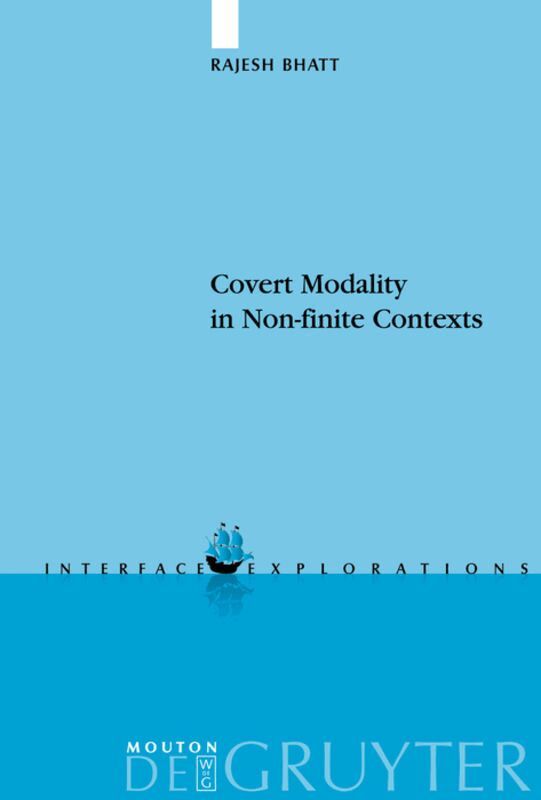
    Covert Modality in Non-finite Contexts

    AvRajesh Bhatt

    Inbunden, Engelska, 2006

    Del i serien Interface Explorations [IE]

    2 672 kr

    Beställningsvara. Skickas inom 5-8 vardagar. Fri frakt över 249 kr.

    Fler format och utgåvor

    E-bok

    2 716 kr

    Beskrivning

    This book investigates the distribution and interpretation of Covert Modality. Covert Modality is modality which we interpret but which is not associated with any lexical item in the structure that we are interpreting. This dissertation investigates a class of environments that involves covert modality. Examples of covert modality include wh-infinitival complements, infinitival relative clauses, purpose clauses, the 'have to' construction, and the 'is to' construction (cf. 1):1a. Tim knows [how to solve the problem]. ("Tim knows how one/he could/should solve the problem.")1b. Jane found [a book to draw cartoons in] for Sara. ("Jane found a book for Sara one could/should draw cartoons in.")1c. [The man to fix the sink] is here. ("The man whose purpose is to fix the sink is here.")1d. Sue went to Torino [to buy a violin]. ("Sue went to Torino so that she could buy a violin.")1e. Bill has to reach Philadelphia before noon. ("Bill must reach Philadelphia before noon.")1f. Will is to leave tomorrow. ("Will is scheduled/supposed to leave tomorrow.") The interpretation of (1a-f) involves modality; however, there is no lexical item that seems to be the source of the modality. What (1a-f) have in common is that they involve infinitivals. This book addresses the following questions about covert modality: what is the source of this modality, what are its semantic properties, why are some but not all infinitival relatives modal, and why are all infinitival questions modal? The infinitival [+wh] Complementizer is identified as the source of the covert modality. The apparent variability of the force of this modality is related to the particular semantics of this Complementizer. Infinitival relatives that receive a non-modal interpretation are analyzed as being reduced relatives and thus not involving the infinitival [+wh] Complementizer.

    Produktinformation

    • Utgivningsdatum:2006-12-18
    • Mått:155 x 230 x 18 mm
    • Vikt:440 g
    • Format:Inbunden
    • Språk:Engelska
    • Serie:Interface Explorations [IE]
    • Antal sidor:212
    • Upplaga:6001
    • Förlag:De Gruyter
    • ISBN:9783110179521

    Utforska kategorier

    • Språkvetenskap och lingvistik inom Språk och ordböcker

    Mer om författaren

    Rajesh Bhatt, University of Texas at Austin, Texas, USA.

    Innehållsförteckning

    • ContentsAcknowledgements iv1 Introduction 11.1 Issues . . . . . . . . . . . . . . . . . . . . . . . . . . . . . . . . . . . . . . . . . 11.2 Dissertation Outline and Summary . . . . . . . . . . . . . . . . . . . . . . . . 31.2.1 Chapter 2: The Syntax of Infinitival Relatives . . . . . . . . . . . . . . 31.2.2 Chapter 3: Non-Modal Infinitival Relative Clauses . . . . . . . . . . . 41.2.3 Chapter 4: The Distribution and Interpretation of Infinitival Questions 61.2.4 Chapter 5: Ability Modals and their Actuality Entailments . . . . . . 82 The syntax of Infinitival Relatives 92.1 Subject infinitival relatives as Reduced Relatives . . . . . . . . . . . . . . . . 92.2 Non-subject Infinitival Relatives . . . . . . . . . . . . . . . . . . . . . . . . . 112.3 The Modality of Infinitival Relatives and Questions . . . . . . . . . . . . . . 142.3.1 Proposal for Object Infinitival Relatives and Infinitival Questions . . 152.3.2 Proposal for Subject Infinitival Relatives and Infinitival Questions . . 162.4 Structures for Reduced Relatives . . . . . . . . . . . . . . . . . . . . . . . . . 172.4.1 Kayne (1994)’s proposal for Reduced Relatives . . . . . . . . . . . . . 172.4.1.1 Kayne (1994)’s general proposal for Relative Clauses . . . . 172.4.1.2 Kayne (1994)’s proposal for Reduced Relatives . . . . . . . 182.5 Arguments for a Raising Analysis of Relative Clauses . . . . . . . . . . . . . 212.5.1 The Candidates . . . . . . . . . . . . . . . . . . . . . . . . . . . . . . . 212.5.2 The Argument from ‘Idioms’ . . . . . . . . . . . . . . . . . . . . . . . 22x2.5.2.1 A related argument from Subcategorization . . . . . . . . . 232.5.3 The argument from Binding Theory . . . . . . . . . . . . . . . . . . . 242.5.4 Amount Relatives . . . . . . . . . . . . . . . . . . . . . . . . . . . . . . 252.5.5 Scope Reconstruction . . . . . . . . . . . . . . . . . . . . . . . . . . . . 262.5.6 Lower Readings of Adjectival Modifiers . . . . . . . . . . . . . . . . . 272.6 My proposal for Reduced Relatives . . . . . . . . . . . . . . . . . . . . . . . . 282.6.1 Version 1 . . . . . . . . . . . . . . . . . . . . . . . . . . . . . . . . . . . 282.6.2 On the nature of Direct Predication . . . . . . . . . . . . . . . . . . . . 302.6.3 Version 2: Accommodating Reconstruction into Reduced and FiniteRelatives . . . . . . . . . . . . . . . . . . . . . . . . . . . . . . . . . . . 322.6.3.1 A comparison with Sauerland (1998) . . . . . . . . . . . . . 372.6.4 Reduced Relatives and Case . . . . . . . . . . . . . . . . . . . . . . . . 382.6.5 Interpreting the New Proposal . . . . . . . . . . . . . . . . . . . . . . 392.7 Conclusions . . . . . . . . . . . . . . . . . . . . . . . . . . . . . . . . . . . . . 413 Non-Modal Subject Infinitival Relatives 423.1 Properties of Non-modal Infinitival Relatives . . . . . . . . . . . . . . . . . . 423.1.1 Non-Modal Infinitival Relatives allow for Modal Readings too . . . . 463.2 A Raising Relative Clause analysis of Non-modal Infinitival Relatives . . . . 473.2.1 Raising Analysis of Relative Clauses . . . . . . . . . . . . . . . . . . . 473.2.2 Interpreting the Raising Analysis (for Reduced Relatives) . . . . . . . 493.2.3 Raising Analysis applied to Non-modal Infinitival Relatives . . . . . 503.3 Motivations for the Movement of Superlative est/Ordinals/only . . . . . . . 513.3.1 A semantics for Superlatives . . . . . . . . . . . . . . . . . . . . . . . 543.3.2 Ordinals and Nominal only: Focus Sensitivity and Analysis . . . . . 563.4 More on the Raising Analysis . . . . . . . . . . . . . . . . . . . . . . . . . . . 593.4.1 Structural Characterization of Superlatives, Ordinals, and only . . . . 593.4.2 Licensing from inside the infinitival clause . . . . . . . . . . . . . . . 613.5 A prediction: Loss of Association with Focus with Non-modal InfinitivalRelatives . . . . . . . . . . . . . . . . . . . . . . . . . . . . . . . . . . . . . . . 633.5.1 Loss of Focus-sensitivity of Superlatives, only, ordinals . . . . . . . . 64xi3.5.2 A Further Prediction . . . . . . . . . . . . . . . . . . . . . . . . . . . . 673.6 Lower Readings: Further evidence for the Raising Analysis . . . . . . . . . . 693.6.1 Evidence for Reconstruction from NPI licensing . . . . . . . . . . . . 713.6.2 Evidence for Reconstruction from the behavior of Numeral Modifiers 723.6.3 Low Readings and Negative Island Effects . . . . . . . . . . . . . . . 733.6.4 Parentheticals: a potential alternative . . . . . . . . . . . . . . . . . . 743.7 Interpretation of the non-modal infinitival clauses . . . . . . . . . . . . . . . 753.7.1 A first semantics for first . . . . . . . . . . . . . . . . . . . . . . . . . . 753.7.1.1 first with possessive NPs . . . . . . . . . . . . . . . . . . . 763.7.1.2 Digression: Larson & Cho (1998)’s Analysis of former . . . . 773.7.1.3 Back from the Digression . . . . . . . . . . . . . . . . . . . . 773.7.2 first with Non-modal Infinitival Relatives . . . . . . . . . . . . . . . 793.7.3 Simultaneity between ‘head’ NP and Relative Clause . . . . . . . . . 803.7.3.1 Simultaneity effects with Finite Relative Clauses and first . 823.7.3.2 On why there is Reconstruction with first . . . . . . . . . . . 843.7.4 A Prediction: Locus of Change of State is Undetermined . . . . . . . 873.7.5 Temporal Properties of the Infinitival Clause . . . . . . . . . . . . . . 883.7.5.1 When is first(P) evaluated? . . . . . . . . . . . . . . . . . . 893.7.5.2 Aspectual Characterization of the Infinitival Clause . . . . 913.7.5.3 A covert Perfect? . . . . . . . . . . . . . . . . . . . . . . . . . 923.7.5.4 A problem with assuming a Covert Perfect and a solution . 933.7.5.5 A Difference between the Covert and the Overt Perfect . . 963.7.5.6 Perfective Aspect . . . . . . . . . . . . . . . . . . . . . . . . 973.7.5.7 A Minimal Crosslinguistic Variation . . . . . . . . . . . . . 993.7.6 Future interpretation . . . . . . . . . . . . . . . . . . . . . . . . . . . . 1003.8 Appendix A: A semantics for Raising Analysis of Relative Clauses . . . . . 1023.9 Appendix B: Semantics of only and first . . . . . . . . . . . . . . . . . . . . . 1083.9.1 only . . . . . . . . . . . . . . . . . . . . . . . . . . . . . . . . . . . . . . 1083.9.2 Ordinals (‘first’, ‘second’, : : :, ‘last’) . . . . . . . . . . . . . . . . . . . . 1093.10 Appendix C: An in situ licensor analysis of Non-modal Infinitival Relatives 1103.11 Conclusions . . . . . . . . . . . . . . . . . . . . . . . . . . . . . . . . . . . . . 112xii4 The Distribution and Interpretation of Wh-infinitivals 1144.1 Infinitival Question Complements: Distribution and Subcategorization . . . 1154.1.1 The Distribution of Infinitival Questions . . . . . . . . . . . . . . . . 1154.1.1.1 A Classification of Predicates that take Finite InterrogativeComplements . . . . . . . . . . . . . . . . . . . . . . . . . . 1154.1.1.2 Infinitival Questions . . . . . . . . . . . . . . . . . . . . . . . 1164.1.2 Infinitival Questions and Subcategorization . . . . . . . . . . . . . . . 1204.1.2.1 Non-interrogative Infinitival Complements of Predicates thattake Infinitival Questions . . . . . . . . . . . . . . . . . . . . 1204.1.2.2 Some Subcategorizational Generalizations . . . . . . . . . . 1214.1.2.3 One Predicate or Many . . . . . . . . . . . . . . . . . . . . . 1244.2 Modality . . . . . . . . . . . . . . . . . . . . . . . . . . . . . . . . . . . . . . . 1274.2.1 Nature of Infinitival Modality . . . . . . . . . . . . . . . . . . . . . . . 1274.2.2 Force of Infinitival Modality . . . . . . . . . . . . . . . . . . . . . . . . 1324.2.2.1 The effect of the wh-word . . . . . . . . . . . . . . . . . . . . 1334.2.2.2 The effect of the embedding predicate . . . . . . . . . . . . 1344.2.2.3 The effect of the infinitival question predicate . . . . . . . . 1354.2.2.4 The effect of the context . . . . . . . . . . . . . . . . . . . . . 1354.3 The Modality in Infinitival Questions . . . . . . . . . . . . . . . . . . . . . . . 1364.3.1 Could Readings . . . . . . . . . . . . . . . . . . . . . .