• Fri frakt över 249 kr
  • •
  • Snabba leveranser
  • •
  • Billiga böcker
Kundservice

Du är på sajten för privatpersoner.

Företag, bibliotek eller offentlig verksamhet?

Du handlar på classic.bokus.com, där alla dina funktioner finns intakta.
Till classic.bokus.com
Bokus logotyp. Gå till startsidan.
  • Erbjudanden
  • Student
  • Topplistor
  • Barn & ungdom
  • Bokus Play
  • E-böcker
  • Ljudböcker
  • Pocketböcker
  • Spel & pussel

Upp till 25% på utvalda nyheter →

Sidfot

Mina sidor

    Hjälp

    • Kundservice
    • Vanliga frågor och svar
    • Frakt och leverans
    • Retur vid ångerrätt
    • Reklamera vara
    • Betalning
    • Köpvillkor
    • Allmänna villkor
    • Information om webbplatsens tillgänglighet

    Om Bokus

    • Om oss
    • Pressrum
    • För studenter
    • För företag
    • För bibliotek och offentlig verksamhet
    • För leverantörer
    • Hållbarhet

    Populärt

    • Aktuella erbjudanden
    • Presentkort
    • Studentlitteratur
    • Nya böcker
    • Topplistor
    • Signerade böcker
    • Engelska böcker

    Inspiration

    • Boktips
    • BookTok
    • Populära bokserier
    • Barnbokskaraktärer
    • Populära författare
    Logotyp för Bokus
    Följ oss på Facebook (extern länk)Följ oss på Instagram (extern länk)Följ oss på YouTube (extern länk)Följ oss på TikTok (extern länk)
    bokus @ CookiesAnpassa cookiesIntegritetspolicyKöpvillkor
    Till Citymail hemsida (extern länk)Till Budbee hemsida (extern länk)Till Postnord hemsida (extern länk)Till Schenker hemsida (extern länk)Till Early Bird hemsida (extern länk)Till Walleys hemsida (extern länk)
    1. Språk och ordböcker
    2. Språkvetenskap och lingvistik

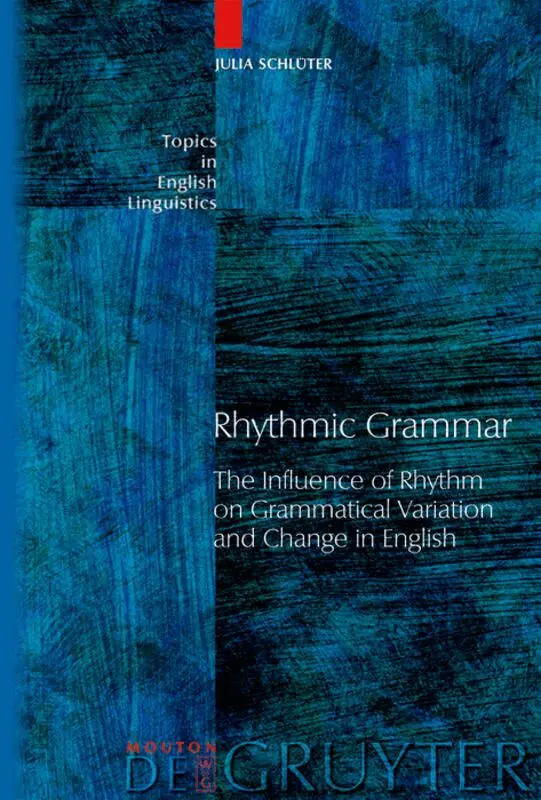
    Rhythmic Grammar

    The Influence of Rhythm on Grammatical Variation and Change in English

    AvJulia Schlüter

    Inbunden, Engelska, 2005

    Del i serien Topics in English Linguistics [TiEL]

    2 834 kr

    Beställningsvara. Skickas inom 5-8 vardagar. Fri frakt över 249 kr.

    Fler format och utgåvor

    E-bok

    2 872 kr

    Beskrivning

    This groundbreaking book highlights a phonological preference, the Principle of Rhythmic Alternation, as a factor in grammatical variation and change in English from the early modern period to the present. Though frequently overlooked in earlier research, the phonetically motivated avoidance of adjacent stresses is shown to exert an influence on a wide variety of phenomena in morphology and syntax.Based on in-depth analyses of extensive electronic databases, the book presents 20 exemplary studies from different structural categories. Among them are much-debated as well as novel issues, including the double comparative worser, 'predicative only' a- adjectives, variant past participles, the placement of the degree modifier quite, the order of conjuncts in binomials, the negation of attributive adjectives and sentence adverbs, variable adverbial marking, the use or omission of the infinitive marker, and the a- prefix before - ing forms. The studies provide qualitative and quantitative evidence of the importance of rhythmic alternation in synchronic variation as well as diachronic change, without neglecting interactions with a set of competing functional tendencies. Thus, the book contributes essential aspects to the description and explanation of the phenomena considered, calling for a fundamental revision of current thinking about the interface between phonology and morphosyntax. In addition, the empirical findings are brought to bear on theoretical discussions of more general interest, yielding a critical assessment of the merits and limitations of two nonmodular linguistic theories: Optimality Theory and spreading activation models. The latter type is developed into a comprehensive conception integrating functional factors such as the Principle of Rhythmic Alternation in an overarching framework for language variation and change. The wide range of subject areas covered makes the volume essential reading and a source of inspiration for linguists with interests as diverse as the phonology-morphosyntax interface, English grammar, the history of English, functional linguistics, Optimality Theory, as well as neuro- and psycholinguistics.

    Produktinformation

    • Utgivningsdatum:2005-09-19
    • Mått:155 x 230 x undefined mm
    • Vikt:820 g
    • Format:Inbunden
    • Språk:Engelska
    • Serie:Topics in English Linguistics [TiEL]
    • Antal sidor:404
    • Förlag:De Gruyter
    • ISBN:9783110186079

    Utforska kategorier

    • Språkvetenskap och lingvistik inom Språk och ordböcker

    Mer om författaren

    Julia Schlüter is Post-doctoral Research Fellow at the Universität Paderborn, Germany.

    Innehållsförteckning

    • Chapter 1 Introduction1.1. The state of the art1.2. Aims and scope1.3. The structure of the argumentChapter 2 The Principle of Rhythmic Alternation introduced2.1. Outline2.1.1. The universality of rhythmic organization2.1.2. Isochrony types: stress timing vs. syllable timing2.1.3. Compensation strategies2.1.4. Functional explanations for rhythmic alternation2.2. Previous research on rhythmic influences on English grammarChapter 3 Methodology3.1. Corpora and their limitations3.2. The phonology of written language3.3. Concordance software and search procedures3.4. Tests of statistical significanceChapter 4 Analysis of attributive structures4.1. Introduction4.2. Worse vs. worser from EModE to nineteenth-century English4.3. A-adjectives in PDE4.4. Mono- and disyllabic variants of past participles4.4.1. Drunk vs. drunken from ME to PDE4.4.2. Broke vs. broken from ME to PDE4.4.3. Struck vs. stricken from ME to PDE4.4.4. Knit vs. knitted from ME to PDE4.4.5. Lit vs. lighted from ME to PDE4.4.6. Summary4.5. A quite vs. quite a from EModE to PDE4.6. The order of coordinated colour adjectives in PDE4.7. Negated attributive adjectives in PDE4.8. SummaryChapter 5 Analysis of verbal and adverbial structures5.1. Introduction5.2. Negated sentence adverbs in PDE5.3. Suffixed and suffixless adverbs5.3.1. Quick vs. quickly from EModE to PDE5.3.2. Slow vs. slowly from EModE to PDE5.3.3. Scarce vs. scarcely in PDE5.4. Marked and unmarked infinitives5.4.1. Infinitives dependent on active make in EmodE and LModE5.4.2. Infinitives dependent on passive make from EmodE to nineteenth-century English5.4.3. Infinitives dependent on passive bid in nineteenth-century English5.4.4. Infinitives dependent on the marginal modal dare from EModE to PDE5.5. A-prefixation of -ing-forms5.5.1. A-prefixation of -ing-forms following set from EModE to PDE5.5.2. A-prefixation of -ing-forms following go from EModE to PDE5.6. SummaryChapter 6 Theoretical implications6.1. Introduction6.2. Optimality Theory6.2.1. Universal, violable and ranked constraints6.2.2. A critique of Optimality Theory6.2.3. OT approaches to language variation and change6.3. Spreading activation models6.3.1. Principles of neural action6.3.2. Networks in production and perception6.3.3. Implications of the alternation of activation and recovery6.3.4. Interactivity between levels6.3.5. Limits to interactivity6.3.6. Language variation and change in a neuro- and psycholinguistic perspective6.3.7. Limitations of interactive activation modelsChapter 7 Conclusion7.1. Synopsis7.2. Outlook