• Fri frakt över 249 kr
  • •
  • Snabba leveranser
  • •
  • Billiga böcker
Kundservice

Du är på sajten för privatpersoner.

Företag, bibliotek eller offentlig verksamhet?

Du handlar på classic.bokus.com, där alla dina funktioner finns intakta.
Till classic.bokus.com
Bokus logotyp. Gå till startsidan.
  • Erbjudanden
  • Nyheter
  • Student
  • Topplistor
  • Barn & ungdom
  • Bokus Play
  • E-böcker
  • Pocketböcker
  • Spel & pussel

10% rabatt på allt med kod NYSTART10 →

Sidfot

Mina sidor

    Hjälp

    • Kundservice
    • Vanliga frågor och svar
    • Frakt och leverans
    • Retur vid ångerrätt
    • Reklamera vara
    • Betalning
    • Köpvillkor
    • Allmänna villkor
    • Information om webbplatsens tillgänglighet

    Om Bokus

    • Om oss
    • Pressrum
    • För studenter
    • För företag
    • För bibliotek och offentlig verksamhet
    • För leverantörer
    • Hållbarhet

    Populärt

    • Aktuella erbjudanden
    • Presentkort
    • Studentlitteratur
    • Nya böcker
    • Topplistor
    • Signerade böcker
    • Engelska böcker

    Inspiration

    • Boktips
    • BookTok
    • Populära bokserier
    • Barnbokskaraktärer
    • Populära författare
    Logotyp för Bokus
    Följ oss på Facebook (extern länk)Följ oss på Instagram (extern länk)Följ oss på YouTube (extern länk)Följ oss på TikTok (extern länk)
    bokus @ CookiesAnpassa cookiesIntegritetspolicyKöpvillkor
    Till Citymail hemsida (extern länk)Till Budbee hemsida (extern länk)Till Postnord hemsida (extern länk)Till Schenker hemsida (extern länk)Till Early Bird hemsida (extern länk)Till Walleys hemsida (extern länk)
    1. Språk och ordböcker
    2. Språkvetenskap och lingvistik

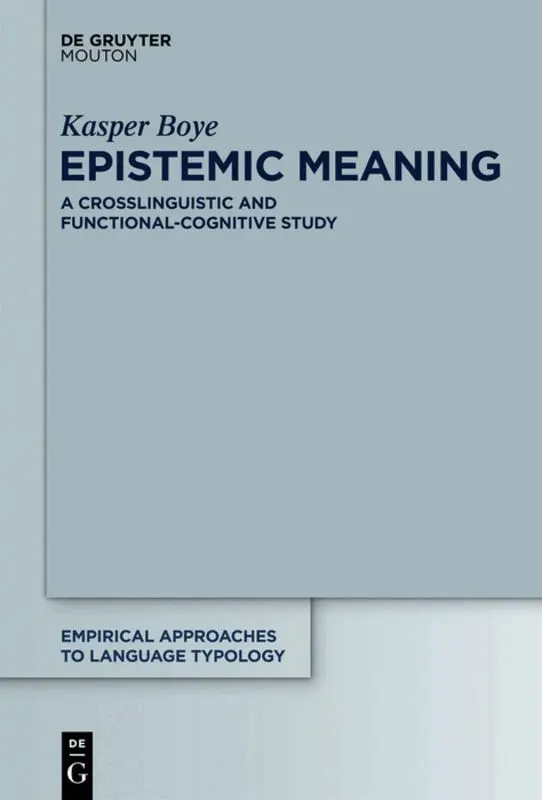
    Epistemic Meaning

    A Crosslinguistic and Functional-Cognitive Study

    AvKasper Boye

    Inbunden, Engelska, 2012

    Del i serien Empirical Approaches to Language Typology [EALT]

    2 314 kr

    Beställningsvara. Skickas inom 5-8 vardagar. Fri frakt över 249 kr.

    Fler format och utgåvor

    E-bok

    2 339 kr

    Beskrivning

    This book is intended to contribute to the clarification of the linguistic research area covered by the terms modal, evidential and epistemic. It sets out to demonstrate that on cross-linguistic grounds a hitherto overlooked epistemic meaning domain must be given due recognition in linguistic theory, on a par with domains such as time and number. The relevant domain is coherent, but at the same time complex in that it consists of two subdomains: one which comprises degree-of-certainty meanings, and one which comprises information-source meanings.The book offers three arguments for giving recognition to such a meaning domain. The first argument concerns the clustering of linguistic expressions with epistemic meaning into morphosyntactically delimited systems of elements. The second argument has to do with the variation pertaining to the coding of epistemic meanings, as highlighted in a semantic map of epistemic expressions. The third argument turns upon the scope properties of epistemic meanings and the morphosyntactic reflections of these properties.Finally, the book proposes a unified cognitive analysis of epistemic meaning in terms of which it attempts to account for the properties of the epistemic meaning domain as well as of individual epistemic meanings.

    Produktinformation

    • Utgivningsdatum:2012-07-16
    • Mått:230 x 155 x 26 mm
    • Vikt:736 g
    • Format:Inbunden
    • Språk:Engelska
    • Serie:Empirical Approaches to Language Typology [EALT]
    • Antal sidor:390
    • Upplaga:12001
    • Förlag:De Gruyter
    • ISBN:9783110204384

    Utforska kategorier

    • Språkvetenskap och lingvistik inom Språk och ordböcker

    Mer om författaren

    Kasper Boye, University of Copenhagen, Denmark.

    Recensioner i media

    "Boye's work is a valuable addition to the literature on epistemic meaning - he is very clear about his thesis and goals and is careful to show how each is demonstrated and met."Robert Earl LaBarge in: Linguist List 24.1827 "This excellent book is an enormous step forward toward a comprehensive theory of propositional marking and of epistemicity. For these fields, it sets standards of clarity and succinctness of argumentation. Therefore, its natural place is among the standard books on these subject matters."Bjorn Wiemer in: Studies in Language 37:2