• Fri frakt över 249 kr
  • •
  • Snabba leveranser
  • •
  • Billiga böcker
Kundservice

Du är på sajten för privatpersoner.

Företag, bibliotek eller offentlig verksamhet?

Du handlar på classic.bokus.com, där alla dina funktioner finns intakta.
Till classic.bokus.com
Bokus logotyp. Gå till startsidan.
  • Erbjudanden
  • Nyheter
  • Student
  • Topplistor
  • Barn & ungdom
  • Bokus Play
  • E-böcker
  • Pocketböcker
  • Spel & pussel

10% studentrabatt med kod TERM26

Sidfot

Mina sidor

    Hjälp

    • Kundservice
    • Vanliga frågor och svar
    • Frakt och leverans
    • Retur vid ångerrätt
    • Reklamera vara
    • Betalning
    • Köpvillkor
    • Allmänna villkor
    • Information om webbplatsens tillgänglighet

    Om Bokus

    • Om oss
    • Pressrum
    • För studenter
    • För företag
    • För bibliotek och offentlig verksamhet
    • För leverantörer
    • Hållbarhet

    Populärt

    • Aktuella erbjudanden
    • Presentkort
    • Studentlitteratur
    • Nya böcker
    • Topplistor
    • Signerade böcker
    • Engelska böcker

    Inspiration

    • Boktips
    • BookTok
    • Populära bokserier
    • Barnbokskaraktärer
    • Populära författare
    Logotyp för Bokus
    Följ oss på Facebook (extern länk)Följ oss på Instagram (extern länk)Följ oss på YouTube (extern länk)Följ oss på TikTok (extern länk)
    bokus @ CookiesAnpassa cookiesIntegritetspolicyKöpvillkor
    Till Citymail hemsida (extern länk)Till Budbee hemsida (extern länk)Till Postnord hemsida (extern länk)Till Schenker hemsida (extern länk)Till Early Bird hemsida (extern länk)Till Walleys hemsida (extern länk)
    1. Ekonomi och Ledarskap
    2. Företagsekonomi
    3. Affärsetik

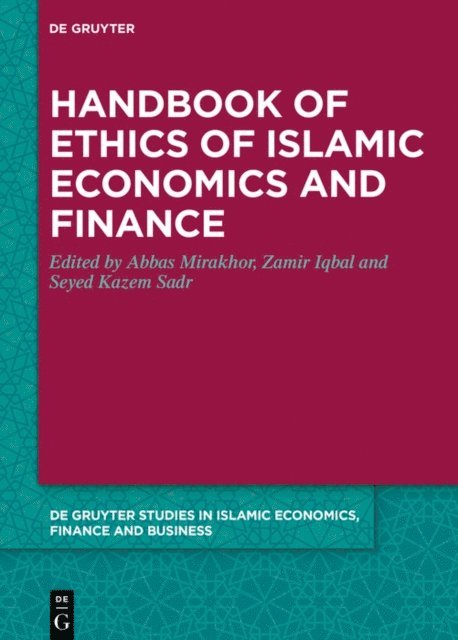
    Handbook of Ethics of Islamic Economics and Finance

    AvAbbas Mirakhor,Zamir Iqbal

    Inbunden, Engelska, 2020

    Del i serien De Gruyter Studies in Islamic Economics, Finance and Business

    2 168 kr

    Beställningsvara. Skickas inom 5-8 vardagar. Fri frakt över 249 kr.

    Beskrivning

    Since the financial crisis of 2007/2008, a renewed discussion on the ethics and finance is being examined from different dimensions – finance for good society, responsible finance, ethical finance, financial crimes, and financial repression. The principal objective of this Handbook on Ethics of Islamic Economics and Finance is to provide a deeper understanding of the ethical underpinning of Islamic economics and finance. The reader will notice that the Handbook reflects a diversity of views on the subject of economic and business ethics in Islam across the intellectual spectrum of Muslim thought over the globe. Handbook attempts to find answers to some questions concerning the definition and characteristics of the ethical system in Islam. What is its goal and how do its rules and practices ensure welfare for individuals and society? Are the moral principles universal and invariable or do they change and adapt with the social changes of communities and progress in science and technology? Is the present generation accountable for the welfare of future generations? Where is the boundary between law and ethics and who guarantees their adoption and implementation?

    Produktinformation

    • Utgivningsdatum:2020-04-20
    • Mått:170 x 240 x 45 mm
    • Vikt:1 191 g
    • Format:Inbunden
    • Språk:Engelska
    • Serie:De Gruyter Studies in Islamic Economics, Finance and Business
    • Antal sidor:648
    • Förlag:De Gruyter
    • ISBN:9783110590425

    Utforska kategorier

    • Affärsetik inom Ekonomi och Ledarskap
    • Islam inom Filosofi och religion
    • Finansiering inom Ekonomi och Ledarskap

    Mer om författaren

    Abbas Mirakhor joined INCEIF in 2010 as Distinguished Scholar and the First Holder of INCEIF's Chair in Islamic Finance. His research interests include conventional and Islamic economics and finance. He is a graduate of the Kansas State University, USA, where he received his Bachelor, Master and PhD Degrees in Economics. In 1968, he started his academic career with University of Alabama, USA. Mirakhor has worked as a professor of economics at the University of Alabama, Alabama A&M University, and the Florida Institute of Technology. In 1984, he joined the IMF in Washington DC as an economist. He spent 24 years with the IMF, serving as the organisation's Executive Director and Dean of the Executive Board, retiring in 2008. Zamir Iqbal is currently serving as the Vice President, Finance and CFO of the Islamic Development Bank. Prior to joining the Islamic Development Bank, he served as head of the World Bank Global Islamic Finance Development Center in Istanbul. He has more than 25 years of experience of capital markets, asset management, risk management, and financial sector at the World Bank. Islamic finance has been his research focus and he has co-authored several articles and books on Islamic finance on the topics of banking risk, financial inclusion, economic development, financial stability, and risk-sharing. He played an instrumental role in the publication of World Bank and IsDB’s first Global Report on Islamic Finance. He earned his PhD in international finance from the George Washington University and served as Professional faculty at Carey Business School of Johns Hopkins University. Seyed Kazem Sadr ist Professor at the Shahid Beheshti University in Iran.