E-bok, Engelska, 2013
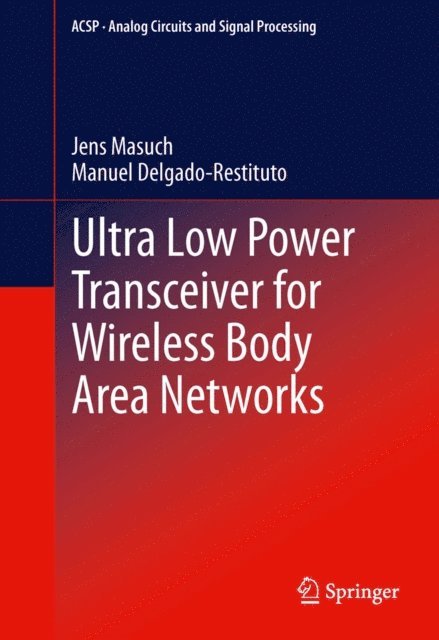
Ultra Low Power Transceiver for Wireless Body Area Networks
Av Manuel Delgado-Restituto, Jens Masuch
1427 kr
Läs direkt i Bokus Reader – eller ladda ned till din enhet (PDF kräver ofta zoom och scroll på små skärmar).
Beskrivning
Wireless Body Area Networks (WBANs) are expected to promote new applications for the ambulatory health monitoring of chronic patients and elderly population, aiming to improve their quality of life and independence. These networks are composed by wireless sensor nodes (WSNs) used for measuring physiological variables (e.g., glucose level in blood or body temperature) or controlling therapeutic devices (e.g., implanted insulin pumps). These nodes should exhibit a high degree of energy autonomy in order to extend their battery lifetime or even make the node supply to rely on harvesting techniques. Typically, the power budget of WSNs is dominated by the wireless link and, hence, many efforts have been directed during the last years toward the implementation of power efficient transceivers.
Because of the short range (typically no more than a few meters) and low data rate (typically in between 10 kb/s and 1 Mb/s), simple communication protocols can be employed. One of these protocols, specifically tailored for WBAN applications, is the Bluetooth low energy (BLE) standard.
This book describes the challenges and solutions for the design of ultra-low power transceivers for WBANs applications and presents the implementation details of a BLE transceiver prototype. Coverage includes not only the main concepts and architectures for achieving low power consumption, but also the details of the circuit design and its implementation in a standard CMOS technology.
Produktinformation
- Utgivningsdatum: 2013-03-28
- Språk: Engelska
- Filformat: PDF
- Kopieringsskydd: LCP
- ISBN: 9783319000985
- Förlag: Springer International Publishing
Utforska kategorier
Betyg & recensioner
0 recensioner
Inga recensioner tillgängliga.