• Fri frakt över 249 kr
  • •
  • Snabba leveranser
  • •
  • Billiga böcker
Kundservice

Du är på sajten för privatpersoner.

Företag, bibliotek eller offentlig verksamhet?

Du handlar på classic.bokus.com, där alla dina funktioner finns intakta.
Till classic.bokus.com
Bokus logotyp. Gå till startsidan.
  • Erbjudanden
  • Nyheter
  • Student
  • Topplistor
  • Barn & ungdom
  • Bokus Play
  • E-böcker
  • Pocketböcker
  • Spel & pussel

10% rabatt på allt med kod NYSTART10 →

Sidfot

Mina sidor

    Hjälp

    • Kundservice
    • Vanliga frågor och svar
    • Frakt och leverans
    • Retur vid ångerrätt
    • Reklamera vara
    • Betalning
    • Köpvillkor
    • Allmänna villkor
    • Information om webbplatsens tillgänglighet

    Om Bokus

    • Om oss
    • Pressrum
    • För studenter
    • För företag
    • För bibliotek och offentlig verksamhet
    • För leverantörer
    • Hållbarhet

    Populärt

    • Aktuella erbjudanden
    • Presentkort
    • Studentlitteratur
    • Nya böcker
    • Topplistor
    • Signerade böcker
    • Engelska böcker

    Inspiration

    • Boktips
    • BookTok
    • Populära bokserier
    • Barnbokskaraktärer
    • Populära författare
    Logotyp för Bokus
    Följ oss på Facebook (extern länk)Följ oss på Instagram (extern länk)Följ oss på YouTube (extern länk)Följ oss på TikTok (extern länk)
    bokus @ CookiesAnpassa cookiesIntegritetspolicyKöpvillkor
    Till Citymail hemsida (extern länk)Till Budbee hemsida (extern länk)Till Postnord hemsida (extern länk)Till Schenker hemsida (extern länk)Till Early Bird hemsida (extern länk)Till Walleys hemsida (extern länk)
    1. Naturvetenskap och teknik
    2. Matematik och naturvetenskap
    3. Fysik

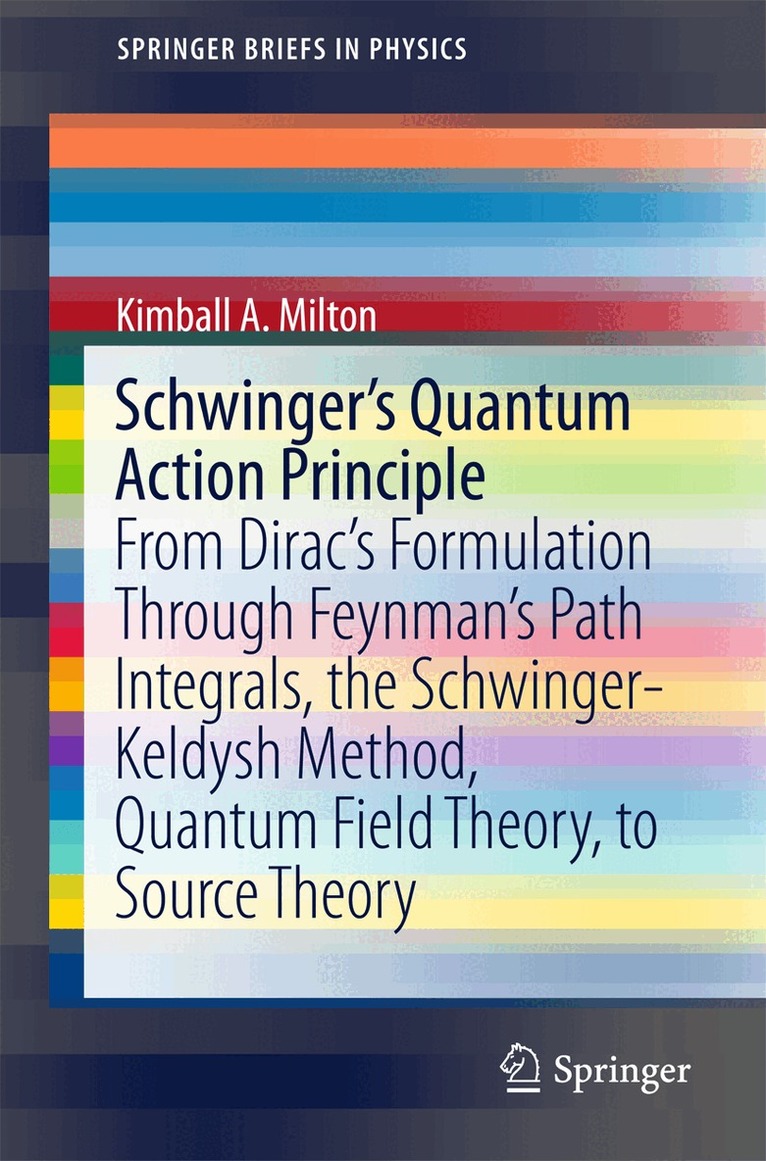
    Schwinger's Quantum Action Principle

    From Dirac’s Formulation Through Feynman’s Path Integrals, the Schwinger-Keldysh Method, Quantum Field Theory, to Source Theory

    AvKimball A. Milton

    Häftad, Engelska, 2015

    Del i serien SpringerBriefs in Physics

    761 kr

    Beställningsvara. Skickas inom 10-15 vardagar. Fri frakt över 249 kr.

    Fler format och utgåvor

    E-bok

    979 kr

    Beskrivning

    Starting from the earlier notions of stationary action principles, these tutorial notes shows how Schwinger’s Quantum Action Principle descended from Dirac’s formulation, which independently led Feynman to his path-integral formulation of quantum mechanics. Part I brings out in more detail the connection between the two formulations, and applications are discussed. Then, the Keldysh-Schwinger time-cycle method of extracting matrix elements is described. Part II will discuss the variational formulation of quantum electrodynamics and the development of source theory.

    Produktinformation

    • Utgivningsdatum:2015-06-25
    • Mått:155 x 235 x 8 mm
    • Vikt:201 g
    • Format:Häftad
    • Språk:Engelska
    • Serie:SpringerBriefs in Physics
    • Antal sidor:116
    • Upplaga:2015
    • Förlag:Springer International Publishing AG
    • ISBN:9783319201276

    Utforska kategorier

    • Fysik inom Naturvetenskap och teknik
    • Matematisk fysik inom Naturvetenskap och teknik
    • Kvantfysik inom Naturvetenskap och teknik

    Mer om författaren

    Professor Kimball Milton is the George Lynn Cross Research Professor of Physics at the University of Oklahoma. Kim Milton, a student of Julian Schwinger, studies in particular vacuum energy phenomena (the Casimir effect) in contexts ranging from cosmological through hadronic to condensed matter systems. He is the author, together with J Mehra of "Climbing the Mountain: The Scientific Biography of Julian Schwinger" Oxford University Press, 2000.

    Recensioner i media

    "The main goal of this short book is to examine quantum action principles and, in particular, the Schwinger action principle. ... For anyone who is interested in a good but brief introduction to the subject, this monograph should be considered." (Paul F. Bracken, Mathematical Reviews, April, 2016)

    Innehållsförteckning

    • Historical introduction.- Review of classical action principles.- Classical field theory - electrodynamics.- Quantum Action Principle.- Time-cycle or Schwinger-keldysh Formulation.- Relativistic Theory of Fields.- Nonrelativistic Source theory.- Concluding remarks.