• Fri frakt över 249 kr
  • •
  • Snabba leveranser
  • •
  • Billiga böcker
Kundservice

Du är på sajten för privatpersoner.

Företag, bibliotek eller offentlig verksamhet?

Du handlar på classic.bokus.com, där alla dina funktioner finns intakta.
Till classic.bokus.com
Bokus logotyp. Gå till startsidan.
  • Erbjudanden
  • Nyheter
  • Student
  • Topplistor
  • Barn & ungdom
  • Bokus Play
  • E-böcker
  • Pocketböcker
  • Spel & pussel

Må bättre, för mindre! Upp till 50% rabatt på hälsoböcker

Sidfot

Mina sidor

    Hjälp

    • Kundservice
    • Vanliga frågor och svar
    • Frakt och leverans
    • Retur vid ångerrätt
    • Reklamera vara
    • Betalning
    • Köpvillkor
    • Allmänna villkor
    • Information om webbplatsens tillgänglighet

    Om Bokus

    • Om oss
    • Pressrum
    • För studenter
    • För företag
    • För bibliotek och offentlig verksamhet
    • För leverantörer
    • Hållbarhet

    Populärt

    • Aktuella erbjudanden
    • Presentkort
    • Studentlitteratur
    • Nya böcker
    • Topplistor
    • Signerade böcker
    • Engelska böcker

    Inspiration

    • Boktips
    • BookTok
    • Populära bokserier
    • Barnbokskaraktärer
    • Populära författare
    Logotyp för Bokus
    Följ oss på Facebook (extern länk)Följ oss på Instagram (extern länk)Följ oss på YouTube (extern länk)Följ oss på TikTok (extern länk)
    bokus @ CookiesAnpassa cookiesIntegritetspolicyKöpvillkor
    Till Citymail hemsida (extern länk)Till Budbee hemsida (extern länk)Till Postnord hemsida (extern länk)Till Schenker hemsida (extern länk)Till Early Bird hemsida (extern länk)Till Walleys hemsida (extern länk)
    1. Historia och arkeologi
    2. Arkeologi

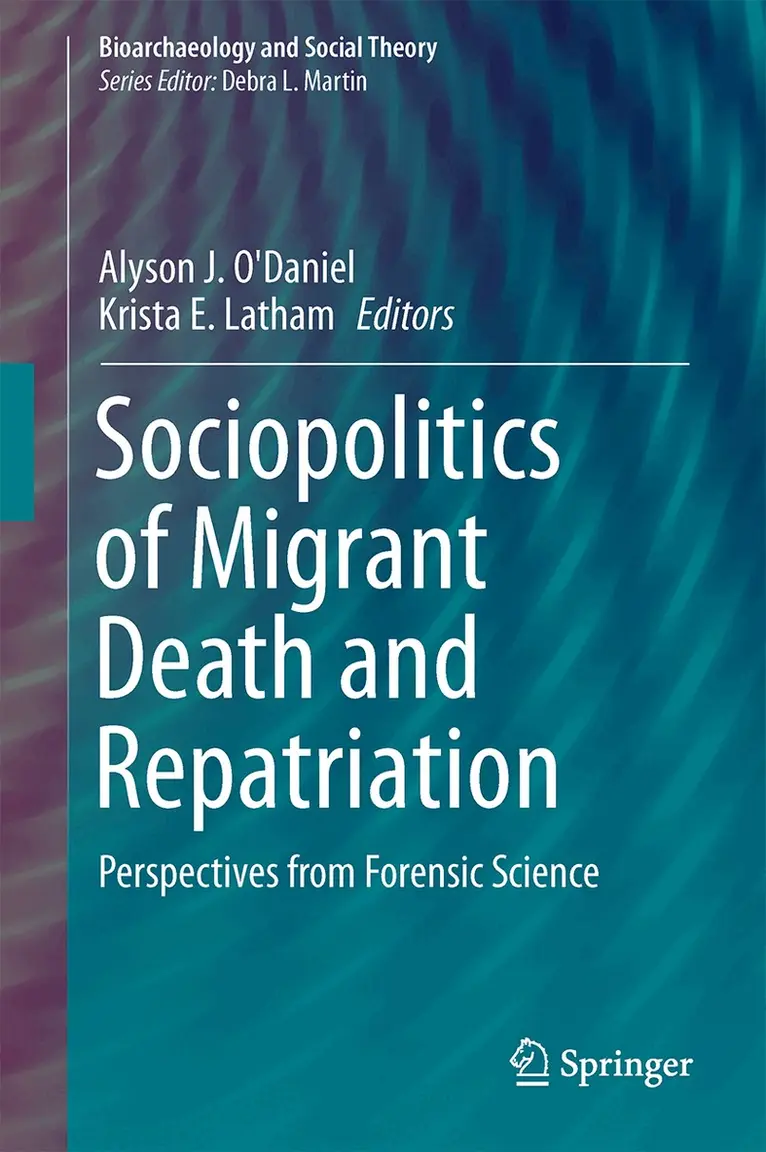
    Sociopolitics of Migrant Death and Repatriation

    Perspectives from Forensic Science

    AvKrista E. Latham,Alyson J. O'Daniel

    Inbunden, Engelska, 2017

    Del i serien Bioarchaeology and Social Theory

    1 341 kr

    Beställningsvara. Skickas inom 10-15 vardagar. Fri frakt över 249 kr.

    Beskrivning

    As scholars have by now long contended, global neoliberalism and the violence associated with state restructuring provide key frameworks for understanding flows of people across national boundaries and, eventually, into the treacherous terrains of the United States borderlands. The proposed volume builds on this tradition of situating migration and migrant death within broad, systems-level frameworks of analysis, but contends that there is another, perhaps somewhat less tidy, but no less important sociopolitical story to be told here. Through examination of how forensic scientists define, navigate, and enact their work at the frontiers of US policy and economics, this book joins a robust body of literature dedicated to bridging social theory with bioarchaeological applications to modern day problems. This volume is based on deeply and critically reflective analyses, submitted by individual scholars, wherein they navigate and position themselves as social actors embeddedwithin and, perhaps partially constituted by, relations of power, cultural ideologies, and the social structures characterizing this moment in history.Each contribution addresses a different variation on themes of power relations, production of knowledge, and reflexivity in practice. In sum, however, the chapters of this book trace relationships between institutions, entities, and individuals comprising the landscapes of migrant death and repatriation and considers their articulation with sociopolitical dynamics of the neoliberal state.

    Produktinformation

    • Utgivningsdatum:2017-10-11
    • Mått:155 x 235 x 17 mm
    • Vikt:471 g
    • Format:Inbunden
    • Språk:Engelska
    • Serie:Bioarchaeology and Social Theory
    • Antal sidor:177
    • Upplaga:17001
    • Förlag:Springer International Publishing AG
    • ISBN:9783319618654

    Utforska kategorier

    • Arkeologi inom Historia och arkeologi
    • Migration inom Samhälle och politik
    • Brottsutredning och kriminalteknik inom Samhälle och politik

    Mer om författaren

    Dr. Krista Erin Latham is an Associate Professor of Biology and Anthropology at the University of Indianapolis, where she has taught since 2007.  She is also the Director of the University of Indianapolis Human Identification Center.  She received her B.S. in Biology and Chemistry from the University of North Texas in 2000, her M.S. in Human Biology from the University of Indianapolis in 2003, and her M.A. and Ph.D. in Anthropology from Temple University in 2006 and 2008.  Dr. Latham is a Board Certified Forensic Anthropologist (D-ABFA) and a Fellow of the American Academy of Forensic Sciences. Her research investigates different aspects of human biological variation, skeletal biology, population genetics and skeletal DNA and she has produced numerous scientific publications.  She currently serves as a Consulting Forensic Anthropologist for police, coroners, and pathologists in the Midwestern U.S. and has delivered numerous lectures for state and local agencies around the country.  Dr. Latham also serves as a DNA Expert in the U.S. Federal Court System.Dr. Alyson O’Daniel is is an Assistant Professor of Medical and Cultural Anthropology at the University of Indianapolis in Indianapolis, Indiana. Her scholarship and teaching explore intersections of state power, policy, and practice, social and bodily vulnerability, and health care inequality in United States. She has worked for fourteen years on discerning racial, class, and gendered dimensions of HIV-related health inequalities, and the relationships between federal public health care policy and the structure and content of local initiatives for the health care and support of HIV-positive women. During this time, she has conducted extensive ethnographic research among HIV-positive women and their service providers in Denver, Colorado, “Midway,” North Carolina, and Indianapolis, Indiana. Her HIV/AIDS related work has been published in journalssuch as Medical Anthropology, Human Organization, and Transforming Anthropology. Her recent book-length ethnography, Holding On: African American Women Surviving HIV/AIDS, was published by University of Nebraska Press in 2016. More recently, Dr. O’Daniel’s research program has expanded to include examining response to the migrant death crisis in South Texas.  In partnership with the humanitarian forensic science team from the University of Indianapolis, the project explores volunteer forensic science as a crucial, yet politically-fraught part of the human migration story.

    Innehållsförteckning

    • Forward.- Preface.- Part I: Beyond Local Jurisdictions: Science in a Global Web of Relations.- Chapter 1: Introduction.- Chapter 2: All that Remains.- Chapter 3: Capitalism and Crisis in Central America.- Chapter 4: Naming State Crimes, Naming the Dead:  Immigration Policy and “the New Disappeared” in the United States and Mexico.- Chapter 5: Loss, Uncertainty and Action: Ethnographic Encounters with Families of the Missing in the Central America-Mexico-US Corridor.- Chapter 6: The Geography of Migrant Death: Implications for Policy and Forensic Science.- Chapter 7: “Follow the Power Lines Until You Hit a Road:” Contextualizing Humanitarian Forensic Science in South Texas.- Part II: Producing and Situating Forensic Science Knowledge.- Chapter 8: Digging, Dollars and Drama: The Economics of Forensic Archaeology and Migrant Exhumation.- Chapter 9: Expanding the Role of Forensic Anthropology in a Humanitarian Crisis: An Example from the United States-Mexico Border.- Chapter 10: Identifying Difference:  Forensic Methods and the Uneven Playing Field of Repatriation.- Chapter 11: Bodies in Limbo: Issues in Identification and Repatriation of Migrant Remains in South Texas.- Chapter 12: Dialog across States & Agencies: Juggling Ethical Concerns of Forensic Anthropologists north of the U.S.-Mexico Border.- Chapter 13: Charting Future Directions.