1 177 kr
Beställningsvara. Skickas inom 5-8 vardagar. Fri frakt över 249 kr.
Beskrivning
Produktinformation
- Utgivningsdatum:2007-02-23
- Mått:170 x 244 x 36 mm
- Vikt:1 066 g
- Format:Inbunden
- Språk:Engelska
- Antal sidor:550
- Upplaga:2
- Förlag:Wiley-VCH Verlag GmbH
- ISBN:9783527310692
Utforska kategorier
Mer om författaren
Carl H. Hamann:Following his studies in mathematics, physics, biology and economics in Hamburg and Bonn, graduating in 1966 as a physicist, Carl H. Hamann gained his doctorate in 1970, becoming Professor for Applied Physical Chemistry at the University of Oldenburg in 1975. He has since concentrated mainly on fuel cells, electrochemical metrology, passage and adsorption kinetics, turbulent flows, the thermodynamics of irreversible systems, preparative electroorganic chemistry and technical electrochemistry. Professor Hamann has thus far published some 80 articles in journals and books. Wolf Vielstich:As Heinz Gerischer's first student, in Gottingen in 1952/53, Wolf Vielstich was concerned with developing a fast Potentiostaten while determining exchange current densities. Upon starting work at the Institute for Physical Chemistry, Bonn University, in 1960 he demonstrated that, apart from mercury, reproducible cyclic voltamograms, such as for the oxidation of hydrogen and methanol, are contained in solid electrodes, including Pt, Ir, Rh, Au and Pd. There then followed experiments with methanol/air and NiMH cells, among others. He was always interested in developing novel methods, such as the rotating ring electrode, on-line MS (DEMS), in-situ FTIRS and UHV analysis of adsorbants. Between 1986 and 1993, Wolf Vielstich was the Coordinator of the first European project to develop a DMFC, and in 1998 he was awarded the Faraday Medal by the Royal Chemical Society. Since 1999 he has been working as a guest of the Universidade de Sao Paulo, and edited Wiley's Handbook of Fuel Cells (2003). Professor Hamnett graduated from the University of Oxford with a BA (Chemistry) in 1970 and a D.Phil. (Chemistry) in 1973. He has held research and academic positions at the University of British Columbia, Canada, and at Oxford and Newcastle Universities, England, before his appointment in January 2001 as Principal and Vice-chancellor of the University of Strathclyde. He has nearly 200 publications in books and scientific journals, covering areas of spectroscopy, quantum theory and electrochemistry. His primary academic interests in recent years include the development and utilisation of spectro-electrochemical techniques in electrochemistry, and the development of improved fuel cells and solar-energy conversion devices.
Recensioner i media
"The text is certainly comprehensive in its coverage, ranging from ionic mobilities and liquid junction potentials, through redox electrochemistry of proteins and surface spectroscopy of electrocatalytic reactions, to fuel cells, batteries and gas sensors." (Chromatographia, February 2010) "The renowned authorial team emphasize application in energy technology while covering the physicalchemical fundamentals, modern methods of investigation, electrochemical analysis and production methods, as well as fuel cells and micro-and nanotechnology." (Chimie Nouvelle, March 2010)"Both classical contents and modern developments of electrochemistry have been incorporated in this textbook to educate young modern electrochemists … .A very solid and useful textbook. I highly recommend it to students and researchers." (The Higher Education Academy Physical Sciences Centre, December 2008) "…an excellent introduction to the physical-chemical aspects of electrochemistry…and is strongly recommended." (CHOICE, December 2007)
Innehållsförteckning
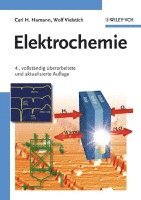
- Preface xiiiList of Symbols and Units xv1 Foundations, Definitions and Concepts 11.1 Ions, Electrolytes and the Quantisation of Electrical Charge 11.2 Transition from Electronic to Ionic Conductivity in an Electrochemical Cell 31.3 Electrolysis Cells and Galvanic Cells: The Decomposition Potential and the Concept of EMF 41.4 Faraday's Laws 71.5 Systems of Units 92 Electrical Conductivity and Interionic Interactions 132.1 Fundamentals 132.2 Empirical Laws of Electrolyte Conductivity 212.3 Ionic Mobility and Hittorf Transport 272.4 The Theory of Electrolyte Conductivity: The Debye-Hückel-Onsager Theory of Dilute Electrolytes 382.5 The Concept of Activity from the Electrochemical Viewpoint 462.6 The Properties of Weak Electrolytes 612.7 The Concept of pH and the Idea of Buffer Solutions 642.8 Non-aqueous Solutions 662.9 Simple Applications of Conductivity Measurements 713 Electrode Potentials and Double-Layer Structure at Phase Boundaries 773.1 Electrode Potentials and their Dependence on Concentration, Gas Pressure and Temperature 773.2 Liquid-junction Potentials 1053.3 Membrane Potentials 1123.4 The Electrolyte Double-Layer and Electrokinetic Effects 1153.5 Potential and Phase Boundary Behaviour at Semiconductor Electrodes 1333.6 Simple Applications of Potential Difference Measurements 1394 Electrical Potentials and Electrical Current 1574.1 Cell Voltage and Electrode Potential during Current Flow: an Overview 1574.2 The Electron-transfer Region of the Current-Potential Curve 1624.3 The Concentration Overpotential – The Effect of Transport of Material on the Current-Voltage Curve 1854.4 The Effect of Simultaneous Chemical Processes on the Current Voltage Curve 2034.5 Adsorption Processes 2074.6 Electrocrystallisation – Metal Deposition and Dissolution 2134.7 Mixed Electrodes and Corrosion 2254.8 Current Flows on Semiconductor Electrodes 2314.9 Bioelectrochemistry 2415 Methods for the Study of the Electrode/Electrolyte Interface 2515.1 The Measurement of Stationary Current-Potential Curves 2515.2 Quasi-Stationary Methods 2605.3 Electrochemical Methods for the Study of Electrode Films 2915.4 Spectroelectrochemical and other Non-classical Methods 2955.5 Preparation of Nanostructures, Combination of STM and UHV-Transfer 3265.6 Optical Methods 3286 Electrocatalysis and Reaction Mechanisms 3396.1 On Electrocatalysis 3396.2 The Hydrogen Electrode 3416.3 The Oxygen Electrode 3466.4 Methanol Oxidation 3486.5 Carbon Monoxide Oxidation at Platinum Surfaces 3586.6 Conversion of Chemical Energy of Ethanol into Electricity 3646.7 Reaction Mechanisms in Electro-organic Chemistry 3666.8 Oscillations in Electrochemical Systems 3757 Solid and Molten-salt Ionic Conductors as Electrolytes 3817.1 Ionically Conducting Solids 3817.2 Solid Polymer Electrolytes (SPE's) 3867.3 Ionically-conducting Melts 3928 Industrial Electrochemical Processes 3978.1 Introduction and Fundamentals 3978.2 The Electrochemical Preparation of Chlorine and NaOH 4048.3 The Electrochemical Extraction and Purification of Metals 4148.4 Special Preparation Methods for Inorganic Chemicals 4188.5 Electro-organic Synthesis 4228.6 Modern Cell Designs 4258.7 Future Possibilities for Electrocatalysis 4288.8 Component Separation Methods 4319 Galvanic Cells 4399.1 Basics 4409.2 Properties, Components and Characteristics of Batteries 4419.3 Secondary Systems 4509.4 Primary Systems other than Leclanché Batteries 4649.5 Fuel Cells 4689.6 Primary and Secondary Air Batteries 4839.7 Efficiency of Batteries and Fuel Cells 4869.8 Super-capacitors 48710 Analytical Applications 49110.1 Titration Processes using Electrochemical Indicators 49110.2 Electro-analytical Methods 49410.3 Electrochemical Sensors 505Subject Index 521
Du kanske också är intresserad av
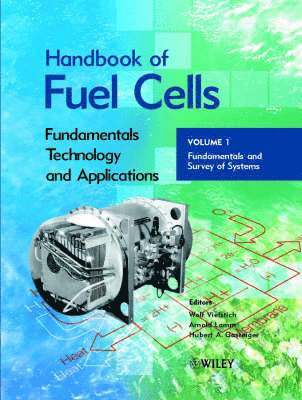
Handbook of Fuel Cells
Editor:Arnold Lamm (DaimlerChrysler ), Editor:Hubert R&D), Wolf Vielstich, Arnold Lamm, Hubert A. Gasteiger
28 927 kr
- Nyhet
Hjärnans akilleshälar : hur din hjärna lurar dig, och vad du kan göra åt det
Anders Hansen
289 kr
- -30%
- Signerad!
- -22%
- Nyhet
- -30%