• Fri frakt över 249 kr
  • •
  • Snabba leveranser
  • •
  • Billiga böcker
Kundservice

Du är på sajten för privatpersoner.

Företag, bibliotek eller offentlig verksamhet?

Du handlar på classic.bokus.com, där alla dina funktioner finns intakta.
Till classic.bokus.com
Bokus logotyp. Gå till startsidan.
  • Erbjudanden
  • Nyheter
  • Student
  • Topplistor
  • Barn & ungdom
  • Bokus Play
  • E-böcker
  • Pocketböcker
  • Spel & pussel

10% rabatt på allt med kod NYSTART10 →

Sidfot

Mina sidor

    Hjälp

    • Kundservice
    • Vanliga frågor och svar
    • Frakt och leverans
    • Retur vid ångerrätt
    • Reklamera vara
    • Betalning
    • Köpvillkor
    • Allmänna villkor
    • Information om webbplatsens tillgänglighet

    Om Bokus

    • Om oss
    • Pressrum
    • För studenter
    • För företag
    • För bibliotek och offentlig verksamhet
    • För leverantörer
    • Hållbarhet

    Populärt

    • Aktuella erbjudanden
    • Presentkort
    • Studentlitteratur
    • Nya böcker
    • Topplistor
    • Signerade böcker
    • Engelska böcker

    Inspiration

    • Boktips
    • BookTok
    • Populära bokserier
    • Barnbokskaraktärer
    • Populära författare
    Logotyp för Bokus
    Följ oss på Facebook (extern länk)Följ oss på Instagram (extern länk)Följ oss på YouTube (extern länk)Följ oss på TikTok (extern länk)
    bokus @ CookiesAnpassa cookiesIntegritetspolicyKöpvillkor
    Till Citymail hemsida (extern länk)Till Budbee hemsida (extern länk)Till Postnord hemsida (extern länk)Till Schenker hemsida (extern länk)Till Early Bird hemsida (extern länk)Till Walleys hemsida (extern länk)
    1. Naturvetenskap och teknik
    2. Teknik och industri
    3. Övrig teknik och tillämpad vetenskap

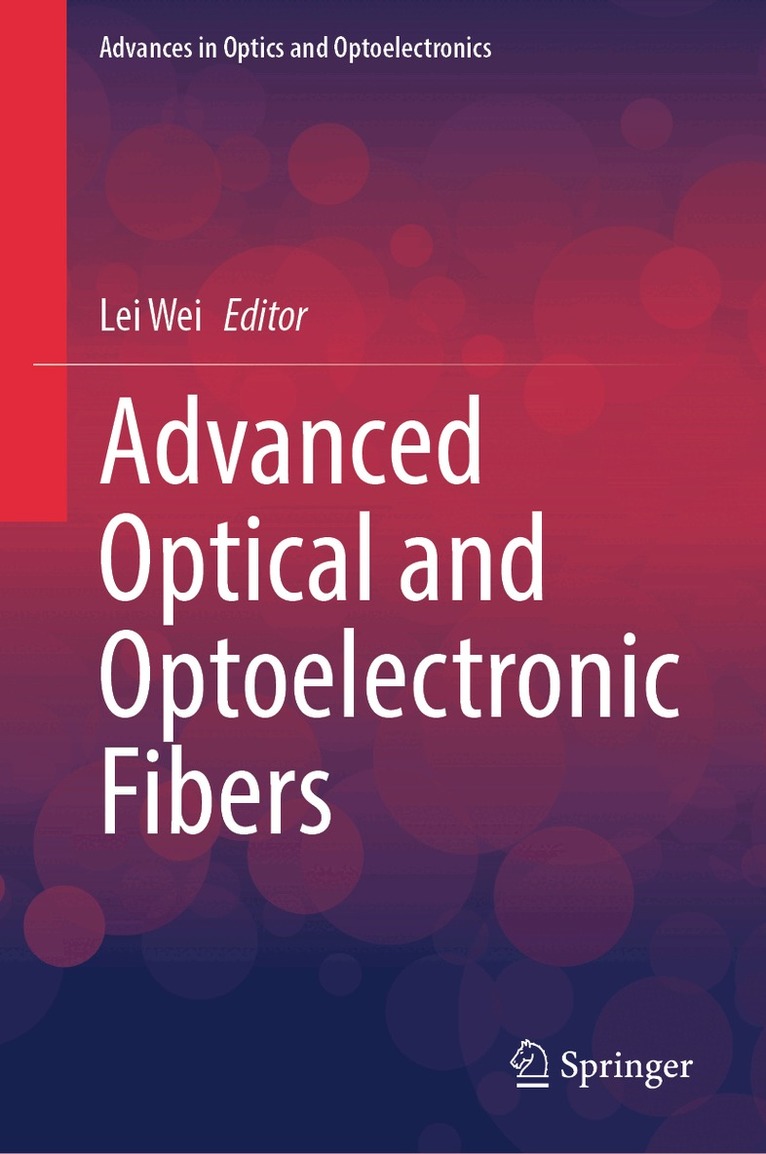
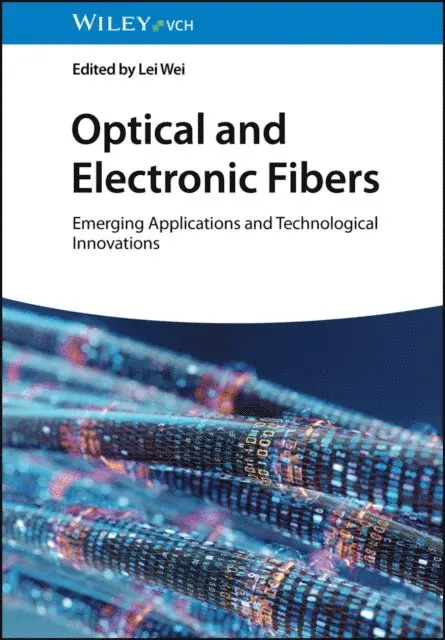
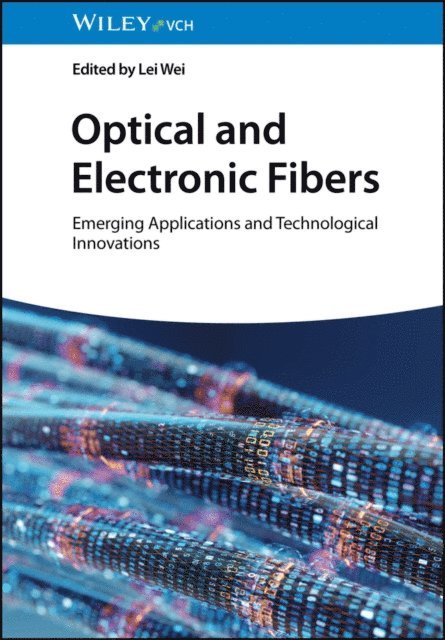
    Optical and Electronic Fibers

    Emerging Applications and Technological Innovations

    AvLei Wei,Lei Wei

    Inbunden, Engelska, 2024

    1 414 kr

    Skickas . Fri frakt över 249 kr.

    Beskrivning

    Understand the cutting edge of fiber technology with this comprehensive guide Because of their sensitivity and flexible capabilities, functional fibers have an enormous range of applications across many industries. In particular, advanced optical and electronic fibers have been integrated into numerous cutting-edge technologies, and their applications are growing year on year. There is an expanding need for scientists and professionals, particularly in the healthcare and sensor industries, to be familiar with the complex web of factors underlying functional fibers. Optical and Electronic Fibers builds this familiarity with an up-to-date, highly readable presentation. It introduces both the characteristics and applications of different functional fiber materials before moving to future opportunities for research and development. The result is an accessible overview of an emerging technology with boundless potential. Optical and Electronic Fibers readers will also find: More than 150 figures, many in full colorApplications in industries ranging from optical waveguides to neural interfacesDetailed treatment of fiber materials, including soft glasses, carbon materials, liquids, and semiconductorsOptical and Electronic Fibers is a useful reference for materials scientists, electrical engineers, and semiconductor and sensor professionals.

    Produktinformation

    • Utgivningsdatum:2024-12-04
    • Mått:170 x 244 x 15 mm
    • Vikt:680 g
    • Format:Inbunden
    • Språk:Engelska
    • Antal sidor:256
    • Förlag:Wiley-VCH Verlag GmbH
    • ISBN:9783527350919

    Utforska kategorier

    • Övrig teknik och tillämpad vetenskap inom Naturvetenskap och teknik

    Mer om författaren

    Lei Wei, PhD, is an Associate Professor in the School of Electrical and Electronic Engineering and the Director of the Centre for Optical Fibre Technology at Nanyang Technological University, Singapore. He is also the Chair of the Singapore sections of both the Optica (formerly OSA) and the IEEE Photonics Society, and has published very widely on fiber-based devices and related research subjects.

    Innehållsförteckning

    • Preface xi1 Optical Fiber with Two-dimensional Materials Integration for Photonic and Optoelectronic Applications 1Jin-hui Chen and Fei Xu1.1 Introduction 11.2 Fiber-integrated 2D Materials for Photonics and Optoelectronics 31.2.1 Basic Properties of 2D Materials 31.2.1.1 Graphene 31.2.1.2 Transition Metal Dichalcogenides 41.2.1.3 Black Phosphorus 61.2.1.4 Other 2D Materials and the Heterostructures 71.2.2 Optical Fiber-2D-material Integrations 71.2.3 Photonic and Optoelectronic Applications 91.2.3.1 Polarimetric Devices 91.2.3.2 Light Sources 101.2.3.3 Modulators 121.2.3.4 Photodetectors 141.2.3.5 Nonlinear Optics 171.2.3.6 Fiber-optic Sensors 201.3 Conclusion 24References 242 Postprocessing of Semiconductor Optical Fibers 29Hei C.L. Tsui and Noel Healy2.1 Introduction 292.2 Semiconductor Optical Fibers 292.2.1 Heat Treatments of Semiconductor Optical Fibers 292.2.1.1 Thermal Annealing 302.2.1.2 Rapid Thermal Annealing 312.2.2 Laser Processing of Semiconductor Optical Fibers 322.2.2.1 Electronic Absorption via the Core 322.2.2.2 Conductive Core Heating via Laser Absorption by the Cladding 332.2.3 Applications of Laser‐processed Optical Fibers 342.2.3.1 Electronic Bandgap Modulation 342.2.3.2 Compositional Microstructuring 352.2.3.3 Capillary Instabilities 352.2.4 Tapering of Semiconductor Optical Fibers 382.2.4.1 Applications of Tapered Optical Fiber 392.2.4.2 Dispersion Tailoring 412.2.4.3 Mode-matched Coupling 412.3 Conclusion 42References 423 Processed Optical Fiber-based Wearable Sensors for Healthcare 45Rajan Jha, Kalipada Chatterjee, and Ranjan Singh3.1 Introduction 453.2 Performance Features of Wearable Sensors 463.2.1 Sensitivity 473.2.2 Linearity and Range of Operation 503.2.3 Response Time and Dynamic Durability 513.2.4 Biocompatibility 523.2.5 Integrability 533.3 Processed Fiber-based Wearable Optical Sensors 543.3.1 Intensity Interrogation-based Sensing Mechanism 553.3.1.1 Micro-/Macro-bend Fiber-based Sensor Probe 553.3.1.2 Hetero-core Fiber-based Sensor Probe 563.3.1.3 Plastic Optical Fiber (POF)-based Sensor Probe 573.3.1.4 Silica Micro-/Nanofiber (MNF)-based Sensor Probe 603.3.2 Wavelength Interrogation-based Sensing Mechanism 613.3.2.1 Processed Fiber Interferometers 613.3.2.2 Fiber Bragg Grating (FBG) Structures 623.3.2.3 Polymer Optical Fiber Bragg Gratings (POFBGFs) 633.3.2.4 Micro/Nano Fiber Structures 653.4 Scope of Optical Wearable Sensors 653.4.1 2D Materials for Miniaturized Wearable Sensors 653.4.2 Computational Modalities for Analytical Augmentation 663.4.3 Additional Utilities of Processed Fiber Wearable Optical Sensors 673.5 Conclusions 68References 694 Electrochemical Plasmonic Fibers for Operando Monitoring of Renewable Energy 75Xiaobin Xue, Xile Han, Fu Liu, and Tuan Guo4.1 Introduction 754.2 Sensing Principle 784.2.1 TFBG-assisted Plasmonic Excitation by Thin Metal Film Coating 784.2.2 Electrochemical Surface Plasmon Resonance (EC-SPR) Sensing Method 804.3 Recent Progress of Operando Monitoring of Renewable Energy 814.3.1 Ultrafast and Repeatable Hydrogen Monitoring 814.3.2 In-situ Monitoring of State of Charge (SOC) of Battery 844.3.3 In-situ Monitoring of Ion Activities in Battery 854.3.4 In-situ Monitoring of State of Health (SOH) of Battery 884.4 Conclusion 90References 905 Fiber Optofluidic Microlasers Toward High-performance Biochemical Sensing 95Yiling Liu, Xi Yang, Yanqiong Wang, and Yuan Gong5.1 Introduction 955.2 Theory 965.2.1 Optical Microcavity and Its Sensing Principle 965.2.1.1 The Principle of Optical Microcavity 965.2.1.2 The Sensing Mechanism of Optical Microcavities 975.2.2 Optofluidic Laser and Its Sensing Principle 985.2.2.1 The Principle of Laser Emission 985.2.2.2 The Sensing Mechanism of the Optofluidic Laser 1005.3 Optical Fiber Microresonators for Optofluidic Lasing 1015.3.1 Fiber Microring Resonator 1015.3.1.1 Common Optical Fibers 1015.3.1.2 Hollow Optical Fibers 1025.3.1.3 Microstructured Optical Fiber 1035.3.1.4 Optical Microfiber Ring Resonator 1045.3.1.5 Other Resonant Microstructures 1055.3.2 Photonic Bandgap Fiber Microcavity 1055.3.3 Fiber Fabry–Pérot Cavity 1065.3.4 Random Scattering 1085.4 Biochemical Sensing Based on FOFLs 1105.4.1 Highly Sensitive Biochemical Sensors 1105.4.2 Disposable Biochemical Sensors 1115.4.3 Fast, High-throughput Biochemical Sensors 1135.4.4 Cell and Organism Analysis 1135.5 Conclusion 116References 1166 Two Micrometer Ultrafast Fiber Laser 119Tianshu Wang6.1 Introduction 1196.2 Mode-locked Fiber Laser 1226.2.1 Active Mode-locked Ultrafast Fiber Lasers 1226.2.2 Passively Mode-locked Ultrafast Fiber Lasers 1246.2.2.1 Nonlinear Polarization Rotation Effect 1246.2.2.2 Nonlinear Amplified Loop Mirror (NALM) 1286.2.2.3 2D Material Mode Locking 1306.2.2.4 Hybrid Mode-locked 1306.3 Two Micrometer Ultrafast Fiber Laser-related Technology 1326.3.1 Wavelength Conversion 1326.3.2 Pulse Shaping and Evolution 1346.4 Two Micrometer Ultrafast Fiber Laser Communication 1376.4.1 FSO Communication 1376.4.2 Somke Channel Communication 1396.5 Conclusion 141References 1417 Advanced Fibers for Optogenetic Modulation 143Minghui Du and Shifeng Zhou7.1 Introduction 1437.2 Basic Principle of the Optogenetic Technology 1447.3 Fabrication Techniques of Advanced Fibers 1457.3.1 Rod-in-tube Method 1467.3.2 Molten-core-in-tube Method 1477.3.3 Thin-film Rolling Method 1487.3.4 Extrusion Method 1497.3.5 Stack-and-draw Method 1507.3.6 3D Printing Approach 1507.3.7 Double-crucible Technique 1517.3.8 High-pressure Chemical Vapor Deposition Technique 1527.3.9 Pressure-assisted Melt Filling Technique 1537.3.10 Laser-heated Pedestal Growth Technique 1537.3.11 Integrated Dynamic Wet Spinning Technique 1557.4 Design Rules of Fiber-based Neural Probes 1557.4.1 Biocompatibility 1557.4.2 Mechanical Properties 1567.4.3 Optical Properties 1577.4.4 Electrical Properties 1577.5 Fiber-based Neural Probes for Optogenetics 1587.5.1 Glass Fiber-based Neural Probes 1587.5.2 Polymer Fiber-based Neural Probes 1627.5.2.1 Nonstretchable Fiber-based Probes 1627.5.2.2 Stretchable Fiber-based Probes 1657.6 Conclusion 1687.7 Acknowledgments 170References 1708 Novel Functional Fibers for Neural Interfacing 179Shan Jiang and Xiaoting Jia8.1 Introduction 1798.2 Genetic Manipulation-enabled Optical Approaches 1808.3 Conventional Silica Fiber 1818.3.1 Direct Optical Readout 1818.3.2 Integration with Electronics 1818.4 Thermally Drawn Multifunctional Fiber 1838.4.1 Design Considerations for Neural Interfacing Applications 1848.4.1.1 Material Selection 1848.4.1.2 Diverse Thermal Drawing Methods 1858.4.2 Application of As-drawn Fiber-based Probes 1868.4.3 Advanced Multifunctional Fibers with Post Processing 1878.4.4 Tissue Engineering 1908.5 Conclusions 191References 1939 Very-large-scale Integration for Fibers 197Alexander Gumennik, Jeffery Coulter, Louis A. van der Elst, Troy A. Leffel, Etgar C. Levi, Camila Faccini de Lima, Tyson Miller, and Mengxin Zheng9.1 Introduction 1979.2 VLSI-Fi: State-of-the-art and Current Challenges 2009.2.1 Architectural and Morphological Control of the Fiber Cross-section by a 3D Printing of the Preform and Its Thermal Draw 2009.2.2 Axial Fiber-structuring and Fiber-embedded Functional Systems Assembly by Material-selective Amplification of Spatially Coherent Capillary Instabilities 2059.2.3 Search for a Physically Intuitive Analytical Model Describing the AVG Breakup 2089.2.4 Engineering the Optoelectronic Properties, Crystallinity, Composition, and Internal Stress of the Breakup-assembled Devices by a Guided Solidification from Melt 2109.3 What’s Next? 2159.3.1 Conclusions and Future Directions 215References 21810 Inorganic Thermoelectric Fibers: Materials, Fabrication Methods, and Applications 225Jiwu Xin, Yongke Wang, Yubo Luo, Qinghui Jiang, and Junyou Yang10.1 Introduction 22510.2 Bi2(Te, Se)3-based Nanofibers 22610.3 PbTe-based Fibers 22910.4 Ag2Te-based Fibers 23010.5 SnSe-based Fibers 23110.6 NaCo2O4-based Fibers 23210.7 Conclusion 234References 235Index 237