• Fri frakt över 249 kr
  • •
  • Snabba leveranser
  • •
  • Billiga böcker
Kundservice

Du är på sajten för privatpersoner.

Företag, bibliotek eller offentlig verksamhet?

Du handlar på classic.bokus.com, där alla dina funktioner finns intakta.
Till classic.bokus.com
Bokus logotyp. Gå till startsidan.
  • Erbjudanden
  • Nyheter
  • Student
  • Topplistor
  • Barn & ungdom
  • Bokus Play
  • E-böcker
  • Pocketböcker
  • Spel & pussel

10% rabatt på allt med kod NYSTART10 →

Sidfot

Mina sidor

    Hjälp

    • Kundservice
    • Vanliga frågor och svar
    • Frakt och leverans
    • Retur vid ångerrätt
    • Reklamera vara
    • Betalning
    • Köpvillkor
    • Allmänna villkor
    • Information om webbplatsens tillgänglighet

    Om Bokus

    • Om oss
    • Pressrum
    • För studenter
    • För företag
    • För bibliotek och offentlig verksamhet
    • För leverantörer
    • Hållbarhet

    Populärt

    • Aktuella erbjudanden
    • Presentkort
    • Studentlitteratur
    • Nya böcker
    • Topplistor
    • Signerade böcker
    • Engelska böcker

    Inspiration

    • Boktips
    • BookTok
    • Populära bokserier
    • Barnbokskaraktärer
    • Populära författare
    Logotyp för Bokus
    Följ oss på Facebook (extern länk)Följ oss på Instagram (extern länk)Följ oss på YouTube (extern länk)Följ oss på TikTok (extern länk)
    bokus @ CookiesAnpassa cookiesIntegritetspolicyKöpvillkor
    Till Citymail hemsida (extern länk)Till Budbee hemsida (extern länk)Till Postnord hemsida (extern länk)Till Schenker hemsida (extern länk)Till Early Bird hemsida (extern länk)Till Walleys hemsida (extern länk)
    1. Naturvetenskap och teknik
    2. Matematik och naturvetenskap
    3. Fysik

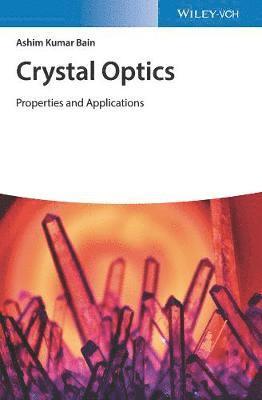
    Crystal Optics: Properties and Applications

    AvAshim Kumar Bain

    Inbunden, Engelska, 2019

    1 948 kr

    Beställningsvara. Skickas inom 5-8 vardagar. Fri frakt över 249 kr.

    Fler format och utgåvor

    E-bok

    2 225 kr

    E-bok

    2 225 kr

    Beskrivning

    Reviews the properties and applications of photo-elastic, acousto-optic, magneto-optic, electro-optic, and photorefractive materials This book deals with the basic physical properties and applications of photo-elastic, acousto-optic, magneto-optic, electro-optic, and photorefractive materials. It also provides up-to-date information on the design and applications of various optoelectronic devices based on these materials. The first chapter of Crystal Optics: Properties and Applications covers the basic concepts of crystal optics, such as index ellipsoid or optical indicatrix, crystal symmetry, wave surface, birefringence, and the polarization of light. Chapter 2 reviews the physical phenomena of crystal optics in isotropic and crystalline materials. It describes in detail research information on modern photoelastic materials and reviews the up-to-date photoelastic device applications. Chapter 3 develops the underlying theory of acousto-optics from first principles, formulating results suitable for subsequent calculations and design. The fourth chapter describes the basic principles of magneto-optic effects and mode of interaction with magnetic materials. The fifth chapter provides an understanding of the physical phenomenon of the linear and quadratic electro-optic effects in isotropic and crystalline materials. The last chapter collects many of the most important recent developments in photorefractive effects and materials, and pays special attention to recent scientific findings and advances on photorefractive materials and devices. -Features up to date information on the design and applications of various optoelectronic devices -Looks at the basic concepts of crystal optics, including the polarization of light, effects of reflection and transmission of polarization and light polarizing devices, and more -Pays special attention to design procedures for the entire range of acousto-optic devices and various applications of these devices -Provides research information on modern magneto-optic materials and reviews the up-to-date magneto-optic device applications?up to terahertz (THz) regime Crystal Optics: Properties and Applications is an excellent book for the scientific community working in the field, including researchers, lecturers, and advanced students.

    Produktinformation

    • Utgivningsdatum:2019-06-12
    • Mått:173 x 249 x 28 mm
    • Vikt:1 089 g
    • Format:Inbunden
    • Språk:Engelska
    • Antal sidor:496
    • Förlag:Wiley-VCH Verlag GmbH
    • ISBN:9783527413850

    Utforska kategorier

    • Fysik inom Naturvetenskap och teknik
    • Kemi inom Naturvetenskap och teknik

    Mer om författaren

    Dr. Ashim Kumar Bain, received his M.Sc. (Physics) degree in 1989 from Rajshahi University, Bangladesh, and his Ph.D. (Materials Science) degree from Dniepropetrovsk State University, Ukraine, in 1994. He was a postdoctoral research fellow (1995-1998) at the Indian Institute of Technology Kanpur, India. Presently he has been working as a freelance Physicist in Birmingham, UK. He has published 15 articles, two book chapters and one book.

    Innehållsförteckning

    • Preface xiOverview xiii1 Crystal Optics 11.1 Introduction 11.2 Index Ellipsoid or Optical Indicatrix 11.3 Effect of Crystal Symmetry 31.4 Wave Surface 41.4.1 Uniaxial Crystal 41.4.2 Biaxial Crystal 51.5 Birefringence 61.6 Polarization of Light 81.6.1 Linear Polarization – Equal Amplitudes 101.6.2 Linear Polarization – Unequal Amplitudes 101.6.3 Circular Polarization 111.6.4 Elliptical Polarization 121.7 Changing the Polarization of Light 131.7.1 Polarizer and Polarizing Beam Splitters 131.7.2 Birefringent Wave Plate 141.8 Effects of Reflection and Transmission on Polarization 161.8.1 Interface Between Two Media 161.8.2 Multilayer Thin-Film Filters 171.9 Light Polarizing Devices 201.9.1 Polarizing Plate 201.9.2 Polarizing Prism 201.9.3 Phase Plate 211.9.4 Optical Isolator 221.9.5 Optical Attenuators 221.9.6 Polarization Rotator 23References 252 Photoelasticity 272.1 Introduction 272.2 Principle of Photoelasticity 272.3 History of Photoelasticity 282.4 Phenomenological Theory of Photoelasticity 302.5 Atomic Theory of Photoelasticity 332.6 Photoelastic Devices 352.6.1 Photoelastic Modulator 362.6.2 Photoelastic Q-Switch 382.6.3 Photoelastic Accelerometer 412.6.4 Photoelastic Force Sensor 452.7 Photoelastic Materials and Applications 502.7.1 LiNbO3 and LiTaO3 Crystals 512.7.2 Li2Ge7O15 Crystals 53References 553 Acousto-Optics 593.1 Introduction 593.2 Short History of Acousto-optics 593.3 Principle of Acousto-optic Effect 613.4 Acousto-optic Devices 633.4.1 Acousto-optic Modulator 633.4.1.1 Acousto-optic Modulator Construction 643.4.1.2 Digital Modulation 653.4.1.3 Analog Modulation 663.4.1.4 Dynamic Contrast Ratio 673.4.1.5 Applications of Acousto-optic Modulators 683.4.2 Acousto-optic Beam Deflector 693.4.2.1 Definition of Optical Deflector Resolution 703.4.2.2 Modulation Transfer Function 713.4.2.3 Scan Flyback Time 723.4.2.4 Cylinder Lensing Effect 723.4.2.5 Applications of AOBD 723.4.3 Acousto-optic Frequency Shifter 733.4.3.1 Principles of Operation 733.4.3.2 Laser Doppler Vibrometer (LDV) 753.4.4 Acousto-optical Q-Switch 763.4.4.1 Applications of Acousto-optical Q-Switches 773.4.5 Acousto-optic Tunable Filter 833.4.5.1 Principles of AOTF Operation 833.4.5.2 Infrared Multispectral Imaging 863.4.5.3 Analytical Applications of AOTF 883.4.5.4 Satellite- and Space-Based Applications of AOTF 1123.5 Acousto-optic Materials andTheir Applications 1243.5.1 Lead Molybdate (PbMoO4) 1253.5.2 Tellurium Dioxide (TeO2) 1253.5.3 Lithium Niobate (LiNbO3) 131References 1344 Magneto-optics 1434.1 Introduction 1434.1.1 Gyrotropic Permittivity 1434.1.2 Kerr Rotation and Kerr Ellipticity 1444.2 Mode of Interaction 1454.2.1 Transmission Mode 1454.2.2 Reflection Mode 1484.2.3 The Absorption Mode 1494.3 Magneto-optic Materials Classification 1494.3.1 Ferromagnetic Metals and Alloys 1514.3.1.1 Ferromagnetic Semiconductor 1524.3.1.2 Magnetic Fluid 1534.3.2 Ferrimagnetic Compounds 1564.3.3 Antiferromagnetic Compounds 1594.4 Magneto-optic Devices 1614.4.1 Magneto-optic Modulator 1614.4.1.1 Magneto-optic Spatial Light Modulator 1614.4.1.2 Mach–Zehnder Magneto-optic Modulator 1664.4.1.3 Magnetic Fluid-Based Magneto-optic Modulator 1704.4.1.4 Terahertz Magneto-optic Modulator 1744.4.2 Magneto-optical Circulator 1774.4.2.1 T-shaped Magneto-optical Circulator 1774.4.2.2 Multiple-Port Integrated Optical Circulators 1864.4.2.3 Terahertz Magneto-optical Circulator 1894.4.3 Magneto-optical Isolator 1904.4.3.1 Quasi-Phase-Matching Faraday Rotation Isolator 1924.4.3.2 Nonreciprocal Phase-Shift Isolator 1934.4.3.3 TM-Mode Waveguide Isolator 1934.4.3.4 Silicon-Based MO Isolator and Circulator 1974.4.3.5 THz Isolators Based on Plasmonics 2014.4.3.6 THz Isolators Based on Metasurfaces 2044.4.4 Magneto-optical Sensor 2054.4.4.1 All-Fiber Sensors 2074.4.4.2 Bulk-optic Sensors 2094.4.4.3 Magnetic Force Sensors 2114.4.5 Magneto-optical Recording 2194.4.5.1 Principles of MO Recording 2204.4.5.2 MO Recording Process 2224.4.5.3 Magneto-optical Readout 2254.4.5.4 MO Recording Materials 2264.4.5.5 High-Density MO Recording 2394.4.5.6 Ultrahigh-Density MO Recording 245References 2475 Electro-optics 2655.1 Introduction 2655.2 History of Electro-optic Effects 2655.3 Principles of Electro-optic Effects 2705.4 Phenomenological Theory of Electro-optic Effect 2715.4.1 Linear Electro-optic Effect 2725.4.2 Quadratic Electro-optic Effect 2745.5 Electro-optic Devices 2755.5.1 Phase Modulator 2755.5.2 Dynamic Wave Retarder 2775.5.3 Intensity Modulators (Type 1) 2785.5.4 Intensity Modulator (Type 2) 2795.5.5 Scanners 2805.5.6 Directional Couplers 2825.5.7 Spatial Light Modulators (Electrically Addressed) 2855.5.8 Spatial Light Modulators (Optically Addressed) 2855.5.9 Pockels Readout Optical Modulator 2875.6 Electro-optic Materials and Applications 2885.6.1 Barium Titanate (BaTiO3) 2885.6.1.1 Waveguide Electro-optic Modulator 2895.6.1.2 Plasmonic Interferometer 2925.6.2 Lead Lanthanum Zirconate Titanate (PLZT) 2935.6.2.1 Electro-optic Tunable Etalon 2945.6.2.2 Nanosecond Speed PLZT Optical Switch 2945.6.3 Lithium Tantalate (LiTaO3) 2955.6.3.1 Second Harmonic Generator, EO Lens, and EO Scanner 2955.6.4 Lithium Niobate (LiNbO3) 2985.6.4.1 Application of LiNbO3 2995.6.5 Barium Strontium Titanate (BST) 3275.6.6 Lead Magnesium Niobate–Lead Titanate (PMN–PT) 3285.6.6.1 Electro-optic Tunable Filter 3295.6.6.2 Electro-optic Q-Switches 3305.6.6.3 Variable Optical Attenuator 3325.6.6.4 Polarization Controller (PC) 3345.6.6.5 Variable Gain Tilt Filters (VGTF) and Dynamic Gain Flattening Filters (DGFF) 3355.6.7 Potassium Niobate (KNbO3) 3385.6.8 Potassium Tantalate Niobate (KTN) 3395.6.8.1 Electro-optic Phase Modulator 3405.6.8.2 KTN Fast Varifocal Lenses 3465.6.8.3 Electro-optic Deflectors 3475.6.8.4 KTN Optical Beam Scanner 3505.7 Electro-optic Plasmonic Materials and Applications 3545.7.1 Transparent Conducting Oxides 3605.7.2 Ultracompact Plasmonic Modulators 3625.7.3 Silicon Waveguide-Based Modulators 3645.7.4 CMOS Compatibility 3675.7.5 Perspectives of EO-Plasmonic Materials 368References 3726 Photorefractive Effect 4096.1 Introduction 4096.2 Photorefractive Effect 4096.2.1 Conventional Model of Photorefractive Effect 4126.2.1.1 Photorefractive Index Gratings 4136.2.1.2 Space Charge Field for Sinusoidal Illumination 4156.2.2 Inter-band Photorefractive Effect 4176.3 Applications of Photorefractive Effect 4186.3.1 Holographic Storage 4196.3.2 Two Waves Mixing 4206.3.3 Light-Induced Waveguides 4216.4 Photorefractive Materials and Devices 4226.4.1 Electro-optic Photorefractive Crystals 4246.4.1.1 Photorefractive Waveguides 4256.4.1.2 Photorefractive Tunable Filters 4326.4.1.3 Photorefractive Switches 4396.4.1.4 Holographic Interferometers 4446.4.2 Photorefractive Polymers 4516.4.2.1 Holographic Display 4526.4.2.2 Holographic Autocorrelator 4536.4.2.3 Laser Ultrasonic Receiver 4546.4.2.4 Ultrasound-Modulated Optical Tomography 4546.4.2.5 Holographic Optical Coherence Imaging 4556.4.2.6 Surface Waveguide 4576.4.3 Holographic Polymer Dispersed Liquid Crystal (H-PDLC) 4576.4.3.1 Wavelength Switch 4586.4.3.2 Electrically Switchable Cylindrical Fresnel Lens 4606.4.4 Photosensitive Glass 4676.4.4.1 VBG Discrete Filter Elements 4726.4.4.2 Universal WDM Combiners/Splitters 4736.4.4.3 Integrated Combiner Modules 4736.4.4.4 Other VBG-Based Devices and Subsystems 473References 475Index 487