• Fri frakt över 249 kr
  • •
  • Snabba leveranser
  • •
  • Billiga böcker
Kundservice

Du är på sajten för privatpersoner.

Företag, bibliotek eller offentlig verksamhet?

Du handlar på classic.bokus.com, där alla dina funktioner finns intakta.
Till classic.bokus.com
Bokus logotyp. Gå till startsidan.
  • Erbjudanden
  • Nyheter
  • Student
  • Topplistor
  • Barn & ungdom
  • Bokus Play
  • E-böcker
  • Pocketböcker
  • Spel & pussel

10% rabatt på allt med kod: NYSTART10 →

Sidfot

Mina sidor

    Hjälp

    • Kundservice
    • Vanliga frågor och svar
    • Frakt och leverans
    • Retur vid ångerrätt
    • Reklamera vara
    • Betalning
    • Köpvillkor
    • Allmänna villkor
    • Information om webbplatsens tillgänglighet

    Om Bokus

    • Om oss
    • Pressrum
    • För studenter
    • För företag
    • För bibliotek och offentlig verksamhet
    • För leverantörer
    • Hållbarhet

    Populärt

    • Aktuella erbjudanden
    • Presentkort
    • Studentlitteratur
    • Nya böcker
    • Topplistor
    • Signerade böcker
    • Engelska böcker

    Inspiration

    • Boktips
    • BookTok
    • Populära bokserier
    • Barnbokskaraktärer
    • Populära författare
    Logotyp för Bokus
    Följ oss på Facebook (extern länk)Följ oss på Instagram (extern länk)Följ oss på YouTube (extern länk)Följ oss på TikTok (extern länk)
    bokus @ CookiesAnpassa cookiesIntegritetspolicyKöpvillkor
    Till Citymail hemsida (extern länk)Till Budbee hemsida (extern länk)Till Postnord hemsida (extern länk)Till Schenker hemsida (extern länk)Till Early Bird hemsida (extern länk)Till Walleys hemsida (extern länk)
    1. Ekonomi och Ledarskap
    2. Ledarskapsböcker
    3. Projektledning

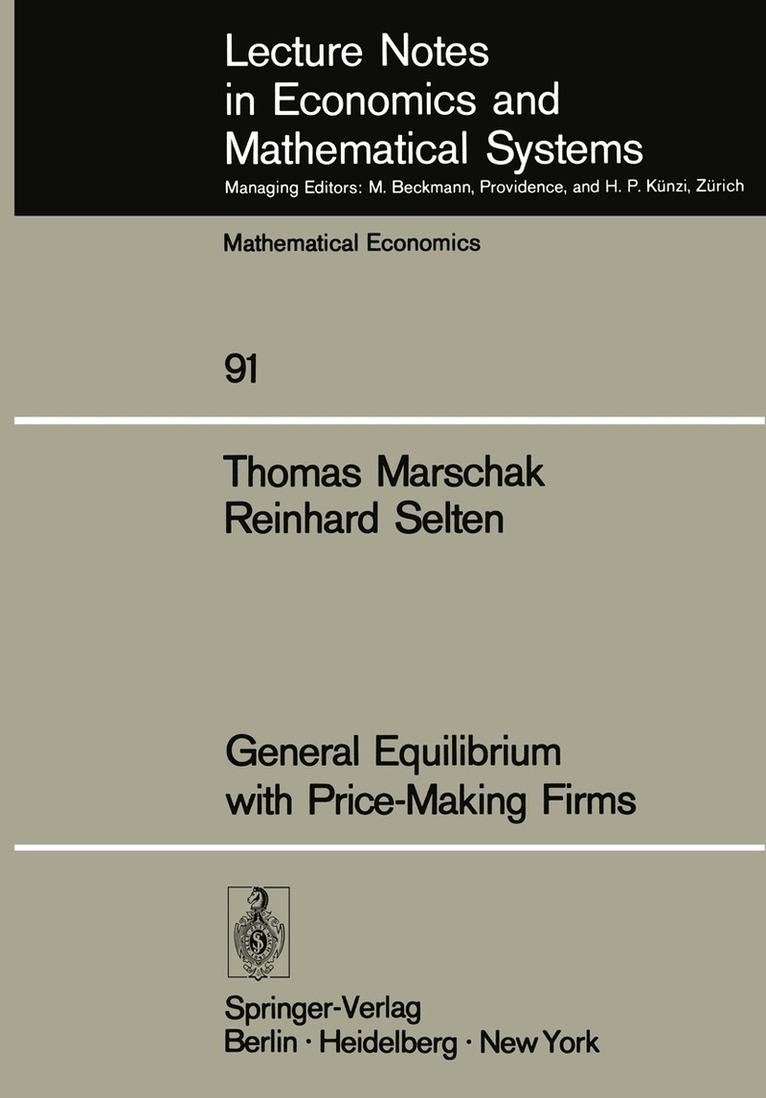
    General Equilibrium with Price-Making Firms

    AvT. Marschak,R. Selten

    Häftad, Engelska, 1974

    Del 91 i serien Lecture Notes in Economics and Mathematical Systems

    563 kr

    Beställningsvara. Skickas inom 10-15 vardagar. Fri frakt över 249 kr.

    Beskrivning

    Motivation. That elegant fiction the competitive equilibrium seems still to dominate the frontiers of theoretical microeconomics. We may think of it in a general way as a state of affairs wherein economic agents, responding "rationally" to annoWlced prices, make choices which are consistent and feasible. The prices may also be described as "taken": for one reason or another the agents who respond to them consider them as given. The existence of such a state, its optimality, its robustness against free bargaining among agents when there are many of them, its Wliqueness, its stability when price displacements evoke specified adjustments--all these issues have been studied, and continue to be studied in a variety of settings. Slowly the equilibrium investigated begins to incorporate public goods, externalities of certain kinds, differences in agents' information, and infinitely many time periods. The appeal of such results need not be belabored: the equilibrium studied may sustain an optimal resource allocation, and when it does it sus­ tains it in a manner that appears to be informationally efficient and to accord well with individual incentives. Therefore it is important to extend the circumstances under which an equilibrium exists, under which it sustains opti­ mality, and under which it survives displacements as well as free bargaining among agents.

    Produktinformation

    • Utgivningsdatum:1974-02-15
    • Mått:170 x 244 x 15 mm
    • Vikt:455 g
    • Format:Häftad
    • Språk:Engelska
    • Serie:Lecture Notes in Economics and Mathematical Systems
    • Antal sidor:247
    • Förlag:Springer-Verlag Berlin and Heidelberg GmbH & Co. KG
    • ISBN:9783540066248

    Utforska kategorier

    • Projektledning inom Ekonomi och Ledarskap

    Innehållsförteckning

    • I. Introduction.- Motivation.- Literature.- The present study.- Notational conventions.- II. General Equilibrium with a Monopolistic Sector: Equilibria of Traditional Type.- 1. “True” General Equilibria of Traditional Type.- 2. General Equilibria of Traditional Type When Monopolists Do Not Sell to Each Other.- 3. Monopolists Selling to Each Other.- 4. Concluding Remarks.- List of Assumptions.- III. A New Approach to Monopolistic and Other Noncooperative Equilibria: The Theory of “Convolutions” (Rationality-Preserving Response Functions).- 1. Basic Concepts.- 2. Examples.- 3. A Necessary Condition for Existence of a Convolution.- 4. “Weak” Convolutions and the Sufficiency of the Necessary Conditions.- 5. Other Variants.- 6. Concluding Remarks.- IV. Oligopolistic Economies as Games of Limited Information: Description of Equilibria.- 1. Introduction.- 2. A Small Oligopolistic Economy with Set-Up Costs and Nondecreasing Returns.- 3. A Large Oligopolistic Economy with Each Firm Visualizing a Small Economy: A Concrete Version and an Abstract Generalization.- V. Oligopolistic Economies as Games of Limited Information: Existence of Equilibria.- 1. An Essential Existence Proposition.- 2. Notation and a Mapping Argument for the Basic Existence Proposition.- 3. The Quantities of Goods Required to Produce a Given Final-Good Vector: Existence and Continuity of the Functions g, ?, $${\overline f _W}$$.- 4. Zero-Profit Prices for Intermediate Goods: Existence and Continuity of the Function µ.- 5. The Intersection Point of a ?-Curve and the Offer Surface: Existence and Continuity of the Function $$\ell $$.- 6. Summary: the Basic Existence Theorem.- 7. Implications of the Basic Existence Theorem for the Existence of Oligopolistic General Equilibria.- 8. OtherEquilibria.- 9. A Numerical Example of Oligopolistic General Equilibrium.- VI. Conclusion.- References.