• Fri frakt över 249 kr
  • •
  • Snabba leveranser
  • •
  • Billiga böcker
Kundservice

Du är på sajten för privatpersoner.

Företag, bibliotek eller offentlig verksamhet?

Du handlar på classic.bokus.com, där alla dina funktioner finns intakta.
Till classic.bokus.com
Bokus logotyp. Gå till startsidan.
  • Erbjudanden
  • Nyheter
  • Student
  • Topplistor
  • Barn & ungdom
  • Bokus Play
  • E-böcker
  • Pocketböcker
  • Spel & pussel

10% rabatt på allt med kod NYSTART10 →

Sidfot

Mina sidor

    Hjälp

    • Kundservice
    • Vanliga frågor och svar
    • Frakt och leverans
    • Retur vid ångerrätt
    • Reklamera vara
    • Betalning
    • Köpvillkor
    • Allmänna villkor
    • Information om webbplatsens tillgänglighet

    Om Bokus

    • Om oss
    • Pressrum
    • För studenter
    • För företag
    • För bibliotek och offentlig verksamhet
    • För leverantörer
    • Hållbarhet

    Populärt

    • Aktuella erbjudanden
    • Presentkort
    • Studentlitteratur
    • Nya böcker
    • Topplistor
    • Signerade böcker
    • Engelska böcker

    Inspiration

    • Boktips
    • BookTok
    • Populära bokserier
    • Barnbokskaraktärer
    • Populära författare
    Logotyp för Bokus
    Följ oss på Facebook (extern länk)Följ oss på Instagram (extern länk)Följ oss på YouTube (extern länk)Följ oss på TikTok (extern länk)
    bokus @ CookiesAnpassa cookiesIntegritetspolicyKöpvillkor
    Till Citymail hemsida (extern länk)Till Budbee hemsida (extern länk)Till Postnord hemsida (extern länk)Till Schenker hemsida (extern länk)Till Early Bird hemsida (extern länk)Till Walleys hemsida (extern länk)
    1. Naturvetenskap och teknik
    2. Matematik och naturvetenskap
    3. Kemi
    4. Fysikalisk kemi

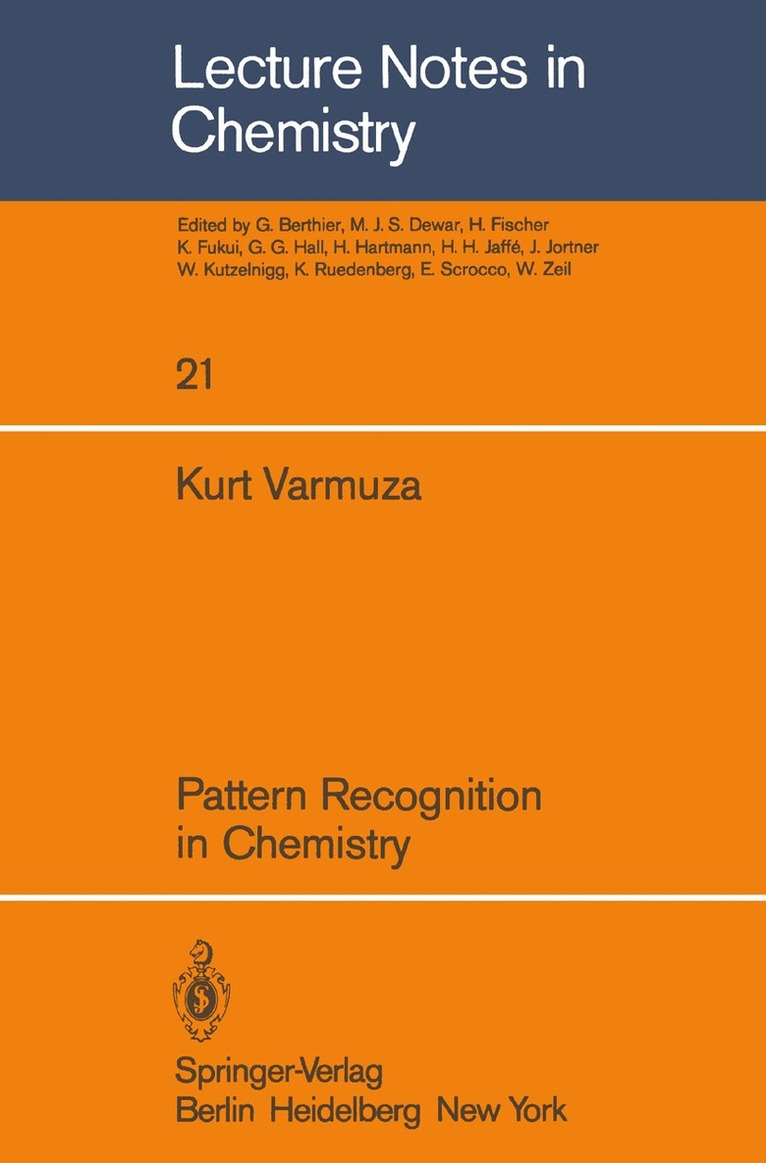
    Pattern Recognition in Chemistry

    AvKurt Varmuza

    Häftad, Engelska, 1980

    Del 21 i serien Lecture Notes in Chemistry

    546 kr

    Beställningsvara. Skickas inom 10-15 vardagar. Fri frakt över 249 kr.

    Fler format och utgåvor

    E-bok

    710 kr

    Beskrivning

    Analytical chemistry of the recent years is strongly influenced by automation. Data acquisition from analytica~ instruments - and some­ times also controlling of instruments - by a computer are principally solved since many years. Availability of microcomputers made these tasks also feasible from the economic point of view. Besides these basic applications of computers in chemical measurements scientists developed computer programs for solving more sophisticated problems for which some kind of "intelligence" is usually supposed to be necessary. Harm­ less numerical experiments on this topic led to passionate discussions about the theme "which jobs cannot be done by a computer but only by human brain ?~. If this question is useful at all it should not be ans­ wered a priori. Application of computers in chemistry is a matter of utility, sometimes it is a social problem, but it is never a question of piety for the human brain. Automated instruments and the necessity to work on complex pro­ blems enhanced the development of automatic methods for the reduction and interpretation of large data sets. Numerous methods from mathematics, statistics, information theory, and computer science have been exten­ sively investigated for the elucidation of chemical information; a new discipline "chemometrics" has been established. Three different approaches have been used for computer-assisted interpretations of chemical data. 1. Heuristic methods try to formu­ late computer programs working in a similar way as a chemist would solve the problem. 2.

    Produktinformation

    • Utgivningsdatum:1980-11-01
    • Mått:155 x 235 x 13 mm
    • Vikt:365 g
    • Format:Häftad
    • Språk:Engelska
    • Serie:Lecture Notes in Chemistry
    • Antal sidor:222
    • Förlag:Springer-Verlag Berlin and Heidelberg GmbH & Co. KG
    • ISBN:9783540102731

    Utforska kategorier

    • Fysikalisk kemi inom Naturvetenskap och teknik

    Innehållsförteckning

    • A: Introduction to Some Pattern Recognition Methods.- 1. Basic Concepts.- 2. Computation of Binary Classifiers.- 3. K — Nearest Neighbour Classification (KNN-Method).- 4. Classification by Adaptive Networks.- 5. Parametric Classification Methods.- 6. Modelling of Clusters.- 7. Clustering Methods.- 8. Display Methods.- 9. Preprocessing.- 10. Feature Selection.- 11. Evaluation of Classifiers.- B: Application of Pattern Recognition Methods in Chemistry.- 12. General Aspects of Pattern Recognition in Chemistry.- 13. Spectral Analysis.- 14. Chromatography.- 15. Electrochemistry.- 16. Classification of Materials and Chemical Compounds.- 17. Relationships between Chemical Structure and Biological Activity.- 18. Clinical Chemistry.- 19. Environmental Chemistry.- 20. Classification of Analytical Methods.- C: Append.- 21. Literature.- 21.4. List of Authors.- 22. Subject Index.