
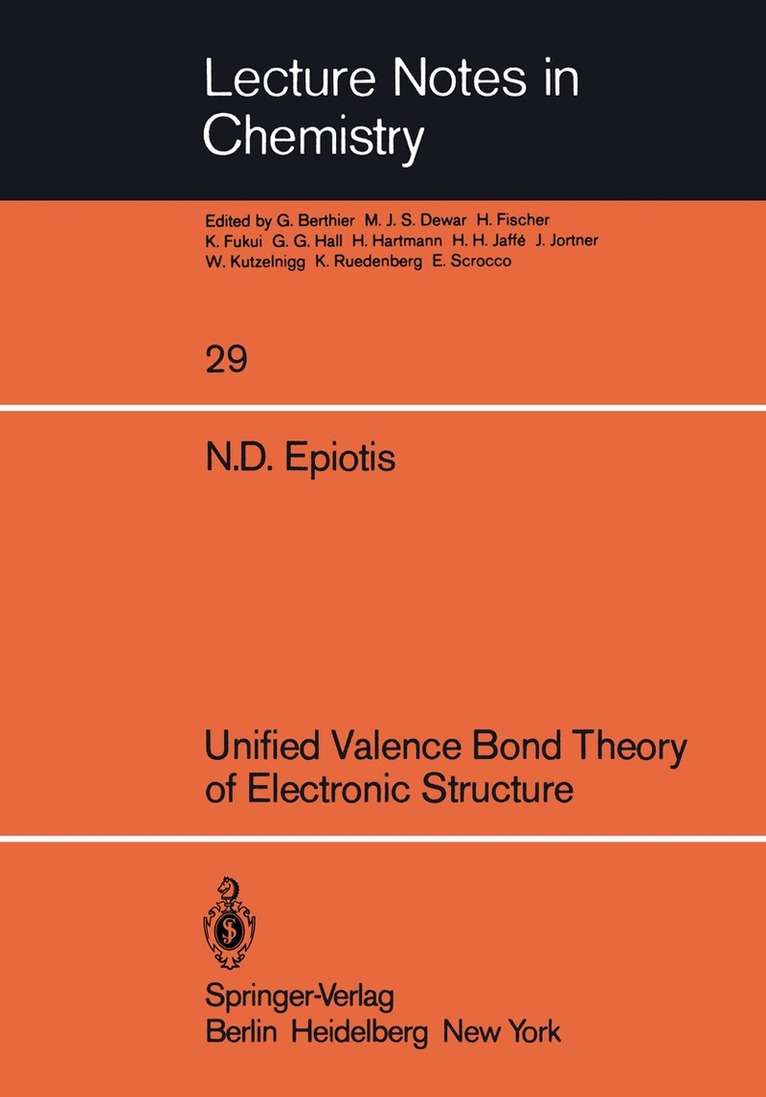
Unified Valence Bond Theory of Electronic Structure
Applications
556 kr
Beställningsvara. Skickas inom 10-15 vardagar. Fri frakt över 249 kr.
Fler format och utgåvor
Beskrivning
The bond diagrammatic representation of molecules is the foundation of MOVB theory. To a certain extent, this kind of representation is analogous to the one on which "resonance theory" is based and this fact can be projected by a comparison of the various ways in which MOVB theory depicts a species made up of three core and two ligand MO's which define two subsystems containing a total of six electrons and the ways in which "resonance theory" (i. e. , qualitative VB theory) depicts a six-electron-six-AO species such as the pi system of CH =CH-CH=CH-CH=O. The 2 different pictorial representations are shown in Scheme 1 so that the analogies are made evident. First of all, the total MOVB diagrammatic representation of the 6/5 species is obtained by a linear combination of three complete bond diagrams, as in Al, which describe the optimal linear combination of!l! MOVB Configuration Wavefunctions (CW's). By the same token, a total VB diagrammatic representation of the 6/6 species can be obtained by writing a "dot structure", as in Bl, and taking this to mean the optimal linear combination of all VB CW's. Next, we can approxi mate the MOVB wavefunction of the 6/5 species by one complete (or detailed) bond dia gram" (A2). No simple VB representation analogy can be given in this case. Alterna tively, we can approximate the MOVB wavefunction by a linear combination of compact bond diagrams, as in A3, in the way described before.
Produktinformation
Utforska kategorier
Innehållsförteckning
Hoppa över listan





Mer från samma serie
Del 94
Del 101
Del 105
Del 105
Del 106
Del 106
Del 107
Del 107
Del 111
Del 111
Hoppa över listan



Du kanske också är intresserad av
Del 29
- Nyhet
Del 11
- Signerad!
Del 3
- Nyhet
- Signerad!
- Signerad!