• Fri frakt över 249 kr
  • •
  • Snabba leveranser
  • •
  • Billiga böcker
Kundservice

Du är på sajten för privatpersoner.

Företag, bibliotek eller offentlig verksamhet?

Du handlar på classic.bokus.com, där alla dina funktioner finns intakta.
Till classic.bokus.com
Bokus logotyp. Gå till startsidan.
  • Erbjudanden
  • Student
  • Topplistor
  • Barn & ungdom
  • Bokus Play
  • E-böcker
  • Ljudböcker
  • Pocketböcker
  • Spel och pussel

5% studentrabatt – använd koden KURSBOK27 →

Sidfot

Mina sidor

    Hjälp

    • Kundservice
    • Vanliga frågor och svar
    • Frakt och leverans
    • Retur vid ångerrätt
    • Reklamera vara
    • Betalning
    • Köpvillkor
    • Allmänna villkor
    • Information om webbplatsens tillgänglighet

    Om Bokus

    • Om oss
    • Pressrum
    • För studenter
    • För företag
    • För bibliotek och offentlig verksamhet
    • För leverantörer
    • Hållbarhet

    Populärt

    • Aktuella erbjudanden
    • Presentkort
    • Studentlitteratur
    • Nya böcker
    • Topplistor
    • Signerade böcker
    • Engelska böcker

    Inspiration

    • Boktips
    • BookTok
    • Barnbokskaraktärer
    • Populära författare
    Logotyp för Bokus
    Följ oss på Facebook (extern länk)Följ oss på Instagram (extern länk)Följ oss på YouTube (extern länk)Följ oss på TikTok (extern länk)
    bokus @ CookiesAnpassa cookiesIntegritetspolicyKöpvillkor
    Till Citymail hemsida (extern länk)Till Budbee hemsida (extern länk)Till Postnord hemsida (extern länk)Till Schenker hemsida (extern länk)Till Early Bird hemsida (extern länk)Till Walleys hemsida (extern länk)
    1. Naturvetenskap och teknik
    2. Teknik och industri
    3. Teknik: allmänt

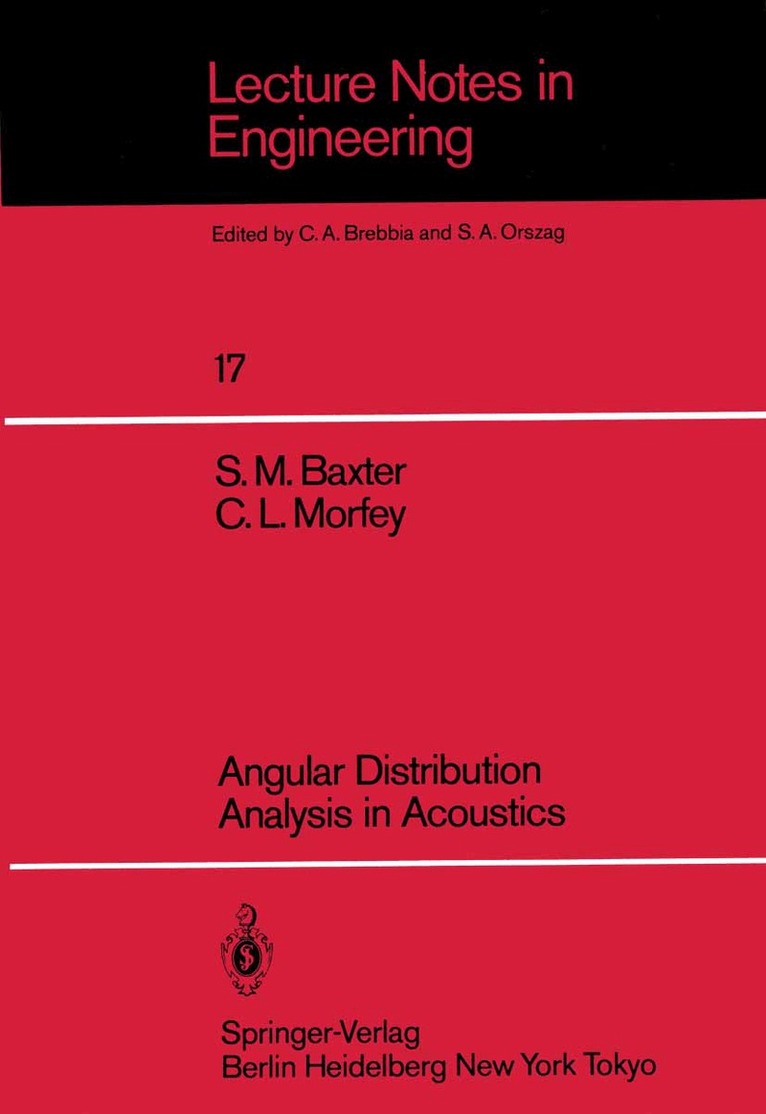
    Angular Distribution Analysis in Acoustics

    AvStephen M. Baxter,Christopher L. Morfey

    Häftad, Engelska, 1986

    Del i serien Lecture Notes in Engineering

    1 078 kr

    Beställningsvara. Skickas inom 10-15 vardagar. Fri frakt över 249 kr.

    Beskrivning

    The purpose of this book is to j.ir€'~ 0l'l\' a new technique for the experimental investigation of the free wave model sound field of acoustics. The technique is based on the use of spherical harmonic functions of angle. Acousticians frequently encounter random sound fields whose properties may be closely modelled by use of the "free wave" field. This model field is defined by two basic statistical properties: stationarity in time, and homogeneity in space. Stationarity means that any single order statistic measured by a microphone in the field will be independent of the time at which the recording is taken, while homogeneity means that the measurement will also be independent of the mic- phone's position in the field. Furthermore, second order statistics obtained from the measurements of two microphones will depend only on the time lapse between the two recordings, and the relative spatial separation of the micro­ phones, and not on the microphones' absolute positions in space and time. The free wave field may also (equivalently) be pictured as a collection of plane sound waves which approach an observation position from all angles. These are the "free waves" of the title, with no correlation between waves at different angles and frequencies, although there may exist an angle-dependant plane wave density function. This is a measure of the density of sound energy arriving from different angles. The free wave field has proved to be a simple but remarkably powerful model.

    Produktinformation

    • Utgivningsdatum:1986-02-01
    • Mått:170 x 244 x undefined mm
    • Vikt:375 g
    • Format:Häftad
    • Språk:Engelska
    • Serie:Lecture Notes in Engineering
    • Antal sidor:202
    • Förlag:Springer-Verlag Berlin and Heidelberg GmbH & Co. KG
    • ISBN:9783540162209

    Utforska kategorier

    • Teknik: allmänt inom Naturvetenskap och teknik

    Innehållsförteckning

    • 1 Introduction.- 2 The Free Wave Sound Field.- 2.1 Introduction.- 2.2 Properties of the Free Wave Field.- 2.3 Spectral Density Measurement in Free Wave Fields: Cook’s Theorem.- 2.4 Extension of Cook’s Theorem for Anisotropic Fields.- 2.5 Summary.- References.- Figures.- 3 Inference of the Plane Wave Weighting Function From Spectral Density Measurements.- 3.1 Introduction.- 3.2 Cook’s Theorem and Nondiffuse Fields.- 3.3 Inductive Weighting Analysis: Parametric Models.- 3.4 Direct Weighting Analysis: Theoretical Inverse.- 3.5 Direct Weighting Analysis: Wavenumber Spectra.- 3.6 Direct Weighting Analysis: Stationary Phase Approximation.- 3.7 Direct Weighting Analysis: Spherical Harmonic Expansions.- 3.8 Conclusions.- References.- Figures.- 4 The Spherical Harmonic Analysis of Free Wave Fields in Practice.- 4.1 Introduction.- 4.2 Formulation of the Harmonic Search Problem: Least Squares Fitting.- 4.3 Harmonic Analysis of the Gravitational and Magnetic Fields of Planets.- 4.4 Development of Harmonic Search Procedure.- 4.5 Development of Axisymmetric Harmonic Search Procedure.- 4.6 Properties of Analysis Results.- 4.7 Conclusions.- References.- Figures.- Tables.- 5 Summary.- Appendix A.- Appendix B.- Appendix C.