• Fri frakt över 249 kr
  • •
  • Snabba leveranser
  • •
  • Billiga böcker
Kundservice

Du är på sajten för privatpersoner.

Företag, bibliotek eller offentlig verksamhet?

Du handlar på classic.bokus.com, där alla dina funktioner finns intakta.
Till classic.bokus.com
Bokus logotyp. Gå till startsidan.
  • Erbjudanden
  • Student
  • Topplistor
  • Barn & ungdom
  • Bokus Play
  • E-böcker
  • Ljudböcker
  • Pocketböcker
  • Spel och pussel

Pocketfynda! Hundratals böcker för 49 kr/st →

Sidfot

Mina sidor

    Hjälp

    • Kundservice
    • Vanliga frågor och svar
    • Frakt och leverans
    • Retur vid ångerrätt
    • Reklamera vara
    • Betalning
    • Köpvillkor
    • Allmänna villkor
    • Information om webbplatsens tillgänglighet

    Om Bokus

    • Om oss
    • Pressrum
    • För studenter
    • För företag
    • För bibliotek och offentlig verksamhet
    • För leverantörer
    • Hållbarhet

    Populärt

    • Aktuella erbjudanden
    • Presentkort
    • Studentlitteratur
    • Nya böcker
    • Topplistor
    • Signerade böcker
    • Engelska böcker

    Inspiration

    • Boktips
    • BookTok
    • Barnbokskaraktärer
    • Populära författare
    Logotyp för Bokus
    Följ oss på Facebook (extern länk)Följ oss på Instagram (extern länk)Följ oss på YouTube (extern länk)Följ oss på TikTok (extern länk)
    bokus @ CookiesAnpassa cookiesIntegritetspolicyKöpvillkor
    Till Citymail hemsida (extern länk)Till Budbee hemsida (extern länk)Till Postnord hemsida (extern länk)Till Schenker hemsida (extern länk)Till Early Bird hemsida (extern länk)Till Walleys hemsida (extern länk)
    1. Naturvetenskap och teknik
    2. Matematik och naturvetenskap
    3. Kemi
    4. Fysikalisk kemi

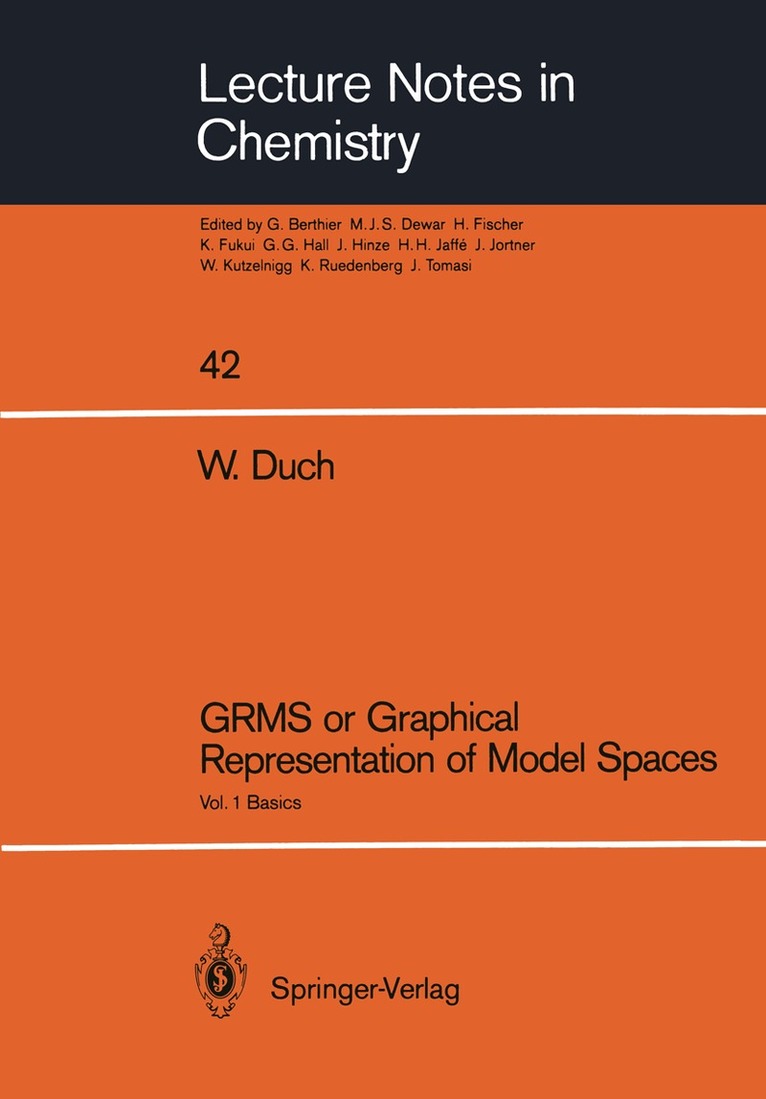
    GRMS or Graphical Representation of Model Spaces

    Vol. 1 Basics

    AvWlodzislaw Duch

    Häftad, Engelska, 1986

    Del 42 i serien Lecture Notes in Chemistry

    1 078 kr

    Beställningsvara. Skickas inom 10-15 vardagar. Fri frakt över 249 kr.

    Fler format och utgåvor

    E-bok

    1 413 kr

    Beskrivning

    The purpose of these notes is to give some simple tools and pictures to physicists and ' chemists working on the many-body problem. Abstract thinking and seeing have much in common - we say "I see" meaning "I understand" , for example. Most of us prefer to have a picture of an abstract object. The remarkable popularity of the Feynman diagrams, and other diagrammatic approaches to many-body problem derived thereof, may be partially due to this preference. Yet, paradoxically, the concept of a linear space, as fundamental to quantum physics as it is, has never been cast in a graphical form. We know that is a high-order contribution to a two-particle scattering process (this one invented by Cvitanovic(1984)) corresponding to a complicated matrix element. The lines in such diagrams are labeled by indices of single-particle states. When things get complicated at this level it should be good to take a global view from the perspective of the whole many-particle space. But how to visualize the space of all many-particle states ? Methods of such visualization or graphical representation of the ,spaces of interest to physicists and chemists are the main topic of this work.

    Produktinformation

    • Utgivningsdatum:1986-11-01
    • Mått:170 x 244 x 12 mm
    • Vikt:355 g
    • Format:Häftad
    • Språk:Engelska
    • Serie:Lecture Notes in Chemistry
    • Antal sidor:189
    • Förlag:Springer-Verlag Berlin and Heidelberg GmbH & Co. KG
    • ISBN:9783540171690

    Utforska kategorier

    • Fysikalisk kemi inom Naturvetenskap och teknik

    Innehållsförteckning

    • 1. Preface.- 2. Introduction.- I: Architecture of Model Spaces.- 1.1 Introducing graphical representation.- 1.2 Labeling and ordering the paths.- 1.3 ?z-adapted graphs in different forms.- 1.4 $${\hat{L}}$$z-adapted graphs.- 1.5 ($${\hat{L}}$$z,?z)-adapted graphs.- 1.6 ?2 -adapted graphs.- 1.7 ($${\hat{L}}$$z,?2)-adapted graphs.- 1.8 ($${\hat{L}}$$2,?2)-adapted graphs.- 1.9 (?2,$${\hat{T}}$$2)-adapted graphs.- 1.10 Spatial symmetry in the graph.- 1.11 Visualization of restricted model spaces.- 1.12 Physical intuitions and graphs.- 1.13 Mathematical remarks.- 1.14 Graphs and computers.- 1.15 Summary and open problems.- II: Quantum Mechanics in Finite Dimensional Spaces.- 2 Matrix elements in model spaces.- 2.1 The shift operators.- 2.2 General formulas for matrix elements.- 2.3 Matrix elements in the ?z and $${\hat{L}}$$z- adapted spaces.- 2.4 Reduction from ?z to ?2 eigenspace.- 2.5 Matrix elements in the ?2-adapted space.- 2.6 Non-fagot graphs and the ?2-adapted space.- References.