• Fri frakt över 249 kr
  • •
  • Snabba leveranser
  • •
  • Billiga böcker
Kundservice

Du är på sajten för privatpersoner.

Företag, bibliotek eller offentlig verksamhet?

Du handlar på classic.bokus.com, där alla dina funktioner finns intakta.
Till classic.bokus.com
Bokus logotyp. Gå till startsidan.
  • Erbjudanden
  • Nyheter
  • Student
  • Topplistor
  • Barn & ungdom
  • Bokus Play
  • E-böcker
  • Pocketböcker
  • Spel & pussel

10% rabatt på allt med kod: NYSTART10 →

Sidfot

Mina sidor

    Hjälp

    • Kundservice
    • Vanliga frågor och svar
    • Frakt och leverans
    • Retur vid ångerrätt
    • Reklamera vara
    • Betalning
    • Köpvillkor
    • Allmänna villkor
    • Information om webbplatsens tillgänglighet

    Om Bokus

    • Om oss
    • Pressrum
    • För studenter
    • För företag
    • För bibliotek och offentlig verksamhet
    • För leverantörer
    • Hållbarhet

    Populärt

    • Aktuella erbjudanden
    • Presentkort
    • Studentlitteratur
    • Nya böcker
    • Topplistor
    • Signerade böcker
    • Engelska böcker

    Inspiration

    • Boktips
    • BookTok
    • Populära bokserier
    • Barnbokskaraktärer
    • Populära författare
    Logotyp för Bokus
    Följ oss på Facebook (extern länk)Följ oss på Instagram (extern länk)Följ oss på YouTube (extern länk)Följ oss på TikTok (extern länk)
    bokus @ CookiesAnpassa cookiesIntegritetspolicyKöpvillkor
    Till Citymail hemsida (extern länk)Till Budbee hemsida (extern länk)Till Postnord hemsida (extern länk)Till Schenker hemsida (extern länk)Till Early Bird hemsida (extern länk)Till Walleys hemsida (extern länk)
    1. Data och IT
    2. Tillämpad datateknik

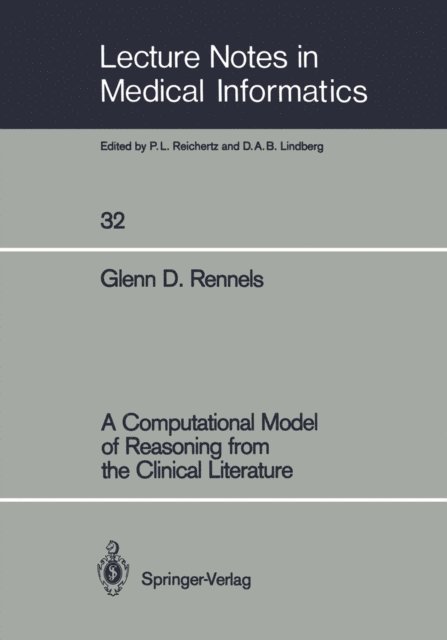
    Computational Model of Reasoning from the Clinical Literature

    AvGlenn D. Rennels

    Häftad, Engelska, 1987

    Del i serien Lecture Notes in Medical Informatics

    1 086 kr

    Beställningsvara. Skickas inom 10-15 vardagar. Fri frakt över 249 kr.

    Fler format och utgåvor

    E-bok

    1 413 kr

    Beskrivning

    As research on expert systems has moved well into its second decade, it has become popular to cite the limitations of the phenomenologic or associational approach to knowledge representation that was typical of first generation systems. For example, the Internist-1 knowledge base represents explicitly over 600 diseases, encoding associated disease manifestations (signs, symptoms, physical findings, and lab abnormalities) but failing to deal with the reasons that those findings may be present in the disease [Miller, R. A. 82]. In recent years Pople has sought to add detailed causal models to the knowledge base in a revised version of the program known as CADUCEUS [Pople 82]. Similarly, a typical production rule in the MYCIN system states inferences that may be drawn when specific conditions are found to be true [Buchanan 84], but the underlying explanations for such relationships are not encoded. Clancey has argued that MYCIN needs such "supporting knowledge" represented, especially if its knowledge base is to be used for teaching purposes [Clancey 83]. By the late 1970s, artificial intelligence researchers were beginning to experiment with reasoning systems that used detailed mechanistic or causal niodels of the object being analyzed. Among the best early examples were a program to teach students how to analyze electronic circuits [Brown 82] and a system for diagnosing problems with mechanical devices [Rieger 76].

    Produktinformation

    • Utgivningsdatum:1987-06-03
    • Mått:170 x 244 x 14 mm
    • Vikt:442 g
    • Format:Häftad
    • Språk:Engelska
    • Serie:Lecture Notes in Medical Informatics
    • Antal sidor:230
    • Förlag:Springer-Verlag Berlin and Heidelberg GmbH & Co. KG
    • ISBN:9783540179498

    Utforska kategorier

    • Tillämpad datateknik inom Data och IT

    Innehållsförteckning

    • 1. Introduction.- 1.1. Introduction to the Problem.- 1.2. Research Themes.- 1.3. The Roundsman System: Examples.- 1.4. Research Contributions.- 1.5. Guide to the Reader.- 2. Background.- 2.1. A Review of Artificial Intelligence in Medicine.- 2.2. Consultation Systems for Biostatistics.- 2.3. Computer Databases.- 2.4. Decision Analysis.- 2.5. Scope of the Biomedical Reports in Roundsman’s Library.- 2.6. Guides to Clinical Application of Biomedical Reports.- 2.7. Management of Primary Breast Cancer.- 3. Overview of the Research and the Roundsman System.- 3.1. Informal Protocol Analysis.- 3.2. The Development of Target Scripts.- 3.3. Selection of Publications to Include in Roundsman.- 3.4. Hardware and Software Support.- 3.5. An Overview of the Roundsman System.- 4. Modeling Distance from Study to Decision.- 4.1. Representing a Study’s Basic Statistical Results.- 4.2. A Taxonomy of Distance.- 4.3. Calibration of Distance.- 4.4. Distance Estimators.- 4.5. Work Related to Roundsman’s Distance Metric.- 4.6. Summary.- 5. Choice and Explanation.- 5.1. Introduction.- 5.2. Multiattribute Decision Making.- 5.3. The Importance of Modelling Both Choice and Explanation.- 5.4. Four Strategies for Choice and Explanation.- 5.5. Lexicographical Ordering.- 5.6. Satisficing.- 5.7. Dominance.- 5.8. Trade-Off.- 5.9. Comparison Strategies Under Uncertainty.- 5.10. Implementation in Roundsman.- 5.11. Summary.- 6. Interactions Between Studies.- 6.1. Updating Roundsman Over Time.- 6.2. Conflict Between Study Results.- 6.3. Summary and Future Directions.- 7. Text Generation.- 7.1. Introduction.- 7.2. Examples.- 7.3. Programming Language Primitives: Objects and Messages.- 7.4. Overview of the Implementation.- 7.5. Operational Description of the Objects.- 7.6. Discussion.- 8. ExtendedExamples and Evaluation.- 8.1. Example 1.- 8.2. Example 2.- 8.3. Example 3.- 8.4. Example 4.- 8.5. Example 5.- 8.6. Example 6.- 8.7. Example 7.- 8.8. Example 8.- 8.9. Evaluation.- 9. Conclusions.- 9.1. Summary.- 9.2. Limitations.- 9.3. Promising Areas for Extending the Research.- Appendix I. Internal Representation of the Studies in Roundsman’s Library.- Appendix II. Sample Distance Estimators.- References.