• Fri frakt över 249 kr
  • •
  • Snabba leveranser
  • •
  • Billiga böcker
Kundservice

Du är på sajten för privatpersoner.

Företag, bibliotek eller offentlig verksamhet?

Du handlar på classic.bokus.com, där alla dina funktioner finns intakta.
Till classic.bokus.com
Bokus logotyp. Gå till startsidan.
  • Erbjudanden
  • Nyheter
  • Student
  • Topplistor
  • Barn & ungdom
  • Bokus Play
  • E-böcker
  • Pocketböcker
  • Spel & pussel

10% rabatt på allt med kod NYSTART10 →

Sidfot

Mina sidor

    Hjälp

    • Kundservice
    • Vanliga frågor och svar
    • Frakt och leverans
    • Retur vid ångerrätt
    • Reklamera vara
    • Betalning
    • Köpvillkor
    • Allmänna villkor
    • Information om webbplatsens tillgänglighet

    Om Bokus

    • Om oss
    • Pressrum
    • För studenter
    • För företag
    • För bibliotek och offentlig verksamhet
    • För leverantörer
    • Hållbarhet

    Populärt

    • Aktuella erbjudanden
    • Presentkort
    • Studentlitteratur
    • Nya böcker
    • Topplistor
    • Signerade böcker
    • Engelska böcker

    Inspiration

    • Boktips
    • BookTok
    • Populära bokserier
    • Barnbokskaraktärer
    • Populära författare
    Logotyp för Bokus
    Följ oss på Facebook (extern länk)Följ oss på Instagram (extern länk)Följ oss på YouTube (extern länk)Följ oss på TikTok (extern länk)
    bokus @ CookiesAnpassa cookiesIntegritetspolicyKöpvillkor
    Till Citymail hemsida (extern länk)Till Budbee hemsida (extern länk)Till Postnord hemsida (extern länk)Till Schenker hemsida (extern länk)Till Early Bird hemsida (extern länk)Till Walleys hemsida (extern länk)
    1. Medicin
    2. Klinisk medicin och internmedicin
    3. Sjukdomar och rubbningar
    4. Onkologi

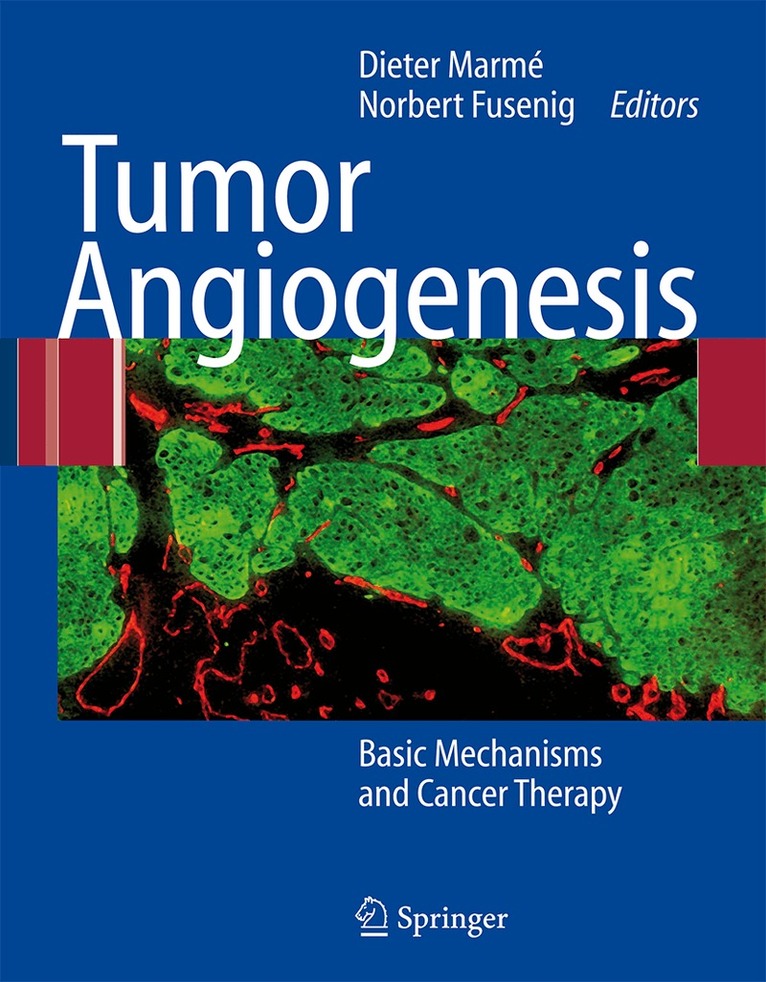
    Tumor Angiogenesis

    Basic Mechanisms and Cancer Therapy

    AvDieter Marmé,Norbert Fusenig

    Inbunden, Engelska, 2007

    3 336 kr

    Beställningsvara. Skickas inom 10-15 vardagar. Fri frakt över 249 kr.

    Beskrivning

    Preface Tumor development and progression occur as a result of cumulative acquisition of genetic alterations affecting oncogenes and tumor suppressor genes. As a consequence of these alterations the arising tumor gains some fatal properties such as increased cell proliferation and decreased apoptosis, resulting in a net accumulation of tra- formed cells. Once a critical volume is achieved, lack of oxygen and nutrients limits further growth. To overcome this obstacle, the tumor cells initiate a program focused on the formation of new blood vessels within the host tissue. This process is termed tumor angiogenesis and contributes to the progression of most solid tumors and the formation of metastases. Since its discovery more than 30 years ago by Dr. Judah Folkman, tumor angiog- esis has been proposed as an ideal target for novel tumor therapies. Today the first anti-angiogenic compounds are available for the treatment of patients but their s- cess in the clinic is rather limited when given as monotherapies. This is in contrast to many preclinical results which revealed a much higher efficacy of these therapeutics in appropriate animal models. The reasons for this discrepancy are manifold, one being the existence of more than one angiogenic signaling system capable of driving tumor angiogenesis. Therefore it is no surprise that the inhibition of just one system is not sufficient to block the formation of new blood vessels in patients.

    Produktinformation

    • Utgivningsdatum:2007-10-15
    • Mått:210 x 279 x 51 mm
    • Vikt:2 316 g
    • Format:Inbunden
    • Språk:Engelska
    • Antal sidor:845
    • Upplaga:2008
    • Förlag:Springer-Verlag Berlin and Heidelberg GmbH & Co. KG
    • ISBN:9783540331766

    Utforska kategorier

    • Onkologi inom Medicin

    Recensioner i media

    From the reviews: "The chapters in Tumor Angiogenesis are divided into four sections ... . Tumor Angiogenesis is an outstanding overview of the basic science and translational aspects of angiogenesis. ... To fully capitalize on antiangiogenic therapy, we must continue to have an open dialogue between basic scientists and clinical investigators. This book will serve that purpose, not only for graduate students and new investigators in the field, but also for experienced investigators." (Lee M. Ellis, The New England Journal of Medicine, May, 2008)

    Innehållsförteckning

    • Historical Overview.- Tumor Angiogenesis: from Bench to Bedside.- Mechanisms.- Vasculogenesis and Angiogenesis in Development.- Guidance of Vascular and Neuronal Network Formation.- The Angiogenic Switch in Tumorigenesis.- Pathophysiology and Clinical Implications of Vascular Endothelial Growth Factor.- Regulation of Angiogenesis and Vascular Homeostasis Through the Angiopoietin / Tie System.- Eph Receptors and Ephrins: Role in Vascular Development and Tumor Angiogenesis.- The Role of the Neuropilins and Their Associated Plexin Receptors in Tumor Angiogenesis and Tumor Progression.- Platelet-derived Growth Factor: Impact on Physiological and Tumor Angiogenesis.- Hypoxia and Tumour Angiogenesis.- Hypoxia and Angiogenesis in Glioblastomas.- Endogenous Inhibitors of Angiogenesis.- Thrombospondins and Angiogenesis.- Molecular and Cellular Aspects of Heparanase.- Vessel Maturation and Perivascular Cells.- Adhesion Molecules in the Vascular Cell Cross-Talk.- Homing and Differentiation of Endothelial Progenitor Cells.- Molecular Players in Lymphangiogenesis.- The Relationship Between Tumors and the Lymphatics: Consequences for Metastasis.- Inflammation and Angiogenesis: Innate Immune Cells as Modulators of Tumor Vascularization.- Arteriovenous Malformation in Mice and Men.- Animal Models and Preclinical Anti-Angiogenic Studies.- Vascular Endothelial Growth Factor Antibodies for Anti-Angiogenic Therapy.- Vascular Endothelial Growth Factor.- Vascular Endothelial Growth Factor Receptor Antibodies for Anti-Angiogenic Therapy.- Angiopoietin-2 Antagonists for Anti-Angiogenic Therapy.- Anti-Angiogenic Therapy with Thrombospondins.- The Use of Orthotopic Models to Validate Antivascular Therapies for Cancer.- Vascular Tumor Targeting.- Molecular Imaging of Targets and Therapeutics in Tumour Angiogenesis.- Imaging of Tumor Angiogenesis and Antiangiogenesis.- Visualization of Microcirculation and Anti-Angiogenic Tumor Therapy.- Cellular Actions of Angiogenesis Inhibitors on Blood Vessels.- Antiangiogenic Therapy for Normalization of Tumor Vasculature and Microenvironment.- Metronomic Antiangiogenic Chemotherapy: Questions and Answers.- Anti-Angiogenic Tumor Therapy in Clinical Studies.- The Development of Avastin.- Clinical Development of Sorafenib (BAY 43–9006) VEGFR and RAF Inhibitor.- Clinical Development of the VEGFR Signalling Inhibitor AZD2171.- Clinical Development of Sunitinib Malate.- The EGF(R) and VEGF(R) Pathways as Combined Targets for Anti-Angiogenesis Trials in Cancer Therapy.- Imaging the Effect of Anti-Angiogenic Tumor Therapy in Clinical Studies.- Vandetanib (ZACTIMA™; ZD6474): Preclinical and Clinical Development.- Integrins: Targets for Anti-Angiogenic Therapy.- Thalidomide in Multiple Myeloma.- Surrogate Markers of Angiogenesis.- Vascular Disrupting Agents in Cancer Therapy.