• Fri frakt över 249 kr
  • •
  • Snabba leveranser
  • •
  • Billiga böcker
Kundservice

Du är på sajten för privatpersoner.

Företag, bibliotek eller offentlig verksamhet?

Du handlar på classic.bokus.com, där alla dina funktioner finns intakta.
Till classic.bokus.com
Bokus logotyp. Gå till startsidan.
  • Erbjudanden
  • Nyheter
  • Student
  • Topplistor
  • Barn & ungdom
  • Bokus Play
  • E-böcker
  • Pocketböcker
  • Spel & pussel

10% rabatt på allt med kod: NYSTART10 →

Sidfot

Mina sidor

    Hjälp

    • Kundservice
    • Vanliga frågor och svar
    • Frakt och leverans
    • Retur vid ångerrätt
    • Reklamera vara
    • Betalning
    • Köpvillkor
    • Allmänna villkor
    • Information om webbplatsens tillgänglighet

    Om Bokus

    • Om oss
    • Pressrum
    • För studenter
    • För företag
    • För bibliotek och offentlig verksamhet
    • För leverantörer
    • Hållbarhet

    Populärt

    • Aktuella erbjudanden
    • Presentkort
    • Studentlitteratur
    • Nya böcker
    • Topplistor
    • Signerade böcker
    • Engelska böcker

    Inspiration

    • Boktips
    • BookTok
    • Populära bokserier
    • Barnbokskaraktärer
    • Populära författare
    Logotyp för Bokus
    Följ oss på Facebook (extern länk)Följ oss på Instagram (extern länk)Följ oss på YouTube (extern länk)Följ oss på TikTok (extern länk)
    bokus @ CookiesAnpassa cookiesIntegritetspolicyKöpvillkor
    Till Citymail hemsida (extern länk)Till Budbee hemsida (extern länk)Till Postnord hemsida (extern länk)Till Schenker hemsida (extern länk)Till Early Bird hemsida (extern länk)Till Walleys hemsida (extern länk)
    1. Naturvetenskap och teknik
    2. Matematik och naturvetenskap
    3. Kemi
    4. Fysikalisk kemi

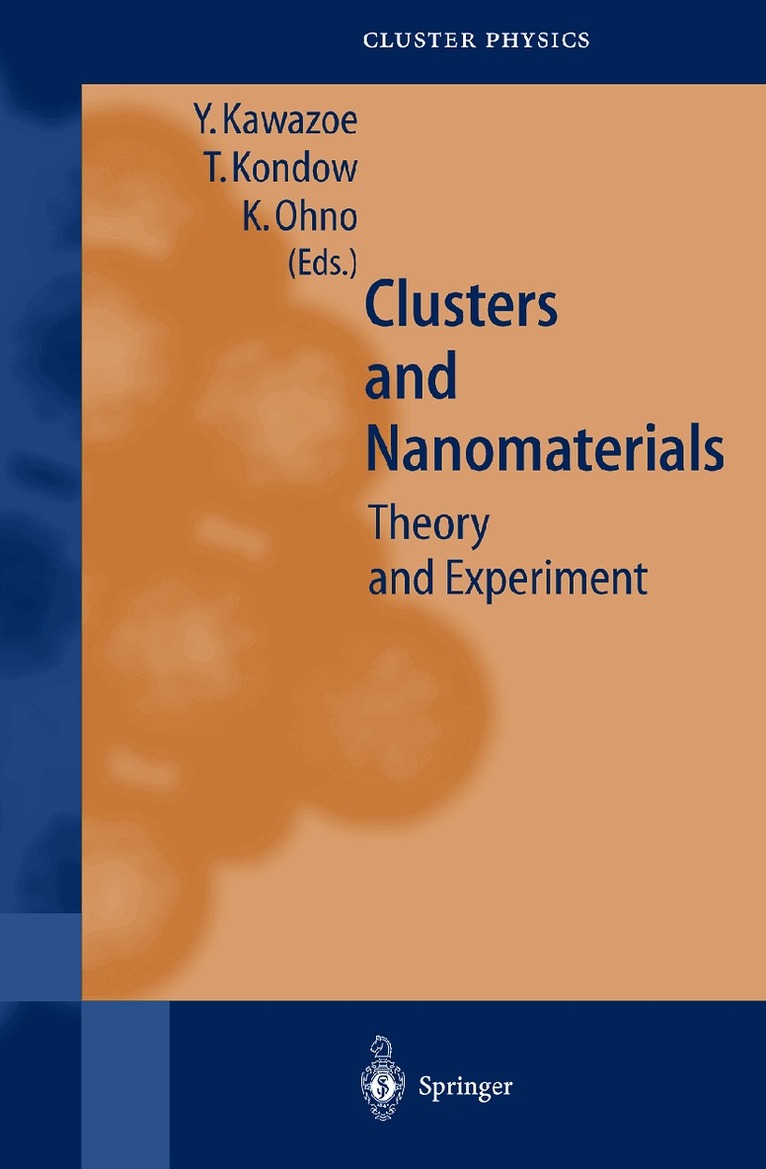
    Clusters and Nanomaterials

    Theory and Experiment

    AvY. Kawazoe,T. Kondow

    Inbunden, Engelska, 2001

    Del i serien Springer Series in Cluster Physics

    2 380 kr

    Beställningsvara. Skickas inom 10-15 vardagar. Fri frakt över 249 kr.

    Beskrivning

    The field of cluster science is currently attracting considerable interest, not only from a fundamental standpoint, but also through its future applications to electronic, optical, magnetic, and other devices. Synthesizing specific clus­ ters as a unit of useful nanostructures or controlling them as an assembly of nanocomposites is one of the ultimate purposes in this field. In order to understand how to synthesize individual clusters and t_o investigate physical properties, chemical reactions, structural stability, response to external fields, aggregation, phase transition, and other aspects of clusters, a great deal of effort has gone into experiment, theory and computer simulation in this area. This is presumably motivated by the fact that a high level of collaboration between theoretical and experimental researchers is particularly important for progress in the field of cluster science. The present book aims to collect together recent advances in this rapidly growing field. The authors are all active researchers, collaborating both ex­ perimentally and theoretically in this field, and most of them have regularly participated in the IMR Workshop, held for three years starting from 1998 at the Institute for Materials Research in Tohoku University. This book is suitable for both theoretical and experimental researchers and also for re­ searchers and graduate students working in related subjects, who wish to overview recent advances in the field.

    Produktinformation

    • Utgivningsdatum:2001-09-25
    • Mått:155 x 235 x 26 mm
    • Vikt:715 g
    • Format:Inbunden
    • Språk:Engelska
    • Serie:Springer Series in Cluster Physics
    • Antal sidor:346
    • Upplaga:2002
    • Förlag:Springer-Verlag Berlin and Heidelberg GmbH & Co. KG
    • ISBN:9783540418054

    Utforska kategorier

    • Fysikalisk kemi inom Naturvetenskap och teknik
    • Materietillstånd inom Naturvetenskap och teknik

    Recensioner i media

    From the reviews of the first edition: "The book starts with a brief introduction written by the editors. They outlined important contributions of cluster science to basic science and the role of cluster science in applications, the crucial role of cluster in the progress of nanotechnology. The book consists of four parts: 'Metallic Clusters', 'Organic Molecules', 'Fullerenes and Nanotubes', 'Theory and Computer Simulation'. ... This book will be useful for researchers and graduated students working in the field of cluster science and in related subjects." (K. M. Salikhov, Applied Magnetic Resonance, Vol. 24 (2), 2003) "The editors of this book have an outstanding track record in the fields of cluster and nanoparticle physics. Their insight into the field can be gleaned from the very well written introductory chapter, which briefly outlines the relevance and importance of each the subsequent chapters. ... it is the theoretical chapters that make this book valuable, giving examples of a wide range of modern numerical modelling approaches. ... should find a place in the library of someone interested in the simulation of nanostructures." (John Dell, The Physicist, Vol. 39 (3), 2002)

    Innehållsförteckning

    • 1 Brief Introduction.- 2 Ab Initio Computer Simulations on Microclusters: Structures and Electronic Properties.- 3 Stability of Multiply Charged Transition Metal Clusters.- 4 Adsorption of Methanol Molecules on Nickel Cluster Ions.- 5 Cluster Investigations in Cyclodextrin Inclusion Compounds: Theory and Experiment.- 6 The Nanostructure of C60 Photopolymers.- 7 Formation of Foreign-Atom-Doped Fullerenes.- 8 Electronic, Transport and Mechanical Properties of Carbon Nanotubes.- 9 Nanostructural Characterization of Inorganic Materials by High-Resolution Electron Microscopy.- 10 Phase Behavior in Systems of Large Molecules.- 11 Formation of Free Clusters and Their Structures: Molecular Dynamics Simulations.- 12 Extended Ensemble Monte Carlo Method.- 13 Molecular Dynamics Simulation for Deformation Dynamics of Ni/Ni3Al Composite with FGM or NFGM Type Interface.- 14 Size-Dependent Evolution of Conduction-Electron Excitations in Small Spherical Particles.