• Fri frakt över 249 kr
  • •
  • Snabba leveranser
  • •
  • Billiga böcker
Kundservice

Du är på sajten för privatpersoner.

Företag, bibliotek eller offentlig verksamhet?

Du handlar på classic.bokus.com, där alla dina funktioner finns intakta.
Till classic.bokus.com
Bokus logotyp. Gå till startsidan.
  • Erbjudanden
  • Nyheter
  • Student
  • Topplistor
  • Barn & ungdom
  • Bokus Play
  • E-böcker
  • Pocketböcker
  • Spel & pussel

10% rabatt på allt med kod NYSTART10 →

Sidfot

Mina sidor

    Hjälp

    • Kundservice
    • Vanliga frågor och svar
    • Frakt och leverans
    • Retur vid ångerrätt
    • Reklamera vara
    • Betalning
    • Köpvillkor
    • Allmänna villkor
    • Information om webbplatsens tillgänglighet

    Om Bokus

    • Om oss
    • Pressrum
    • För studenter
    • För företag
    • För bibliotek och offentlig verksamhet
    • För leverantörer
    • Hållbarhet

    Populärt

    • Aktuella erbjudanden
    • Presentkort
    • Studentlitteratur
    • Nya böcker
    • Topplistor
    • Signerade böcker
    • Engelska böcker

    Inspiration

    • Boktips
    • BookTok
    • Populära bokserier
    • Barnbokskaraktärer
    • Populära författare
    Logotyp för Bokus
    Följ oss på Facebook (extern länk)Följ oss på Instagram (extern länk)Följ oss på YouTube (extern länk)Följ oss på TikTok (extern länk)
    bokus @ CookiesAnpassa cookiesIntegritetspolicyKöpvillkor
    Till Citymail hemsida (extern länk)Till Budbee hemsida (extern länk)Till Postnord hemsida (extern länk)Till Schenker hemsida (extern länk)Till Early Bird hemsida (extern länk)Till Walleys hemsida (extern länk)
    1. Data och IT
    2. Människa – datorinteraktion

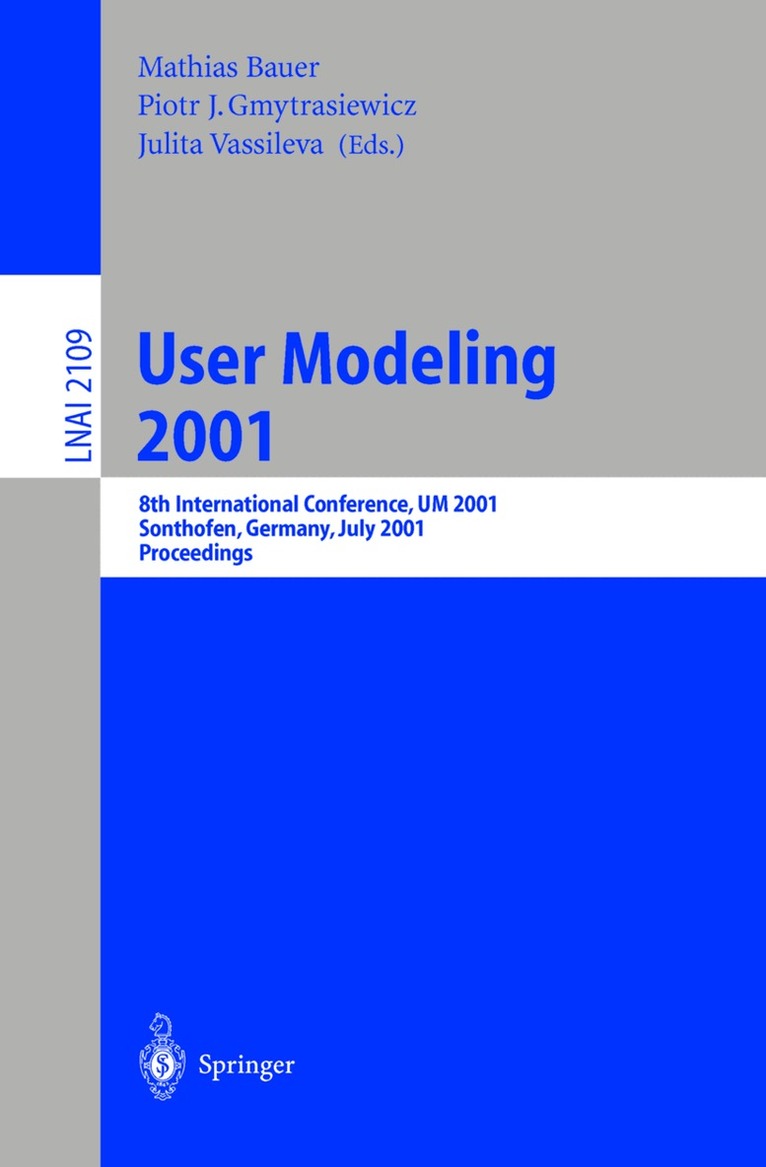
    User Modeling 2001

    8th International Conference, UM 2001, Sonthofen, Germany, July 13-17, 2001. Proceedings

    AvMathias Bauer,Piotr J. Gmytrasiewicz

    Häftad, Engelska, 2001

    Del i serien Lecture Notes in Computer Science

    562 kr

    Beställningsvara. Skickas inom 10-15 vardagar. Fri frakt över 249 kr.

    Beskrivning

    The study of the ?eld of user modeling (UM) has resulted in signi?cant amounts of theoretical work, as well as practical experience, in developing UM-based applications in traditional areas of human-computer interaction and tutoring systems. Further, it promises to have an enormous impact on recent developments in areas like information ?ltering, e-commerce, adaptive presentation techniques, and interface agents. A user model is an explicit representation of properties of a particular user, which allows the system to adapt diverse aspects of its performance to individual users'needs. TechniquesforUMhavebeendevelopedandevaluatedbytheoreticiansandpractitioners in a variety of ?elds, including arti?cial intelligence, education, psychology, cognitive science, linguistics, and human-computer interaction. The International Conferences on User Modeling constitute the major forum for pres- tationanddiscussionofboththelatestdevelopmentsinacademicresearchonallaspects of user modeling and industrial experience in deploying adaptive systems in real-world applications.This volume contains the proceedings of the Eighth International C- ference on User Modeling (UM2001), held in Sonthofen, Germany. It follows UM99 (Banff,Canada),UM97(Sardinia,Italy),UM96(Hawaii,USA),UM94(Hyannis,USA), UM92(Dagstuhl,WestGermany),UM90(Hawaii,USA)andUM86(MariaLaach,West Germany). Until now, the proceedings of the conference have been published with university p- lishers.AfterdiscussionswithinUMInc.,itwasdecidedfromnowontopublishthep- ceedingsvolumewithoneofthemajorpublishingcompanies,toensurewideravailability of the volume in libraries and archives. After careful consideration Springer-Verlag was chosen. The UM2001 program includes tutorials, invited talks, technical paper and poster s- sions, a doctoral consortium, workshops, and system demonstrations. There were a total of 79 technical submissions from 20 countries.

    Produktinformation

    • Utgivningsdatum:2001-06-27
    • Mått:155 x 235 x 19 mm
    • Vikt:517 g
    • Format:Häftad
    • Språk:Engelska
    • Serie:Lecture Notes in Computer Science
    • Antal sidor:326
    • Förlag:Springer-Verlag Berlin and Heidelberg GmbH & Co. KG
    • ISBN:9783540423256

    Utforska kategorier

    • Människa – datorinteraktion inom Data och IT
    • Nätverk och kommunikation inom Data och IT
    • Digital livsstil och datorspel inom Data och IT

    Innehållsförteckning

    • Full Papers.- Harnessing Models of Users’ Goals to Mediate Clarification Dialog in Spoken Language Systems.- Modeling the Acquisition of English: An Intelligent CALL Approach ?.- Recognizing Time Pressure and Cognitive Load on the Basis of Speech: An Experimental Study.- The Learning Shell: Automated Macro Construction.- Learning Interaction Models in a Digital Library Service.- A User Modeling Approach to Determining System Initiative in Mixed-Initiative AI Systems.- Collaborating with Focused and Unfocused Users under Imperfect Communication.- Improving User Modelling with Content-Based Techniques.- An Integrated Approach for Generating Arguments and Rebuttals and Understanding Rejoinders.- Acquiring User Preferences for Product Customization.- Utility-Based Decision Tree Optimization: A Framework for Adaptive Interviewing.- User Modelling in I-Help: What, Why, When and How.- An Adaptive User-Interface-Agent Modeling Communication Availability.- Cognitive Computer Tutors: Solving the Two-Sigma Problem.- Applying Interactive Open Learner Models to Learning Technical Terminology.- Student and Instructor Models: Two Kinds of User Model and Their Interaction in an ITS Authoring Tool.- METIORE: A Personalized Information Retrieval System.- Personalizing Delivered Information in a Software Reuse Environment.- Automating Personal Categorization Using Artificial Neural Networks.- Posters.- User Modelling as an Aid for Human Web Assistants.- Modelling the Interests of a News Service User.- Category Based Customization Approach for Information Retrieval.- Using Rollouts to Induce a Policy from a User Model.- Tailoring the Content of Dynamically Generated Explanations.- A User Model Based on Content Analysis for the Intelligent Personalization of a News Service.- ModelingExploratory Behaviour.- Ascribing and Weighting Beliefs in Deceptive Information Exchanges.- Visual Search and Background Complexity: Does the Forest Hide the Trees?.- Characterizing Sequences of User Actions for Access Logs Analysis.- Modeling Literary Style for Semi-automatic Generation of Poetry.- Perceptual Considerations for Quality of Service Management: An Integrated Architecture.- Emotions and Personality in Agent Design and Modeling.- Using Document Structures for Personal Ontologies and User Modeling*.- User-Tailored Plan Presentation.- Investigating Students’ Self-Assessment Skills.- Generating Personal Travel Guides - And Who Wants Them?.- Inspectability and User Controlled Revision on Long Term User Models.- Getting the Right Information to the Right Person.- Goals, Tasks and Application Domains as the Guidelines for Defining a Framework for User Modelling.- Doctoral Consortium.- Improving Student Models by Reasoning about Cognitive Ability, Emotions and Gender.- Integrating Multilingual Text Classification Tasks and User Modeling in Personalized Newspaper Services.- Enhancing Embodied Intelligent Agents with Affective User Modelling.- Designing TV Viewer Stereotypes for an Electronic Program Guide.- AGENDA CULTUREL An Adaptive Cultural Information Service.- Ubiquitous User Modeling for Situated Interaction.- An Intelligent Pedagogical Agent in CALL.- How to Learn More about Users from Implicit Observations1.- Student Modelling for CALL Based on Pedagogical Standards.- Evaluation of Adaptive Systems.- Supporting Negotiated Assessment Using Open Student Models.- Using Markov Chains for Structural Link Prediction in Adaptive Web Sites.- Invited Talks.- Tailoring Privacy to Users’ Needs 1.- Heavyweight Applications of Lightweight User Models: A Look atCollaborative Filtering, Recommender Systems, and Real-Time Personalization.- Eye Tracking: A Rich Source of Information for User Modeling.