• Fri frakt över 249 kr
  • •
  • Snabba leveranser
  • •
  • Billiga böcker
Kundservice

Du är på sajten för privatpersoner.

Företag, bibliotek eller offentlig verksamhet?

Du handlar på classic.bokus.com, där alla dina funktioner finns intakta.
Till classic.bokus.com
Bokus logotyp. Gå till startsidan.
  • Erbjudanden
  • Nyheter
  • Student
  • Topplistor
  • Barn & ungdom
  • Bokus Play
  • E-böcker
  • Pocketböcker
  • Spel & pussel

10% rabatt på allt med kod NYSTART10 →

Sidfot

Mina sidor

    Hjälp

    • Kundservice
    • Vanliga frågor och svar
    • Frakt och leverans
    • Retur vid ångerrätt
    • Reklamera vara
    • Betalning
    • Köpvillkor
    • Allmänna villkor
    • Information om webbplatsens tillgänglighet

    Om Bokus

    • Om oss
    • Pressrum
    • För studenter
    • För företag
    • För bibliotek och offentlig verksamhet
    • För leverantörer
    • Hållbarhet

    Populärt

    • Aktuella erbjudanden
    • Presentkort
    • Studentlitteratur
    • Nya böcker
    • Topplistor
    • Signerade böcker
    • Engelska böcker

    Inspiration

    • Boktips
    • BookTok
    • Populära bokserier
    • Barnbokskaraktärer
    • Populära författare
    Logotyp för Bokus
    Följ oss på Facebook (extern länk)Följ oss på Instagram (extern länk)Följ oss på YouTube (extern länk)Följ oss på TikTok (extern länk)
    bokus @ CookiesAnpassa cookiesIntegritetspolicyKöpvillkor
    Till Citymail hemsida (extern länk)Till Budbee hemsida (extern länk)Till Postnord hemsida (extern länk)Till Schenker hemsida (extern länk)Till Early Bird hemsida (extern länk)Till Walleys hemsida (extern länk)
    1. Data och IT
    2. Systemvetenskap och AI
    3. Artificiell intelligens

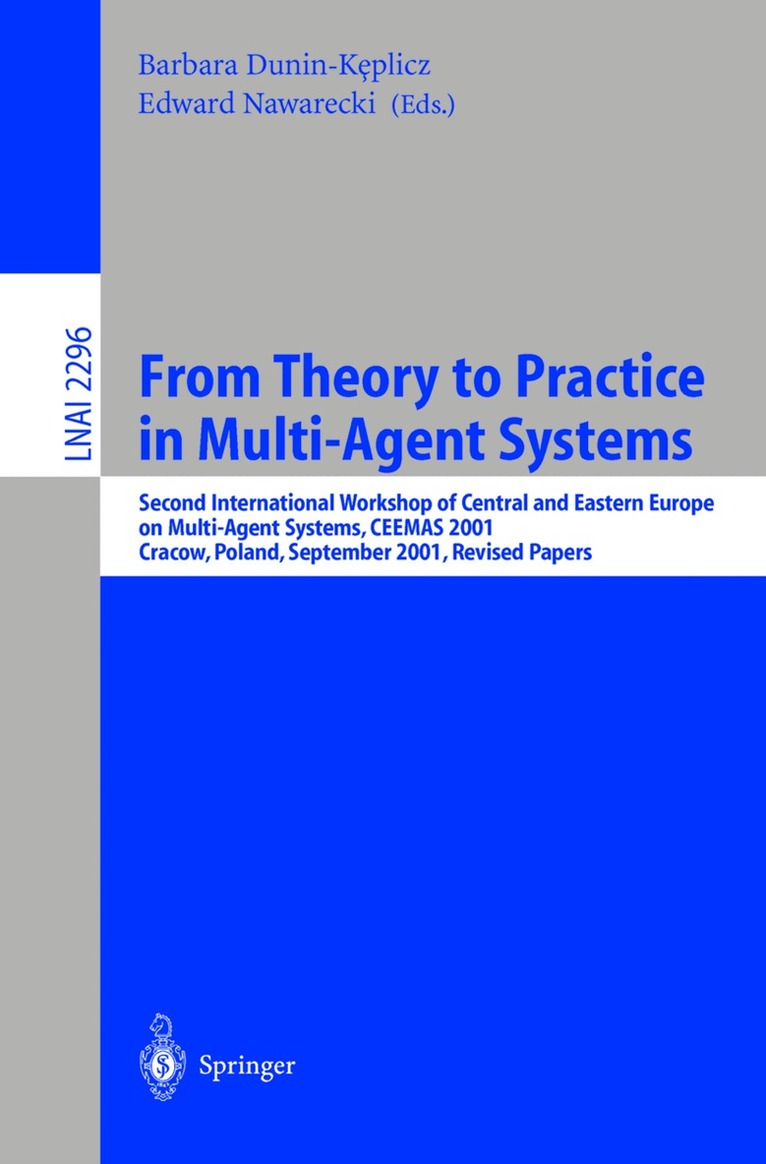
    From Theory to Practice in Multi-Agent Systems

    Second International Workshop of Central and Eastern Europe on Multi-Agent Systems, CEEMAS 2001 Cracow, Poland, September 26-29, 2001, Revised Papers

    AvBarbara Dunin-Keplicz,Edward Nawarecki

    Häftad, Engelska, 2002

    Del i serien Lecture Notes in Computer Science

    563 kr

    Beställningsvara. Skickas inom 10-15 vardagar. Fri frakt över 249 kr.

    Beskrivning

    This volume contains the papers selected for presentation at CEEMAS 2001. The wo- shop was the fourth in a series of international conferences devoted to autonomous agents and multi-agent systems organized in Central-Eastern Europe. Its predecessors wereCEEMAS’99andDAIMAS’97,whichtookplaceinSt. Petersburg,Russia,aswell as DIMAS’95, which took place in Cracow, Poland. Organizers of all these events made efforts to make them wide-open to participants from all over the world. This would have been impossible without some help from friendly centers in the Czech Republic, England, France, Japan, and The Netherlands. DIMAS’95 featured papers from 15 countries, while CEEMAS’99 from 18 co- tries. A total of 61 papers were submitted to CEEMAS 2001 from 17 countries. Out of these papers, 31 were selected for regular presentation, while 14 were quali ed as posters. The motto of the meeting was “Diversity is the core of multi-agent systems". This variety of subjects was clearly visible in the CEEMAS 2001 program, addressing the following major areas of multi-agent systems: – Organizations and social aspects of multi-agent systems – Agent and multi-agent system architectures, models, and formalisms – Communication languages, protocols, and negotiation – Applications of multi-agent systems – Agent and multi-agent development tools – Theoretical foundations of DistributedAI – Learning in multi-agent systems The richness of workshop subjects was ensured thanks to the CEEMAS 2001 contributing authors as well as the keynote speakers.

    Produktinformation

    • Utgivningsdatum:2002-03-13
    • Mått:155 x 235 x 20 mm
    • Vikt:540 g
    • Format:Häftad
    • Språk:Engelska
    • Serie:Lecture Notes in Computer Science
    • Antal sidor:346
    • Upplaga:2002
    • Förlag:Springer-Verlag Berlin and Heidelberg GmbH & Co. KG
    • ISBN:9783540433705

    Utforska kategorier

    • Artificiell intelligens inom Data och IT

    Innehållsförteckning

    • Invited Papers.- Approximate Reasoning by Agents.- Network Services in Context of Pervasive Mobile Internet.- Regular Papers.- On BAN Logics for Industrial Security Protocols.- A Concept of Agent Language in Agentspace.- Agent’s Adaptivity — Some Aspects of Theoretical Foundations of a Neural Agent Training Process.- Mobie: Personalized Automated Recharge of Prepaid Mobile Phones.- A Formal Specification of M-Agent Architecture.- Multi-agent System for Flexible Manufacturing Systems Management.- Motivational Attitudes of Agents: On Desires, Obligations, and Norms.- On Commitments, Roles, and Obligations.- Automata-Based Multi-agent Model as a Tool for Constructing Real-Time Intelligent Control Systems.- Rascal — A Resource Manager for Multi Agent Systems in Smart Spaces.- Software Development Kit for Multi-agent Systems Design and Implementation.- Formal Semantics for Behavioural Substitutability of Agent Components: Application to Interaction Protocols.- A Modelling Environment for Mind and Matter Aspects of Intentional Behaviour.- Temporal Languages for Simulation and Analysis of the Dynamics within an Organisation.- Syntactic Pattern Recognition-Based Agents for Real-Time Expert Systems.- Learning User Preferences in Multi-agent System.- Towards Requirements Analysis for Autonomous Agent Behaviour.- Messages, Clocks, and Gravitation.- An Improved Q-Learning Algorithm Using Synthetic Pheromones.- Organisations in the Particular Class of Multi-agent Systems.- UML for Behavior-Oriented Multi-agent Simulations.- Robot Disassembly Process Using Multi-agent System.- CPlanT: An Acquaintance Model-Based Coalition Formation Multi-agent System.- Efficient Model Checking of Causal-Knowledge Protocols.- Volcano, a Vowels-Oriented Multi-agent Platform.- Model of Cooperationin Multi-agent Systems with Fuzzy Coalitions.- Learning Collective Behaviour from Local Interactions.- MAS Oriented Patterns.- Multi-agent Architecture for Knowledge Fusion from Distributed Sources.- Universal Formal Model of Collective Intelligence and Its IQ Measure.- A Programming Language for Coordinating Group Actions.- Optimization of Resource Allocation in Distributed Production Networks.- Utility-Based Role Exchange.