• Fri frakt över 249 kr
  • •
  • Snabba leveranser
  • •
  • Billiga böcker
Kundservice

Du är på sajten för privatpersoner.

Företag, bibliotek eller offentlig verksamhet?

Du handlar på classic.bokus.com, där alla dina funktioner finns intakta.
Till classic.bokus.com
Bokus logotyp. Gå till startsidan.
  • Erbjudanden
  • Nyheter
  • Student
  • Topplistor
  • Barn & ungdom
  • Bokus Play
  • E-böcker
  • Pocketböcker
  • Spel & pussel

10% rabatt på allt med kod NYSTART10 →

Sidfot

Mina sidor

    Hjälp

    • Kundservice
    • Vanliga frågor och svar
    • Frakt och leverans
    • Retur vid ångerrätt
    • Reklamera vara
    • Betalning
    • Köpvillkor
    • Allmänna villkor
    • Information om webbplatsens tillgänglighet

    Om Bokus

    • Om oss
    • Pressrum
    • För studenter
    • För företag
    • För bibliotek och offentlig verksamhet
    • För leverantörer
    • Hållbarhet

    Populärt

    • Aktuella erbjudanden
    • Presentkort
    • Studentlitteratur
    • Nya böcker
    • Topplistor
    • Signerade böcker
    • Engelska böcker

    Inspiration

    • Boktips
    • BookTok
    • Populära bokserier
    • Barnbokskaraktärer
    • Populära författare
    Logotyp för Bokus
    Följ oss på Facebook (extern länk)Följ oss på Instagram (extern länk)Följ oss på YouTube (extern länk)Följ oss på TikTok (extern länk)
    bokus @ CookiesAnpassa cookiesIntegritetspolicyKöpvillkor
    Till Citymail hemsida (extern länk)Till Budbee hemsida (extern länk)Till Postnord hemsida (extern länk)Till Schenker hemsida (extern länk)Till Early Bird hemsida (extern länk)Till Walleys hemsida (extern länk)
    1. Data och IT
    2. Nätverk och kommunikation

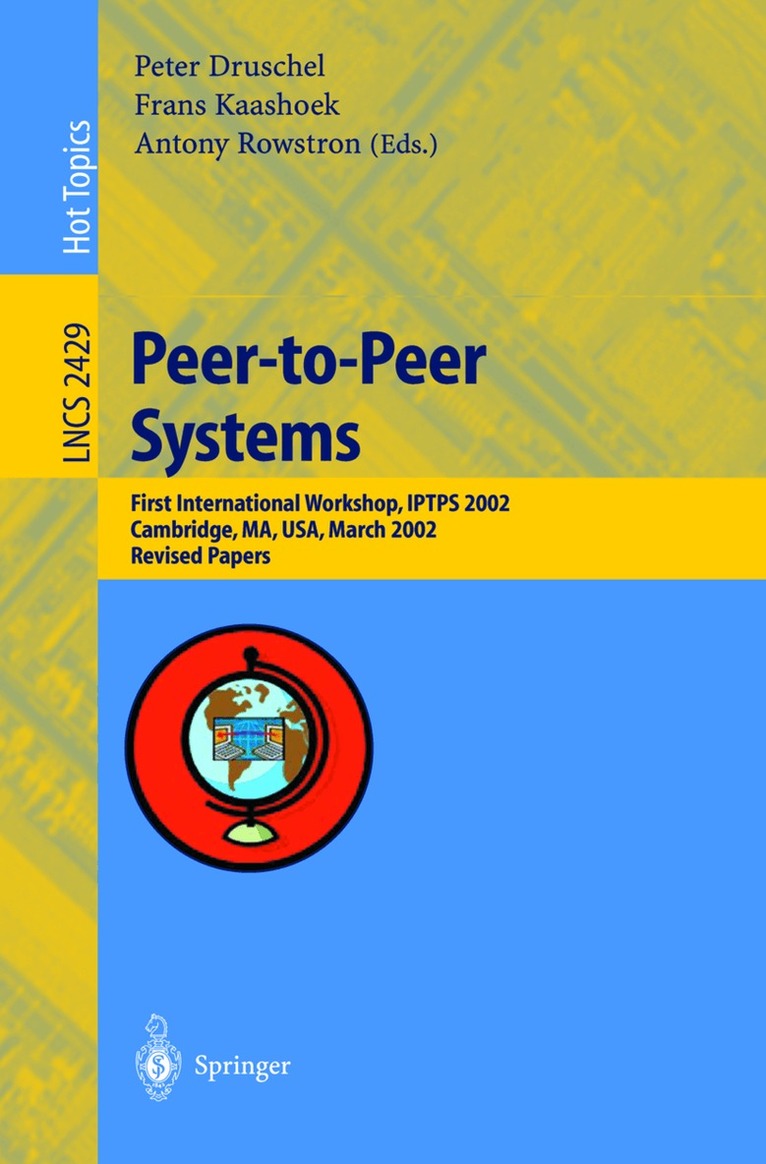
    Peer-to-Peer Systems

    First International Workshop, IPTPS 2002, Cambridge, MA, USA, March 7-8, 2002, Revised Papers

    AvPeter Druschel,Frans Kaashoek

    Häftad, Engelska, 2002

    Del i serien Lecture Notes in Computer Science

    562 kr

    Beställningsvara. Skickas inom 10-15 vardagar. Fri frakt över 249 kr.

    Beskrivning

    Peer-to-peer has emerged as a promising new paradigm for large-scale distributed computing. The International Workshop on Peer-to-Peer Systems (IPTPS) aimed to provide a forum for researchers active in peer-to-peer computing to discuss the state of the art and to identify key research challenges. The goal of the workshop was to examine peer-to-peer technologies, appli- tions, and systems, and also to identify key research issues and challenges that lie ahead. In the context of this workshop, peer-to-peer systems were characterized as being decentralized, self-organizing distributed systems, in which all or most communication is symmetric. The program of the workshop was a combination of invited talks, pres- tations of position papers, and discussions covering novel peer-to-peer appli- tions and systems, peer-to-peer infrastructure, security in peer-to-peer systems, anonymity and anti-censorship, performance of peer-to-peer systems, and wo- load characterization for peer-to-peer systems. To ensure a productive workshop environment, attendance was limited to 55 participants. Each potential participant was asked to submit a position paper of 5 pages that exposed a new problem, advocated a speci?c solution, or reported on actual experience. We received 99 submissions and were able to accept 31. Participants were invited based on the originality, technical merit, and topical relevance of their submissions, as well as the likelihood that the ideas expressed in their submissions would lead to insightful technical discussions at the workshop.

    Produktinformation

    • Utgivningsdatum:2002-10-09
    • Mått:155 x 235 x 20 mm
    • Vikt:540 g
    • Format:Häftad
    • Språk:Engelska
    • Serie:Lecture Notes in Computer Science
    • Antal sidor:346
    • Upplaga:2002
    • Förlag:Springer-Verlag Berlin and Heidelberg GmbH & Co. KG
    • ISBN:9783540441793

    Utforska kategorier

    • Nätverk och kommunikation inom Data och IT

    Innehållsförteckning

    • Workshop Report for IPTPS’02 1st International Workshop on Peer-to-Peer Systems 7–8 March 2002 — MIT Faculty Club, Cambridge, MA, USA.- Workshop Report for IPTPS’02 1st International Workshop on Peer-to-Peer Systems 7–8 March 2002 — MIT Faculty Club, Cambridge, MA, USA.- Structure Overlay Routing Protocols: State of the Art and Future Directions.- Observations on the Dynamic Evolution of Peer-to-Peer Networks.- Brocade: Landmark Routing on Overlay Networks.- Routing Algorithms for DHTs: Some Open Questions.- Kademlia: A Peer-to-Peer Information System Based on the XOR Metric.- Efficient Peer-to-Peer Lookup Based on a Distributed Trie.- Self-Organizing Subsets: From Each According to His Abilities, to Each According to His Needs.- Deployed Peer-to-Peer Systems.- Mapping the Gnutella Network: Macroscopic Properties of Large-Scale Peer-to-Peer Systems.- Can Heterogeneity Make Gnutella Scalable?.- Experiences Deploying a Large-Scale Emergent Network.- Anonymous Overlays.- Anonymizing Censorship Resistant Systems.- Introducing Tarzan, a Peer-to-Peer Anonymizing Network Layer.- Applications.- Mnemosyne: Peer-to-Peer Steganographic Storage.- ConChord: Cooperative SDSI Certificate Storage and Name Resolution.- Serving DNS Using a Peer-to-Peer Lookup Service.- Network Measurement as a Cooperative Enterprise.- The Case for Cooperative Networking*.- Internet Indirection Infrastructure.- Peer-to-Peer Caching Schemes to Address Flash Crowds.- Evaluation.- Exploring the Design Space of Distributed and Peer-to-Peer Systems: Comparing the Web, TRIAD, and Chord/CFS.- Are Virtualized Overlay Networks Too Much of a Good Thing?.- Searching and Indexing.- Locating Data in (Small-World?) Peer-to-Peer Scientific Collaborations.- Complex Queries in DHT-based Peer-to-Peer Networks.-The Sybil Attack.- Security Considerations for Peer-to-Peer Distributed Hash Tables.- Dynamically Fault-Tolerant Content Addressable Networks.- Data Management.- Scalable Management and Data Mining Using Astrolabe*.- Atomic Data Access in Distributed Hash Tables.- Dynamic Replica Placement for Scalable Content Delivery.- Peer-to-Peer Resource Trading in a Reliable Distributed System.- Erasure Coding Vs. Replication: A Quantitative Comparison.