• Fri frakt över 249 kr
  • •
  • Snabba leveranser
  • •
  • Billiga böcker
Kundservice

Du är på sajten för privatpersoner.

Företag, bibliotek eller offentlig verksamhet?

Du handlar på classic.bokus.com, där alla dina funktioner finns intakta.
Till classic.bokus.com
Bokus logotyp. Gå till startsidan.
  • Erbjudanden
  • Student
  • Topplistor
  • Barn & ungdom
  • Bokus Play
  • E-böcker
  • Ljudböcker
  • Pocketböcker
  • Spel och pussel

Pocketfynda! Hundratals böcker för 49 kr/st →

Sidfot

Mina sidor

    Hjälp

    • Kundservice
    • Vanliga frågor och svar
    • Frakt och leverans
    • Retur vid ångerrätt
    • Reklamera vara
    • Betalning
    • Köpvillkor
    • Allmänna villkor
    • Information om webbplatsens tillgänglighet

    Om Bokus

    • Om oss
    • Pressrum
    • För studenter
    • För företag
    • För bibliotek och offentlig verksamhet
    • För leverantörer
    • Hållbarhet

    Populärt

    • Aktuella erbjudanden
    • Presentkort
    • Studentlitteratur
    • Nya böcker
    • Topplistor
    • Signerade böcker
    • Engelska böcker

    Inspiration

    • Boktips
    • BookTok
    • Barnbokskaraktärer
    • Populära författare
    Logotyp för Bokus
    Följ oss på Facebook (extern länk)Följ oss på Instagram (extern länk)Följ oss på YouTube (extern länk)Följ oss på TikTok (extern länk)
    bokus @ CookiesAnpassa cookiesIntegritetspolicyKöpvillkor
    Till Citymail hemsida (extern länk)Till Budbee hemsida (extern länk)Till Postnord hemsida (extern länk)Till Schenker hemsida (extern länk)Till Early Bird hemsida (extern länk)Till Walleys hemsida (extern länk)
    1. Ekonomi och Ledarskap
    2. Nationalekonomi

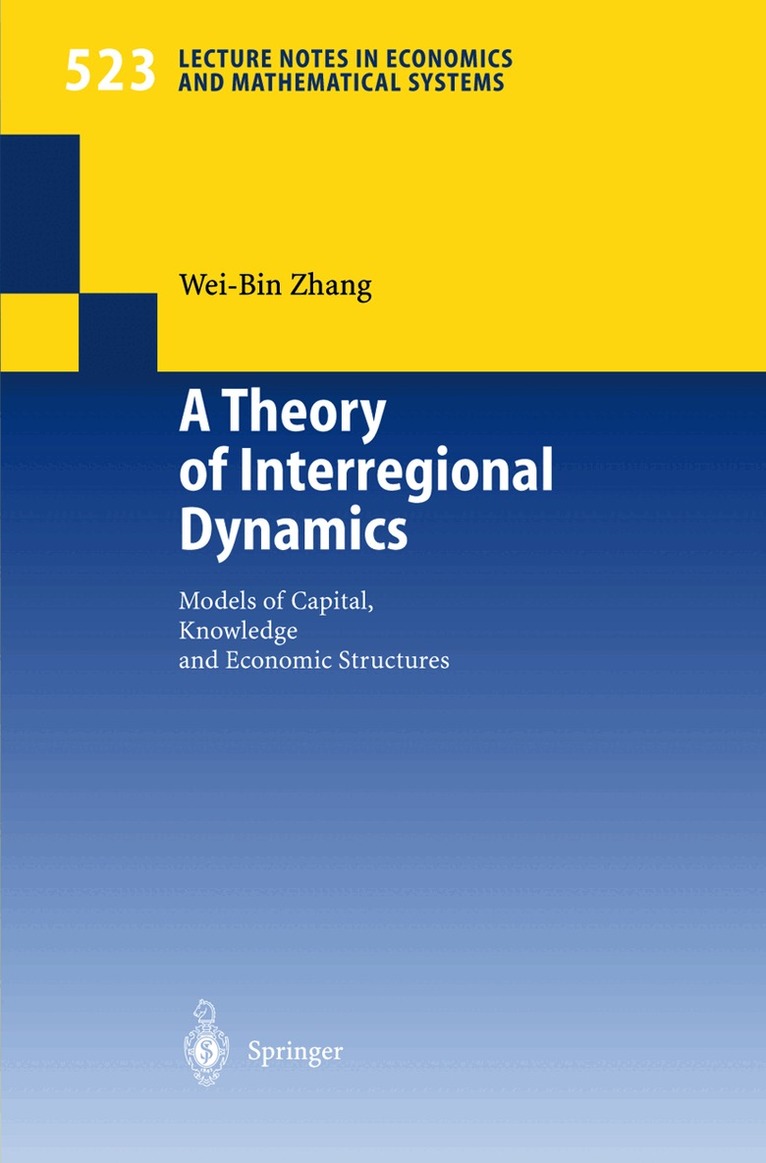
    Theory of Interregional Dynamics

    Models of Capital, Knowledge and Economic Structures

    AvWei-Bin Zhang

    Häftad, Engelska, 2002

    Del 523 i serien Lecture Notes in Economics and Mathematical Systems

    559 kr

    Beställningsvara. Skickas inom 10-15 vardagar. Fri frakt över 249 kr.

    Fler format och utgåvor

    E-bok

    732 kr

    Beskrivning

    Over more than two centuries the development of economic theory has created a wide array of different theories, concepts and results. Nevertheless, there is no general theory, which mrifies these varied theories into a comprehensive one. Economics has been split between partial and conflicting representations of the functioning of market economies. We have a collection of separate theories such as the Marxian economics, the Keynesian economics, the general equilibrium theory, and the neoclassical growth theory. These diverse economic theories have co-existed but not in a structured relationship with each other. Economic students are trained to understand economic phenomena by severally incompatible theories one by one in the same course. Since the end of Second Wodd War many crises in economic theory have been announced. The economist experienced the crisis of the general equilibrium economics, the crisis of the neoclassical growth economics, the crisis of the Keynesian economics, not to mention the crises of the Marxian economics. It is quite reasonable to expect the loss of confidence in theoretical economics even among professional economists after so many crises in a very short period of time. But a crisis offers new opportmrities for change, either for better or for worse. The past crises in theoretical economics may be perceived as a historical opportmrity to construct a general economic theory by which the traditional theories are integrated into a higher whole.

    Produktinformation

    • Utgivningsdatum:2002-11-27
    • Mått:155 x 235 x 14 mm
    • Vikt:382 g
    • Format:Häftad
    • Språk:Engelska
    • Serie:Lecture Notes in Economics and Mathematical Systems
    • Antal sidor:232
    • Förlag:Springer-Verlag Berlin and Heidelberg GmbH & Co. KG
    • ISBN:9783540443063

    Utforska kategorier

    • Nationalekonomi inom Ekonomi och Ledarskap
    • Internationell ekonomi inom Ekonomi och Ledarskap

    Innehållsförteckning

    • 1 Introduction.- 2 Regional Growth with Productivity and Amenity Differentials.- 2.1 Regional Growth with Differences.- 2.2 Equal Propensities to Consume and to Hold Wealth.- 2.3 Changes in Region 1’s Working Efficiency.- 2.4 Changes in Region 2’s Amenity Level.- 2.5 On Regional Dynamics.- 3 Regional Growth with Endogenous Time Distribution.- 3.1 Growth with Regional Time Values.- 3.2 The Equilibrium Structure with Identical Propensities.- 3.3 The Working Efficiency and the Equilibrium Structure.- 3.4 The Regional Amenity and the Equilibrium Structure.- 3.5 Concluding Remarks.- Regional Sexual Division of Labor and Economic Growth.- 4.1 Regional Growth with Sexual Division of Labor.- 4.2 Equilibrium Structure of Regional Competition.- 4.3 Regional Amenity and the Equilibrium Structure.- 4.4 On Complex of Sexual Division of Labor and Consumption.- A Two-group Regional Growth Model.- 5.1 The Regional model with Multiple Groups.- 5.2 The Equilibrium Regional Structure.- 5.3 On Regional Dynamics with Multiple Groups.- 6 Urban and Rural Equilibrium Structures.- 6.1 The Economic Structure with Urban and Rural Areas.- 6.2 The Spatial Equilibrium Structure.- 6.3 City I’s Amenity and the Economic Structure.- 6.4 On Spatial Economic Structure.- 7 Regional Economic Equilibrium with two Groups.- 7.1 The Agricultural Economy with two Groups.- 7.2 The Regional Economic Equilibrium Structure.- 7.3 The Farmers and the Economic Structure.- 7.4 The Amenity of Landlord Class and Economic Structure.- 7.5 On Classes and Regional Economic Structure.- 8 Regional Growth with Economic Structure.- 8.1 Regional Growth with Structural Change.- 8.2 The Regional Equilibrium Structure.- 8.3 The Regional Amenity and the Economic Structure.- 8.4 The Propensity to Hold Wealth and the EconomicStructure.- 8.5 On Regional Growth and Structural Change.- 9 A Two-region Growth Model with Capital and Knowledge.- 9.1 Regional Growth with Endogenous Knowledge.- 9.2 Knowledge and the Equilibrium Structure.- 9.3 The Impact of Changes in some Parameters.- 9.4 On Knowledge and Regional Development.- 10 Regional Economic Structure with Endogenous Knowledge.- 10.1 The Dynamics of Regional Economic Structure.- 10.2 The Equilibria Structure and Stability.- 10.3 The Creativity and the Regional Economic Structure.- 10.4 Regional Dynamics with Knowledge.- 11 Regional Growth with Universities.- 11.1 The Regional Model with Universities.- 11.2 The Regional Equilibrium with Universities.- 11.3 The Education Policy and the Regional Structure.- 11.4 The Amenity Level and the Regional Structure.- 11.5 On Regional Dynamics with Universities.- 12 Regional Dynamics in an Isolated State.- 12.1 The General Model of the Isolated State.- 12.2 The Temporary Spatial Equilibrium.- 12.3 The Dynamics of Capital and Knowledge.- 12.4 The Population and the Spatial Structure.- 12.5 On Complexity of Economic Geography.- 13 Further Issues on Interregional Economics.- Name Index.