• Fri frakt över 249 kr
  • •
  • Snabba leveranser
  • •
  • Billiga böcker
Kundservice

Du är på sajten för privatpersoner.

Företag, bibliotek eller offentlig verksamhet?

Du handlar på classic.bokus.com, där alla dina funktioner finns intakta.
Till classic.bokus.com
Bokus logotyp. Gå till startsidan.
  • Erbjudanden
  • Student
  • Topplistor
  • Barn & ungdom
  • Bokus Play
  • E-böcker
  • Ljudböcker
  • Pocketböcker
  • Spel och pussel

Pocketfynda! Hundratals böcker för 49 kr/st →

Sidfot

Mina sidor

    Hjälp

    • Kundservice
    • Vanliga frågor och svar
    • Frakt och leverans
    • Retur vid ångerrätt
    • Reklamera vara
    • Betalning
    • Köpvillkor
    • Allmänna villkor
    • Information om webbplatsens tillgänglighet

    Om Bokus

    • Om oss
    • Pressrum
    • För studenter
    • För företag
    • För bibliotek och offentlig verksamhet
    • För leverantörer
    • Hållbarhet

    Populärt

    • Aktuella erbjudanden
    • Presentkort
    • Studentlitteratur
    • Nya böcker
    • Topplistor
    • Signerade böcker
    • Engelska böcker

    Inspiration

    • Boktips
    • BookTok
    • Barnbokskaraktärer
    • Populära författare
    Logotyp för Bokus
    Följ oss på Facebook (extern länk)Följ oss på Instagram (extern länk)Följ oss på YouTube (extern länk)Följ oss på TikTok (extern länk)
    bokus @ CookiesAnpassa cookiesIntegritetspolicyKöpvillkor
    Till Citymail hemsida (extern länk)Till Budbee hemsida (extern länk)Till Postnord hemsida (extern länk)Till Schenker hemsida (extern länk)Till Early Bird hemsida (extern länk)Till Walleys hemsida (extern länk)
    1. Data och IT
    2. Systemvetenskap och AI

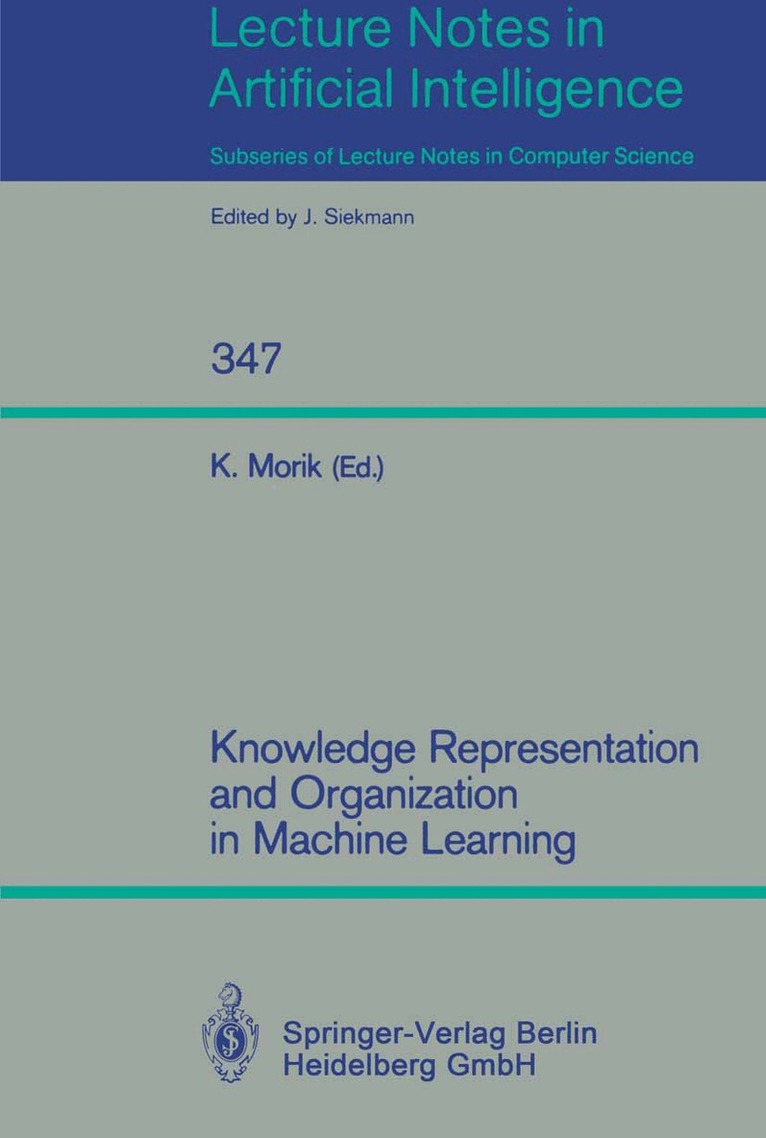
    Knowledge Representation and Organization in Machine Learning

    AvKatharina Morik

    Häftad, Engelska, 1989

    Del i serien Lecture Notes in Computer Science

    559 kr

    Beställningsvara. Skickas inom 10-15 vardagar. Fri frakt över 249 kr.

    Beskrivning

    Machine learning has become a rapidly growing field of Artificial Intelligence. Since the First International Workshop on Machine Learning in 1980, the number of scientists working in the field has been increasing steadily. This situation allows for specialization within the field. There are two types of specialization: on subfields or, orthogonal to them, on special subjects of interest. This book follows the thematic orientation. It contains research papers, each of which throws light upon the relation between knowledge representation, knowledge acquisition and machine learning from a different angle. Building up appropriate representations is considered to be the main concern of knowledge acquisition for knowledge-based systems throughout the book. Here machine learning is presented as a tool for building up such representations. But machine learning itself also states new representational problems. This book gives an easy-to-understand insight into a new field with its problems and the solutions it offers. Thus it will be of good use to both experts and newcomers to the subject.

    Produktinformation

    • Utgivningsdatum:1989-01-25
    • Mått:155 x 235 x 19 mm
    • Vikt:517 g
    • Format:Häftad
    • Språk:Engelska
    • Serie:Lecture Notes in Computer Science
    • Antal sidor:322
    • Upplaga:1989
    • Förlag:Springer-Verlag Berlin and Heidelberg GmbH & Co. KG
    • ISBN:9783540507680

    Utforska kategorier

    • Systemvetenskap och AI inom Data och IT

    Innehållsförteckning

    • Explanation: A source of guidance for knowledge representation.- (Re)presentation issues in second generation expert systems.- Some aspects of learning and reorganization in an analogical representation.- A knowledge-intensive learning system for document retrieval.- Constructing expert systems as building mental models or toward a cognitive ontology for expert systems.- Sloppy modeling.- The central role of explanations in disciple.- An inference engine for representing multiple theories.- The acquisition of model-knowledge for a model-driven machine learning approach.- Using attribute dependencies for rule learning.- Learning disjunctive concepts.- The use of analogy in incremental SBL.- Knowledge base refinement using apprenticeship learning techniques.- Creating high level knowledge structures from simple elements.- Demand-driven concept formation.