• Fri frakt över 249 kr
  • •
  • Snabba leveranser
  • •
  • Billiga böcker
Kundservice

Du är på sajten för privatpersoner.

Företag, bibliotek eller offentlig verksamhet?

Du handlar på classic.bokus.com, där alla dina funktioner finns intakta.
Till classic.bokus.com
Bokus logotyp. Gå till startsidan.
  • Erbjudanden
  • Nyheter
  • Student
  • Topplistor
  • Barn & ungdom
  • Bokus Play
  • E-böcker
  • Pocketböcker
  • Spel & pussel

10% rabatt på allt med kod NYSTART10 →

Sidfot

Mina sidor

    Hjälp

    • Kundservice
    • Vanliga frågor och svar
    • Frakt och leverans
    • Retur vid ångerrätt
    • Reklamera vara
    • Betalning
    • Köpvillkor
    • Allmänna villkor
    • Information om webbplatsens tillgänglighet

    Om Bokus

    • Om oss
    • Pressrum
    • För studenter
    • För företag
    • För bibliotek och offentlig verksamhet
    • För leverantörer
    • Hållbarhet

    Populärt

    • Aktuella erbjudanden
    • Presentkort
    • Studentlitteratur
    • Nya böcker
    • Topplistor
    • Signerade böcker
    • Engelska böcker

    Inspiration

    • Boktips
    • BookTok
    • Populära bokserier
    • Barnbokskaraktärer
    • Populära författare
    Logotyp för Bokus
    Följ oss på Facebook (extern länk)Följ oss på Instagram (extern länk)Följ oss på YouTube (extern länk)Följ oss på TikTok (extern länk)
    bokus @ CookiesAnpassa cookiesIntegritetspolicyKöpvillkor
    Till Citymail hemsida (extern länk)Till Budbee hemsida (extern länk)Till Postnord hemsida (extern länk)Till Schenker hemsida (extern länk)Till Early Bird hemsida (extern länk)Till Walleys hemsida (extern länk)
    1. Ekonomi och Ledarskap
    2. Nationalekonomi

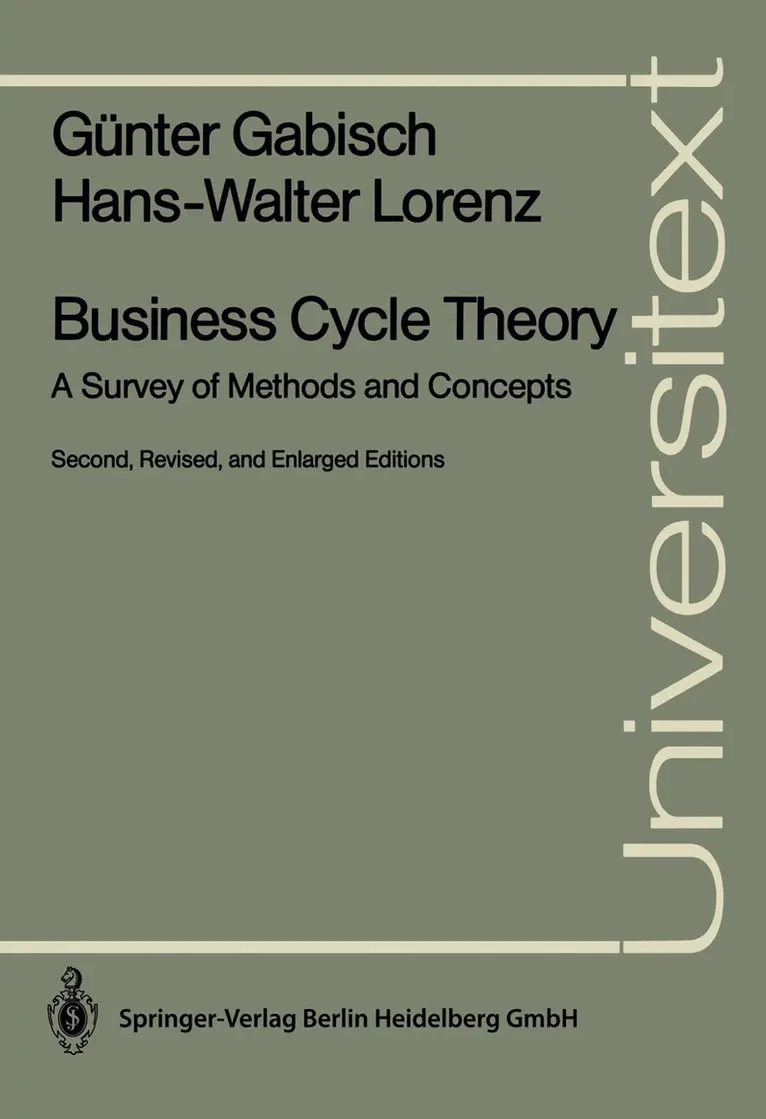
    Business Cycle Theory

    A Survey of Methods and Concepts

    AvGünter Gabisch,Hans-Walter Lorenz

    Häftad, Engelska, 1989

    Del i serien Universitext

    563 kr

    Beställningsvara. Skickas inom 10-15 vardagar. Fri frakt över 249 kr.

    Beskrivning

    "Is the business cycle obsolete?" This often cited title of a book edited by Bronfenbren­ ner with the implicit affirmation of the question reflected the attitude of mainstream macroeconomics in the 1960s regarding the empirical relevance of cyclic motions of an economy. The successful income policies, theoretically grounded in Keynesian macroec­ onomics, seemed to have eased or even abolished the fluctuations in Western economies which motivated studies of many classical and neoclassical economists for more than 100 years. The reasoning behind the conviction that business cycles would increasingly be­ come irrelevant was rather simple: if an economy fluctuates for whatever reason, then it is almost always possible to neutralize these cyclic motions by means of anticyclic demand policies. From the 1950s until the mid-1960s business cycle theory had often been consid­ ered either as an appendix to growth theory or as an academic exercise in dynamical economics. The common business cycle models were essentially multiplier-accelerator models whose dependence on particular parameter values (in order to exhibit oscillatory motion) suggested a rather improbable occurrence of persistent fluctuations. The obvi­ ous success in compensating business cycles in those days prevented intensive concern with the occurrence of cycles. Rather, business cycle theory turned into stabilization theory which investigated theoretical possibilities of stabilizing a fluctuating economy. Many macroeconomic textbooks appeared in the 1960s which consequently identified business cycle theory with inquiries on the possibilities to stabilize economies by means of active fiscal or monetary policies.

    Produktinformation

    • Utgivningsdatum:1989-04-14
    • Mått:170 x 244 x 15 mm
    • Vikt:462 g
    • Format:Häftad
    • Språk:Engelska
    • Serie:Universitext
    • Antal sidor:250
    • Upplaga:2
    • Förlag:Springer-Verlag Berlin and Heidelberg GmbH & Co. KG
    • ISBN:9783540510598

    Utforska kategorier

    • Nationalekonomi inom Ekonomi och Ledarskap

    Innehållsförteckning

    • Preface.- 1. Fluctuations in Major Economic Variables.- 1.1. Periodic Patterns and Stylized Facts.- 1.2. The Measurement of the Business Cycle.- 2. Shock-Dependent Business Cycle Theories.- 2.1. Discrete-Time Shock-Dependent Models.- 2.2. Continuous-Time Shock-Dependent Models.- 2.3. The Kalecki Model and Mixed Difference-Differential Equations.- 2.4. The Relevance of Shock-Dependent Business Cycle Theories.- 3. Business Cycle Theory and Exogenous Shocks.- 3.1. The Political Business Cycle.- 3.2. The Theory of Stochastic Business Cycles.- 3.3. The Rational Expectations Approach to Business Cycles.- 4. Shock-Independent Business Cycle Theorie.- 4.1. A Linear Shock-Independent Growth Cycle Model.- 4.2. Goodwin’s Quasi-Non-Linear Accelerator.- 4.3. Non-Linear Theories of the Cycle.- 5. Complex Motion in Business Cycle Models.- 5.1. Non-Linearities and Chaotic Movements.- 5.2. Catastrophe Theory and Business Cycle Theory.- 5.3. Structural Instability and Business Cycle Theory - Conclusions.- References.- Name Index.