• Fri frakt över 249 kr
  • •
  • Snabba leveranser
  • •
  • Billiga böcker
Kundservice

Du är på sajten för privatpersoner.

Företag, bibliotek eller offentlig verksamhet?

Du handlar på classic.bokus.com, där alla dina funktioner finns intakta.
Till classic.bokus.com
Bokus logotyp. Gå till startsidan.
  • Erbjudanden
  • Nyheter
  • Student
  • Topplistor
  • Barn & ungdom
  • Bokus Play
  • E-böcker
  • Pocketböcker
  • Spel & pussel

10% rabatt på allt med kod: NYSTART10 →

Sidfot

Mina sidor

    Hjälp

    • Kundservice
    • Vanliga frågor och svar
    • Frakt och leverans
    • Retur vid ångerrätt
    • Reklamera vara
    • Betalning
    • Köpvillkor
    • Allmänna villkor
    • Information om webbplatsens tillgänglighet

    Om Bokus

    • Om oss
    • Pressrum
    • För studenter
    • För företag
    • För bibliotek och offentlig verksamhet
    • För leverantörer
    • Hållbarhet

    Populärt

    • Aktuella erbjudanden
    • Presentkort
    • Studentlitteratur
    • Nya böcker
    • Topplistor
    • Signerade böcker
    • Engelska böcker

    Inspiration

    • Boktips
    • BookTok
    • Populära bokserier
    • Barnbokskaraktärer
    • Populära författare
    Logotyp för Bokus
    Följ oss på Facebook (extern länk)Följ oss på Instagram (extern länk)Följ oss på YouTube (extern länk)Följ oss på TikTok (extern länk)
    bokus @ CookiesAnpassa cookiesIntegritetspolicyKöpvillkor
    Till Citymail hemsida (extern länk)Till Budbee hemsida (extern länk)Till Postnord hemsida (extern länk)Till Schenker hemsida (extern länk)Till Early Bird hemsida (extern länk)Till Walleys hemsida (extern länk)
    1. Ekonomi och Ledarskap
    2. Nationalekonomi
    3. Makroekonomi

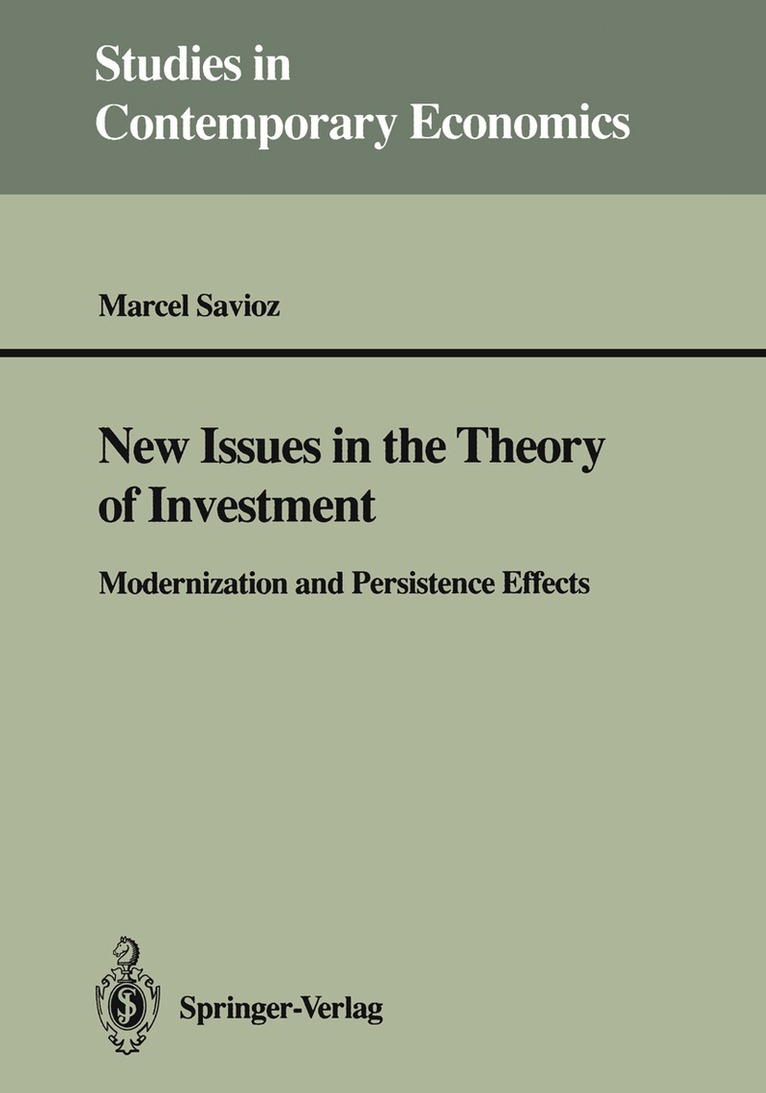
    New Issues in the Theory of Investment

    Modernization and Persistence Effects

    AvMarcel Savioz

    Häftad, Engelska, 1992

    Del i serien Studies in Contemporary Economics

    1 119 kr

    Beställningsvara. Skickas inom 10-15 vardagar. Fri frakt över 249 kr.

    Fler format och utgåvor

    E-bok

    1 455 kr

    Beskrivning

    The investment good market, together with the consumer good market, the money market and the labour market, are indeed the most extensively studied markets. The exhaustive survey of investment theory by Eisner and Strotz, already quoted four hundred references in 1963, although this work advocating for adjustment costs, was in fact only carried out at the very beginning of modern investment theory! This chapter gives an introduction of the extensive field and is an attempt to present some key ideas of investment theory. 1) We show that modern investment theory is the integration of many traditional approaches. The content of the chapter is set as follows. Section 2 presents an illustrative model of investment theory. Section 3, using this model, describes the investment decision of the firm. Sections 4 to 10 each present a "classical" investment hypothesis within the framework of the model. Section 11 concludes. For convenience, the key to the symbols used is given in Table 1. 2. The Model of the Firm Investment theory was born with the claim of Keynes (1936) that besides the capital demand (demand for a stock of capital at a point in time), an investment demand (demand for the increment of the capital stock in a period 1) Recent surveys are: Abel (1988), Coen and Eisner (1987) Artus and Muet (1984). The book on investment theory by Nickell (1978) is outstanding.

    Produktinformation

    • Utgivningsdatum:1992-01-29
    • Mått:170 x 242 x 13 mm
    • Vikt:412 g
    • Format:Häftad
    • Språk:Engelska
    • Serie:Studies in Contemporary Economics
    • Antal sidor:216
    • Förlag:Springer-Verlag Berlin and Heidelberg GmbH & Co. KG
    • ISBN:9783540549796

    Utforska kategorier

    • Makroekonomi inom Ekonomi och Ledarskap

    Innehållsförteckning

    • Investment Theory: An Integrative Framework.- 1. The Main Problem of Investment Theory.- 2. The Main Approaches to Investment Theory.- 3. An Integrative Framework.- Ageing of Capital Stock and Fiscal Policy.- 1. Description of the Model.- 2. Predictions of the Model.- Persistence of Extensive Growth.- 1. Description of the Model.- 2. Predictions of the Model.- I Investment Theory: An Integrative Framework.- 1. Introduction.- 2. The Model of the Firm.- 3. The Investment Decision of the Firm.- 4. Tobin’s “Q — Investment Demand”.- 5. Treadway’s “Optimal Accelerator”.- 6. Lucas’s “Optimal Investment with Rational Expectations”.- 7. Keynes’s “Marginal Efficiency of Capital”.- 8. Jorgenson’s “Neoclassical Investment Demand”.- 9. Kydland and Prescott’s “Time to Build”.- 10. Arrow’s “Irreversibility of Investment”.- 11. Conclusions.- II Ageing of the Capital Stock: A Long Run Side-Effect of Expansive Fiscal Policy.- 1. Introduction.- 2. The Model of the Firm.- 3. Necessary and Sufficient Conditions.- 4. Predictions of the Model.- 5. Fiscal Policy and Age of the Capital Stock.- 6. Conclusions.- III Persistence of Extensive Growth: A Growth Model of the Soviet Economy.- 1. Introduction.- 2. Model of the Central Planning Economy.- 3. Necessary Conditions.- 4. The Growth-Process.- 5. The Growth Process of the Soviet Union.- 6. Conclusions.- References.- Appendices.- Appendices to Chapter I.- Appendix 1.- Appendix 2.- Appendix 3.- Appendix 4.- Appendix 5.- Appendix 6.- Appendices to Chapter II.- Appendix 1.- Appendix 2.- Appendix 3.- Appendix 4.- Appendix 5.- Appendices to Chapter III.- Appendix 1.- Appendix 2.