• Fri frakt över 249 kr
  • •
  • Snabba leveranser
  • •
  • Billiga böcker
Kundservice

Du är på sajten för privatpersoner.

Företag, bibliotek eller offentlig verksamhet?

Du handlar på classic.bokus.com, där alla dina funktioner finns intakta.
Till classic.bokus.com
Bokus logotyp. Gå till startsidan.
  • Erbjudanden
  • Nyheter
  • Student
  • Topplistor
  • Barn & ungdom
  • Bokus Play
  • E-böcker
  • Pocketböcker
  • Spel & pussel

10% rabatt på allt med kod: NYSTART10 →

Sidfot

Mina sidor

    Hjälp

    • Kundservice
    • Vanliga frågor och svar
    • Frakt och leverans
    • Retur vid ångerrätt
    • Reklamera vara
    • Betalning
    • Köpvillkor
    • Allmänna villkor
    • Information om webbplatsens tillgänglighet

    Om Bokus

    • Om oss
    • Pressrum
    • För studenter
    • För företag
    • För bibliotek och offentlig verksamhet
    • För leverantörer
    • Hållbarhet

    Populärt

    • Aktuella erbjudanden
    • Presentkort
    • Studentlitteratur
    • Nya böcker
    • Topplistor
    • Signerade böcker
    • Engelska böcker

    Inspiration

    • Boktips
    • BookTok
    • Populära bokserier
    • Barnbokskaraktärer
    • Populära författare
    Logotyp för Bokus
    Följ oss på Facebook (extern länk)Följ oss på Instagram (extern länk)Följ oss på YouTube (extern länk)Följ oss på TikTok (extern länk)
    bokus @ CookiesAnpassa cookiesIntegritetspolicyKöpvillkor
    Till Citymail hemsida (extern länk)Till Budbee hemsida (extern länk)Till Postnord hemsida (extern länk)Till Schenker hemsida (extern länk)Till Early Bird hemsida (extern länk)Till Walleys hemsida (extern länk)
    1. Data och IT
    2. Systemvetenskap och AI
    3. Artificiell intelligens

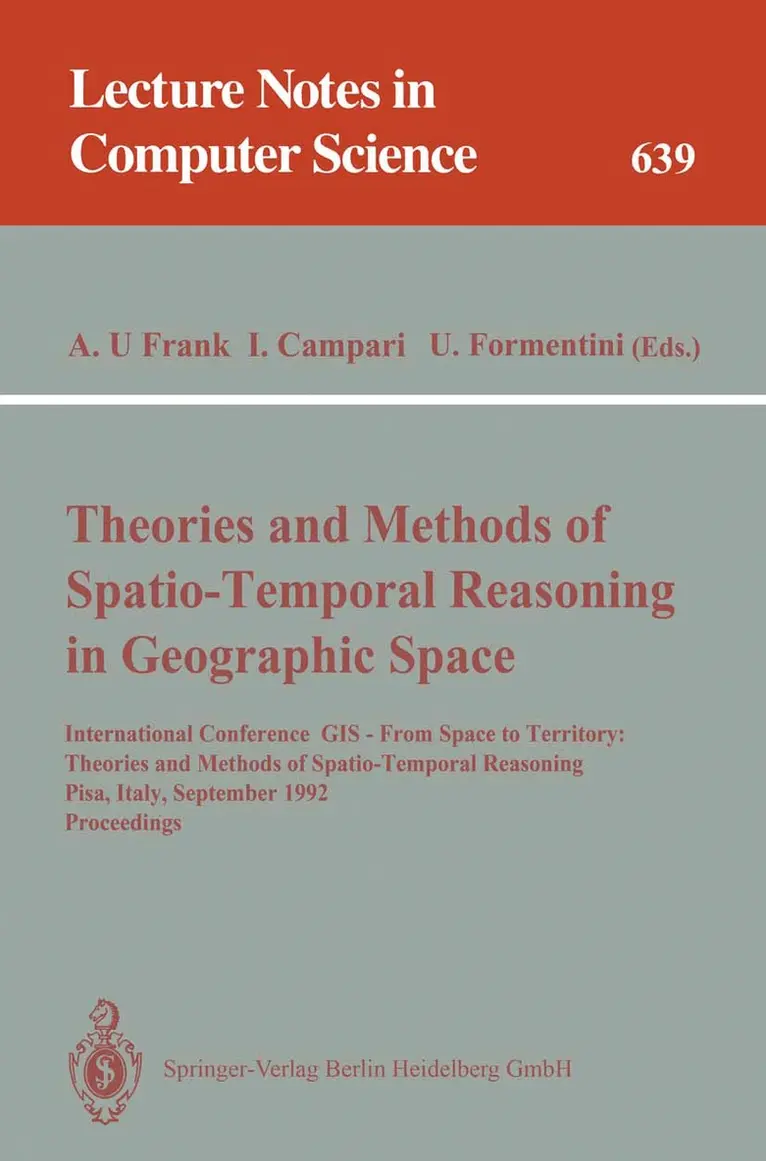
    Theories and Methods of Spatio-Temporal Reasoning in Geographic Space

    International Conference GIS - From Space to Territory: Theories and Methods of Spatio-Temporal Reasoning, Pisa, Italy, September 21-23, 1992. Proceedings

    AvAndrew U. Frank,Irene Campari

    Häftad, Engelska, 1992

    Del i serien Lecture Notes in Computer Science

    563 kr

    Beställningsvara. Skickas inom 10-15 vardagar. Fri frakt över 249 kr.

    Beskrivning

    This volume collects the papers presented at the firstinternational conference dedicated to spatial and temporalreasoning in geographic space, entitled "GIS: from space toterritory - theories and methods of spatio-temporalreasoning".Within the National Center for Geographic Information andAnalysis (NCGIA, one of the supporters of the conference)the importance of spatial and temporal reasoning wasrecognized several years ago. Initial research found thatspatial reasoning in geographic or large-scale space isdifferent from spatial reasoning in small-scale space, asusually dealt with in robotics and expertsystems. Temporalreasoning has attracted interest in the artificialintelligence community.The volume also includes two invited papers: "Do peopleunderstand spatial concepts: the case of first-orderprimtives" by R.G. Golledge, and "Temporal databases" byR.T. Snodgrass.

    Produktinformation

    • Utgivningsdatum:1992-09-09
    • Mått:155 x 235 x 25 mm
    • Vikt:680 g
    • Format:Häftad
    • Språk:Engelska
    • Serie:Lecture Notes in Computer Science
    • Antal sidor:439
    • Upplaga:1992
    • Förlag:Springer-Verlag Berlin and Heidelberg GmbH & Co. KG
    • ISBN:9783540559665

    Utforska kategorier

    • Artificiell intelligens inom Data och IT

    Innehållsförteckning

    • Do people understand spatial concepts: The case of first-order primitives.- Temporal databases.- People manipulate objects (but cultivate fields): Beyond the raster-vector debate in GIS.- Time and space:An economic model.- The changing language of and persisting patterns in the urban design of Edo/Tokyo.- Toward a behavioral theory of regionalization.- Descriptive modeling and prescriptive modeling in spatial data handling.- The geometry of environmental knowledge.- Spatial reasoning using symbolic arrays.- Using orientation information for qualitative spatial reasoning.- The observer's point of view: An extension of symbolic projections.- Reasoning about gradual changes of topological relationships.- The meaning of “neighbour”.- A hierarchical triangle-based model for terrain description.- A model for expressing topological integrity constraints in geographic databases.- Encoding spatial information: The evidence for hierarchical processing.- Is there a relationship between spatial cognition and environmental patterns?.- Counter-intuitive geographic ‘facts’: Clues for spatial reasoning at geographic scales.- Spatial-linguistic reasoning in LEI.- User models and information theory in the design of a query interface for GIS.- A conceptual model of wayfinding using multiple levels of abstraction.- Towards acquiring spatio-temporal knowledge from sensor data.- Automatically acquiring knowledge by digital maps in artificial intelligence planning techniques.- Machine induction of geospatial knowledge.- Treatment of qualitative geographic information in monitoring environmental pollution.