• Fri frakt över 249 kr
  • •
  • Snabba leveranser
  • •
  • Billiga böcker
Kundservice

Du är på sajten för privatpersoner.

Företag, bibliotek eller offentlig verksamhet?

Du handlar på classic.bokus.com, där alla dina funktioner finns intakta.
Till classic.bokus.com
Bokus logotyp. Gå till startsidan.
  • Erbjudanden
  • Nyheter
  • Student
  • Topplistor
  • Barn & ungdom
  • Bokus Play
  • E-böcker
  • Pocketböcker
  • Spel & pussel

10% rabatt på allt med kod NYSTART10 →

Sidfot

Mina sidor

    Hjälp

    • Kundservice
    • Vanliga frågor och svar
    • Frakt och leverans
    • Retur vid ångerrätt
    • Reklamera vara
    • Betalning
    • Köpvillkor
    • Allmänna villkor
    • Information om webbplatsens tillgänglighet

    Om Bokus

    • Om oss
    • Pressrum
    • För studenter
    • För företag
    • För bibliotek och offentlig verksamhet
    • För leverantörer
    • Hållbarhet

    Populärt

    • Aktuella erbjudanden
    • Presentkort
    • Studentlitteratur
    • Nya böcker
    • Topplistor
    • Signerade böcker
    • Engelska böcker

    Inspiration

    • Boktips
    • BookTok
    • Populära bokserier
    • Barnbokskaraktärer
    • Populära författare
    Logotyp för Bokus
    Följ oss på Facebook (extern länk)Följ oss på Instagram (extern länk)Följ oss på YouTube (extern länk)Följ oss på TikTok (extern länk)
    bokus @ CookiesAnpassa cookiesIntegritetspolicyKöpvillkor
    Till Citymail hemsida (extern länk)Till Budbee hemsida (extern länk)Till Postnord hemsida (extern länk)Till Schenker hemsida (extern länk)Till Early Bird hemsida (extern länk)Till Walleys hemsida (extern länk)
    1. Data och IT
    2. Systemvetenskap och AI

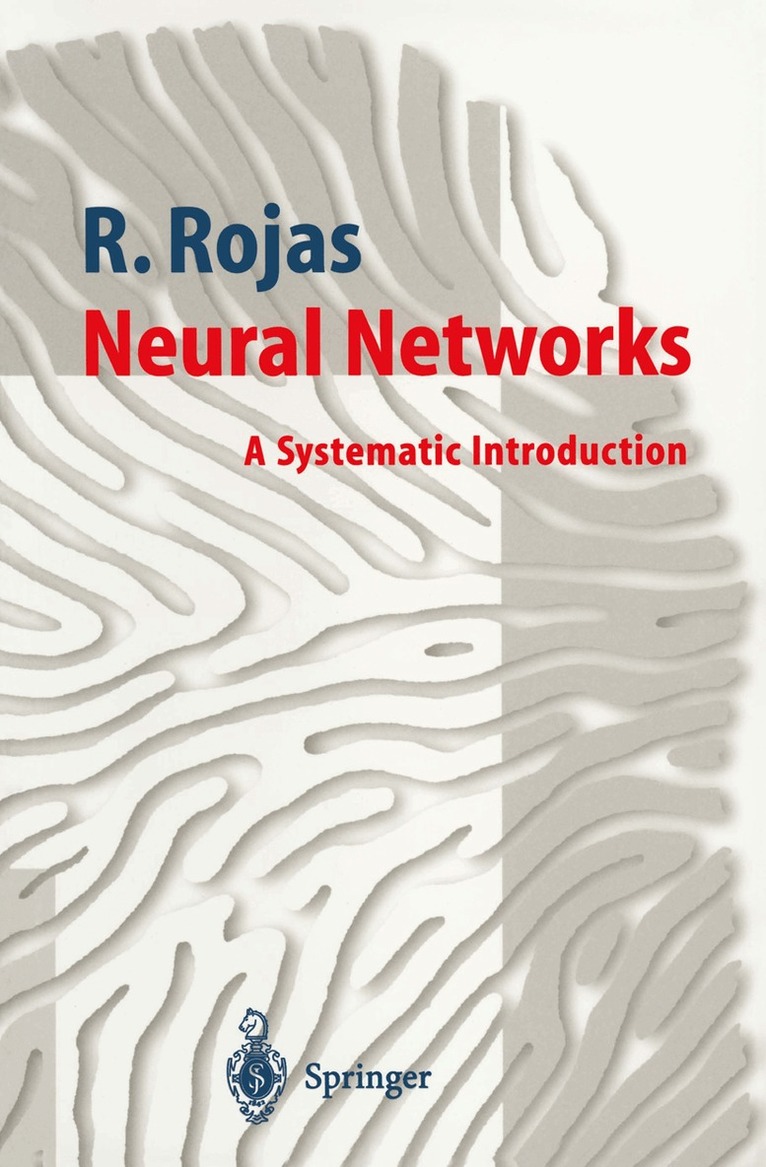
    Neural Networks

    A Systematic Introduction

    AvRaul Rojas

    Häftad, Engelska, 1996

    1 117 kr

    Beställningsvara. Skickas inom 10-15 vardagar. Fri frakt över 249 kr.

    Fler format och utgåvor

    E-bok

    1 255 kr

    Beskrivning

    Neural networks are a computing paradigm that is finding increasing attention among computer scientists. In this book, theoretical laws and models previously scattered in the literature are brought together into a general theory of artificial neural nets. Always with a view to biology and starting with the simplest nets, it is shown how the properties of models change when more general computing elements and net topologies are introduced. Each chapter contains examples, numerous illustrations, and a bibliography. The book is aimed at readers who seek an overview of the field or who wish to deepen their knowledge. It is suitable as a basis for university courses in neurocomputing.

    Produktinformation

    • Utgivningsdatum:1996-07-12
    • Mått:155 x 235 x 29 mm
    • Vikt:785 g
    • Format:Häftad
    • Språk:Engelska
    • Antal sidor:502
    • Förlag:Springer-Verlag Berlin and Heidelberg GmbH & Co. KG
    • Medarbetare:J. Feldman
    • ISBN:9783540605058

    Utforska kategorier

    • Systemvetenskap och AI inom Data och IT
    • 3D-grafik och modellering inom Data och IT

    Recensioner i media

    "If you want a systematic and thorough overview of neural networks, need a good reference book on this subject, or are giving or taking a course on neural networks, this book is for you." Computing Reviews

    Innehållsförteckning

    • 1. The Biological Paradigm.- 1.1 Neural computation.- 1.2 Networks of neurons.- 1.3 Artificial neural networks.- 1.4 Historical and bibliographical remarks.- 2. Threshold Logic.- 2.1 Networks of functions.- 2.2 Synthesis of Boolean functions.- 2.3 Equivalent networks.- 2.4 Recurrent networks.- 2.5 Harmonic analysis of logical functions.- 2.6 Historical and bibliographical remarks.- 3.Weighted Networks — The Perceptron.- 3.1 Perceptrons and parallel processing.- 3.2 Implementation of logical functions.- 3.3 Linearly separable functions.- 3.4 Applications and biological analogy.- 3.5 Historical and bibliographical remarks.- 4. Perceptron Learning.- 4.1 Learning algorithms for neural networks.- 4.2 Algorithmic learning.- 4.3 Linear programming.- 4.4 Historical and bibliographical remarks.- 5. Unsupervised Learning and Clustering Algorithms.- 5.1 Competitive learning.- 5.2 Convergence analysis.- 5.3 Principal component analysis.- 5.4 Some applications.- 5.5 Historical and bibliographical remarks.- 6. One and Two Layered Networks.- 6.1 Structure and geometric visualization.- 6.2 Counting regions in input and weight space.- 6.3 Regions for two layered networks.- 6.4 Historical and bibliographical remarks.- 7. The Backpropagation Algorithm.- 7.1 Learning as gradient descent.- 7.2 General feed-forward networks.- 7.3 The case of layered networks.- 7.4 Recurrent networks.- 7.5 Historical and bibliographical remarks.- 8. Fast Learning Algorithms.- 8.1 Introduction — classical backpropagation.- 8.2 Some simple improvements to backpropagation.- 8.3 Adaptive step algorithms.- 8.4 Second-order algorithms.- 8.5 Relaxation methods.- 8.6 Historical and bibliographical remarks.- 9. Statistics and Neural Networks.- 9.1 Linear and nonlinear regression.- 9.2 Multiple regression.- 9.3Classification networks.- 9.4 Historical and bibliographical remarks.- 10. The Complexity of Learning.- 10.1 Network functions.- 10.2 Function approximation.- 10.3 Complexity of learning problems.- 10.4 Historical and bibliographical remarks.- 11. Fuzzy Logic.- 11.1 Fuzzy sets and fuzzy logic.- 11.2 Fuzzy inferences.- 11.3 Control with fuzzy logic.- 11.4 Historical and bibliographical remarks.- 12. Associative Networks.- 12.1 Associative pattern recognition.- 12.2 Associative learning.- 12.3 The capacity problem.- 12.4 The pseudoinverse.- 12.5 Historical and bibliographical remarks.- 13. The Hopfield Model.- 13.1 Synchronous and asynchronous networks.- 13.2 Definition of Hopfield networks.- 13.3 Converge to stable states.- 13.4 Equivalence of Hopfield and perceptron learning.- 13.5 Parallel combinatorics.- 13.6 Implementation of Hopfield networks.- 13.7 Historical and bibliographical remarks.- 14. Stochastic Networks.- 14.1 Variations of the Hopfield model.- 14.2 Stochastic systems.- 14.3 Learning algorithms and applications.- 14.4 Historical and bibliographical remarks.- 15. Kohonen Networks.- 15.1 Self-organization.- 15.2 Kohonen’s model.- 15.3 Analysis of convergence.- 15.4 Applications.- 15.5 Historical and bibliographical remarks.- 16. Modular Neural Networks.- 16.1 Constructive algorithms for modular networks.- 16.2 Hybrid networks.- 16.3 Historical and bibliographical remarks.- 17. Genetic Algorithms.- 17.1 Coding and operators.- 17.2 Properties of genetic algorithms.- 17.3 Neural networks and genetic algorithms.- 17.4 Historical and bibliographical remarks.- 18. Hardware for Neural Networks.- 18.1 Taxonomy of neural hardware.- 18.2 Analog neural networks.- 18.3 Digital networks.- 18.4 Innovative computer architectures.- 18.5 Historical and bibliographicalremarks.