• Fri frakt över 249 kr
  • •
  • Snabba leveranser
  • •
  • Billiga böcker
Kundservice

Du är på sajten för privatpersoner.

Företag, bibliotek eller offentlig verksamhet?

Du handlar på classic.bokus.com, där alla dina funktioner finns intakta.
Till classic.bokus.com
Bokus logotyp. Gå till startsidan.
  • Erbjudanden
  • Student
  • Topplistor
  • Barn & ungdom
  • Bokus Play
  • E-böcker
  • Ljudböcker
  • Pocketböcker
  • Spel & pussel

10% rabatt på allt med kod NYSTART10 →

Sidfot

Mina sidor

    Hjälp

    • Kundservice
    • Vanliga frågor och svar
    • Frakt och leverans
    • Retur vid ångerrätt
    • Reklamera vara
    • Betalning
    • Köpvillkor
    • Allmänna villkor
    • Information om webbplatsens tillgänglighet

    Om Bokus

    • Om oss
    • Pressrum
    • För studenter
    • För företag
    • För bibliotek och offentlig verksamhet
    • För leverantörer
    • Hållbarhet

    Populärt

    • Aktuella erbjudanden
    • Presentkort
    • Studentlitteratur
    • Nya böcker
    • Topplistor
    • Signerade böcker
    • Engelska böcker

    Inspiration

    • Boktips
    • BookTok
    • Populära bokserier
    • Barnbokskaraktärer
    • Populära författare
    Logotyp för Bokus
    Följ oss på Facebook (extern länk)Följ oss på Instagram (extern länk)Följ oss på YouTube (extern länk)Följ oss på TikTok (extern länk)
    bokus @ CookiesAnpassa cookiesIntegritetspolicyKöpvillkor
    Till Citymail hemsida (extern länk)Till Budbee hemsida (extern länk)Till Postnord hemsida (extern länk)Till Schenker hemsida (extern länk)Till Early Bird hemsida (extern länk)Till Walleys hemsida (extern länk)
    1. Data och IT
    2. Systemvetenskap och AI

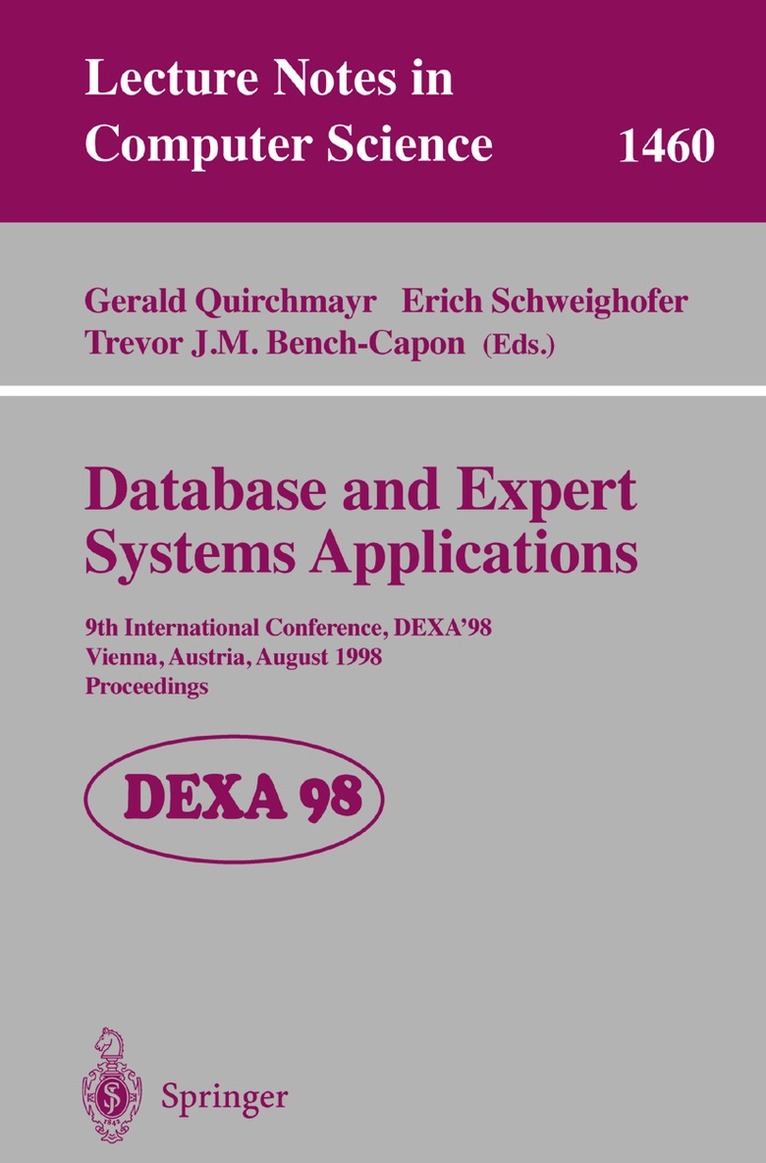
    Database and Expert Systems Applications

    9th International Conference, DEXA'98, Vienna, Austria, August 24-28, 1998, Proceedings

    AvGerald Quirchmayr,Erich Schweighofer

    Häftad, Engelska, 1998

    Del i serien Lecture Notes in Computer Science

    1 116 kr

    Beställningsvara. Skickas inom 10-15 vardagar. Fri frakt över 249 kr.

    Beskrivning

    This book constitutes the refereed proceedings of the 9th International Conference on Database and Expert Systems Applications, DEXA'98, held in Vienna, Austria, in August 1998.The 81 revised full papers presented were carefully selected from a total of more than 200 submissions. The papers are organized in sections on active databases, object-oriented systems, data engineering, information retrieval, workflow and cooperative systems, spatial and temporal aspects, document management, spatial databases, adaptation and view updates, genetic algorithms, cooperative and distributed environments, interaction and communication, transcation, advanced applications, temporal aspects, oriented systems, partitioning and fragmentation, database queries, data, data warehouses, knowledge discovery and data mining, knowledge extraction, and knowledge base reduction for comprehension and reuse.

    Produktinformation

    • Utgivningsdatum:1998-08-14
    • Mått:155 x 235 x undefined mm
    • Format:Häftad
    • Språk:Engelska
    • Serie:Lecture Notes in Computer Science
    • Antal sidor:926
    • Förlag:Springer-Verlag Berlin and Heidelberg GmbH & Co. KG
    • ISBN:9783540649502

    Utforska kategorier

    • Systemvetenskap och AI inom Data och IT
    • Databaser inom Data och IT

    Innehållsförteckning

    • Composite event management in TriGS — Concepts and implementation.- Towards a semantic event service for distributed active database applications.- Involving fuzzy concepts in active mobile databases.- An analytical study of object identifier indexing.- D02: Deductive object-oriented database system.- Selecting actions to trigger in active database applications.- Program understanding in databases reverse engineering.- Semantics based schema analysis.- Automatic derivation of terminological properties from database schemes.- A novel integration of OODBMS and information retrieval techniques for a document repository.- Rectangular decomposition of signature file: Design issues and performance evaluation.- Cumulative duality in designing information brokers.- A workflow system based on agents.- Multiuser transactions for collaborative database applications.- Modeling phenomena in spatiotemporal databases: Desiderata and solutions.- Rulebase checking using a spatial representation.- Hypermedia broadcasting with temporal links.- Inferring functional dependencies in linearly ordered databases.- Building consistent sample databases to support information system evolution and migration.- Process centred approach for developing tool support of situated methods.- A retrieval language for historical documents.- Modeling, indexing and retrieving images using conceptual graphs.- Applying document retrieval techniques in software engineering environments.- Browsing SGML documents with maps: The french “inventaire” experience.- An application-oriented approach for hytime structured document management.- Qualitative spatial relationships representation IO&T and its retrieval.- A qualitative approach to integration in spatial databases.- SVIQUEL: A spatial visual query andexploration language.- View adaptation in data warehousing systems.- Query containment checking as a view updating problem.- View updates translations in relational databases.- Optimisation of active rule agents using a genetic algorithm approach.- Optimization of constrained queries with a hybrid genetic algorithm.- Highlights of the SAMMOA framework for object oriented application modelling.- Virtual enterprises and federated information sharing.- Facilitating virtual representation of CAD data through a learning based approach to conceptual database evolution employing direct instance sharing.- Evaluation of the strength of computer aided method engineering for product development process modeling.- Distributed light-weight persistence in Java — A tour on RMI-and CORBA-based solutions.- Specifying the interaction between information sources.- HEROS: A heterogeneous object oriented database system.- An architecture for nested transaction support on standard database systems.- Transaction-based coordination of software agents.- Object-based group protocol.- Aurora: An architecture for dynamic and adaptive work sessions in open environments.- Design of secure distributed medical database systems.- Modeling of subjective interpretation for street landscape image.- Extend Dexter model to capture more semantics of hypermedia.- A generic framework for structured document access.- An evolvable personal advisor to optimize internet search technologies.- Indexing valid time intervals.- Indexing time-series databases for inverse queries.- Implementing embedded valid time query languages.- On the correctness of a transaction model for mobile computin.- A single-phase non-blocking atomic commitment protocol.- A global garbage collector for federated database managementsystems.- Rule-based management of routing plans in CIM systems.- Applications of model-based co-operative agents in production planning.- Open architecture for natural language distributed systems.- Join processing in web databases.- TENTACLE: A database system for the world wide web.- Workey: A method and tool to build web-enabled workflows.- Attribute-pair range rules.- Query-driven horizontal class partitioning for object-oriented databases.- An extended meta model for conditional fragmentation.- Query by example for nested tables.- A new heuristic for optimizing large queries.- Discovery of user-interests from range queries.- Database architecture for data warehousing: An evolutionary approach.- An integrated platform for the evaluation of spatial query processing strategies.- On updating the data warehouse from multiple data sources.- Concurrent warehouse maintenance without compromising session consistency.- Mining flexible multiple-level association rules in all concept hierarchies.- A framework for temporal data mining.- KD in FM: Knowledge discovery in facilities management databases.- CIA's view of the world and what neural networks learn from it: A comparison of geographical document space representation metaphors.- Learning concepts from databases.- Rule extraction using rough sets when membership values are intervals.- Using semantic links for reuse in Knowledge Base Systems.- Incremental updating of classification rules.- Declarative semantics for active rules.- Towards visual schemas in deductive databases.- Incorporating methods and encapsulation into deductive object-oriented database languages.