• Fri frakt över 249 kr
  • •
  • Snabba leveranser
  • •
  • Billiga böcker
Kundservice

Du är på sajten för privatpersoner.

Företag, bibliotek eller offentlig verksamhet?

Du handlar på classic.bokus.com, där alla dina funktioner finns intakta.
Till classic.bokus.com
Bokus logotyp. Gå till startsidan.
  • Erbjudanden
  • Student
  • Topplistor
  • Barn & ungdom
  • Bokus Play
  • E-böcker
  • Ljudböcker
  • Pocketböcker
  • Spel och pussel

Pocketfynda! Hundratals böcker för 49 kr/st →

Sidfot

Mina sidor

    Hjälp

    • Kundservice
    • Vanliga frågor och svar
    • Frakt och leverans
    • Retur vid ångerrätt
    • Reklamera vara
    • Betalning
    • Köpvillkor
    • Allmänna villkor
    • Information om webbplatsens tillgänglighet

    Om Bokus

    • Om oss
    • Pressrum
    • För studenter
    • För företag
    • För bibliotek och offentlig verksamhet
    • För leverantörer
    • Hållbarhet

    Populärt

    • Aktuella erbjudanden
    • Presentkort
    • Studentlitteratur
    • Nya böcker
    • Topplistor
    • Signerade böcker
    • Engelska böcker

    Inspiration

    • Boktips
    • BookTok
    • Barnbokskaraktärer
    • Populära författare
    Logotyp för Bokus
    Följ oss på Facebook (extern länk)Följ oss på Instagram (extern länk)Följ oss på YouTube (extern länk)Följ oss på TikTok (extern länk)
    bokus @ CookiesAnpassa cookiesIntegritetspolicyKöpvillkor
    Till Citymail hemsida (extern länk)Till Budbee hemsida (extern länk)Till Postnord hemsida (extern länk)Till Schenker hemsida (extern länk)Till Early Bird hemsida (extern länk)Till Walleys hemsida (extern länk)
    1. Ekonomi och Ledarskap
    2. Nationalekonomi

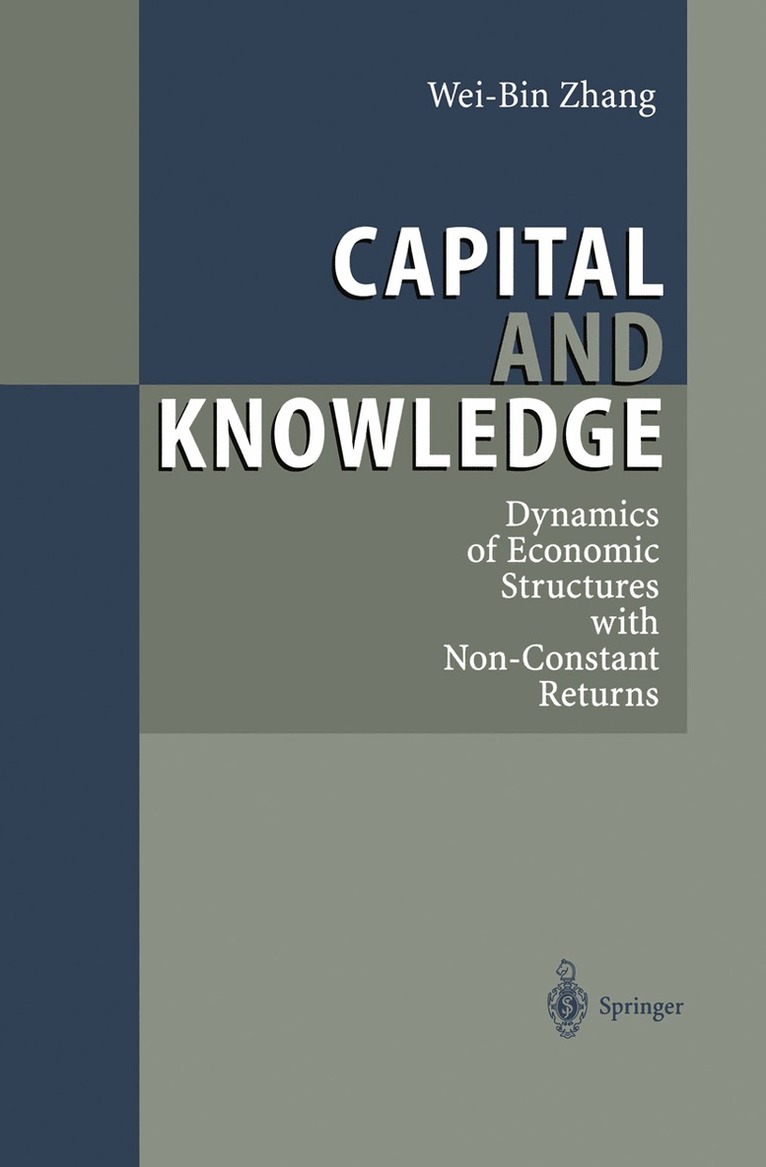
    Capital and Knowledge

    Dynamics of Economic Structures with Non-Constant Returns

    AvWei-Bin Zhang

    Inbunden, Engelska, 1999

    1 110 kr

    Beställningsvara. Skickas inom 10-15 vardagar. Fri frakt över 249 kr.

    Fler format och utgåvor

    E-bok

    1 413 kr

    Häftad

    1 078 kr

    Beskrivning

    This book constructs a general economic theory to analyze how different economic forces interact over time. It proposes some new combinations of various economic forces which may function at various stages of social and economic evolution. The theory includes the main economic ideas of Smith, Malthus, Ricardo, Marx, Mills, Walras, Marshall, Schumpeter and Keynes. It also includes, as special cases, the well-established mathematical models, such as the Arrow-Debreu general equilibrium model, the Tobin model, the Solow-Swan-Uzawa growth model, the Kaldor-Pasinetti two-class model, the Ricardian models by Morishima, Samuelson and Pasinetti, Keynesian theory, to explain certain economic phenomena which cannot be explained by traditional works.

    Produktinformation

    • Utgivningsdatum:1999-01-21
    • Mått:155 x 235 x 29 mm
    • Vikt:834 g
    • Format:Inbunden
    • Språk:Engelska
    • Antal sidor:431
    • Upplaga:1999
    • Förlag:Springer-Verlag Berlin and Heidelberg GmbH & Co. KG
    • ISBN:9783540651345

    Utforska kategorier

    • Nationalekonomi inom Ekonomi och Ledarskap

    Innehållsförteckning

    • 1 Introduction.- 1.1 Classical Economics.- 1.2 General Equilibrium Theory.- 1.3 Neoclassical Growth Theory.- 1.4 Disequilibrium Economics.- 1.5 Economic Structure.- 1.6 Economics with Returns to Scale.- 1.7 Modern Vision of Economic Processes by Complex Theory.- 1.8 Structure of the Study.- 2 One-Sector Growth Models under Constant Returns to Scale.- 2.1 The One-Sector Growth Model.- 2.2 Growth with Home Capital.- 2.3 Time Distribution in the One-Sector Growth Model.- 2.4 Conclusions.- A. 2.1 Production Functions in Growth Theory.- A. 2.2 Preference and Utility Functions.- A. 2.3 The Solow-Swan Model.- A. 2.4 The Ramsey Growth Model.- 3 One-Sector Economies under Non-Constant Returns to Scale.- 3.1 The Growth Model with Public Goods.- 3.2 Knowledge, Population, Environment and Economic Growth.- 3.3 An Economic Dynamics with Livestock.- 3.4 Economic Development with Human Capital and Opening.- 3.5 On Returns to Scale.- A. 3.1 Economic Growth with Money.- A. 3.2 Economic Chaos with Endogenous Population.- 4 Knowledge, Growth and Economic Structures.- 4.1 An Agricultural Economy with Land Ownership Distribution.- 4.2 A Two-Sector Ricardian Economy.- 4.3 The Ricardian System with Knowledge and Infrastructures.- 4.4 A Structural Dynamics of Agriculture, Industry and Service.- 4.5 Economic Structure with Multiple Capital Goods.- 4.6 On Economic Structures.- A. 4.1 The Neoclassical Two-Sector Growth Model.- A.4.2 The Neoclassical Multiple Sector Models.- A.4.3 Proving Proposition 4.2.1.- A.4.4 Proving Proposition 4.4.1.- A.4.5 Proving Proposition 4.5.1.- 5 Knowledge, Growth and Wealth Distribution.- 5.1 Income Distribution with Human Capital, Diligence and Frugality.- 5.2 Growth with Government’s Redistribution Policy.- 5.3 Economic Structure with Multiple Groups and JobAmenities.- 5.4 A Two-Group Growth Model with Capital and Knowledge.- 5.5 On Economic Evolution with Multiple Groups.- A.5.1 Distribution of Income and Wealth in Sato’s Model.- A.5.2 Proving Propositions 5.1.1 and5.1.2.- A.5.3 Proving Proposition 5.3.1.- A.5.4 Proving Proposition 5.4.1.- 6 Education, Research and Growth.- 6.1 Education and Saving in the Growth Model.- 6.2 The Research Model with Job Amenities.- 6.3 The Two-Group Model with Research and Job Amenities.- 6.4 Growth with Capital, Human Capital and Knowledge.- A.6.1 Proving Proposition 6.1.1.- 7 Unemployment in Disequilibrium Dynamics.- 7.1 Growth and Unemployment in a Two-Group Economy.- 7.2 Unemployment with Endogenous Knowledge.- 7.3 Unemployment in a ‘Welfare Economy’.- 7.4 Conclusions.- A. 7.1 Proving Lemmas 7.1.3 and 7.1.4 and Examining the Case of Different Preferences.- A. 7.2 Proving Proposition 7.2.1.- 8 Economic Development with Sexual Division of Labor.- 8.1 Sexual Division of Labor with Home Capital and Time Distribution.- 8.2 The Impact of Female Labor Participation on Knowledge Economies.- 8.3 Sexual Division of Labor with Capital and Knowledge.- 8.4 Economic Growth with Sexual Discrimination.- 8.5 On Complex of Sexual Division of Labor and Consumption.- A.8.1 Proving Lemmas 8.1.3 and 8.1.4.- A.8.2 Proving Lemma 8.2.1.- A.8.3 Proving Propositions 8.3.1 and 8.3.2.- 9 Preference Change with Capital and Knowledge.- 9.1 Preference Change in the One-Sector Growth Model.- 9.2 Dynamics of Capital, Knowledge and Preference.- 9.3 Dynamic Economic Structure with Preference Change.- 9.4 Growth and Preference Change with Sexual Division of Labor.- 9.5 Concluding Remarks.- 10 Summary.- Name Index.