• Fri frakt över 249 kr
  • •
  • Snabba leveranser
  • •
  • Billiga böcker
Kundservice

Du är på sajten för privatpersoner.

Företag, bibliotek eller offentlig verksamhet?

Du handlar på classic.bokus.com, där alla dina funktioner finns intakta.
Till classic.bokus.com
Bokus logotyp. Gå till startsidan.
  • Erbjudanden
  • Nyheter
  • Student
  • Topplistor
  • Barn & ungdom
  • Bokus Play
  • E-böcker
  • Pocketböcker
  • Spel & pussel

10% rabatt på allt med kod NYSTART10 →

Sidfot

Mina sidor

    Hjälp

    • Kundservice
    • Vanliga frågor och svar
    • Frakt och leverans
    • Retur vid ångerrätt
    • Reklamera vara
    • Betalning
    • Köpvillkor
    • Allmänna villkor
    • Information om webbplatsens tillgänglighet

    Om Bokus

    • Om oss
    • Pressrum
    • För studenter
    • För företag
    • För bibliotek och offentlig verksamhet
    • För leverantörer
    • Hållbarhet

    Populärt

    • Aktuella erbjudanden
    • Presentkort
    • Studentlitteratur
    • Nya böcker
    • Topplistor
    • Signerade böcker
    • Engelska böcker

    Inspiration

    • Boktips
    • BookTok
    • Populära bokserier
    • Barnbokskaraktärer
    • Populära författare
    Logotyp för Bokus
    Följ oss på Facebook (extern länk)Följ oss på Instagram (extern länk)Följ oss på YouTube (extern länk)Följ oss på TikTok (extern länk)
    bokus @ CookiesAnpassa cookiesIntegritetspolicyKöpvillkor
    Till Citymail hemsida (extern länk)Till Budbee hemsida (extern länk)Till Postnord hemsida (extern länk)Till Schenker hemsida (extern länk)Till Early Bird hemsida (extern länk)Till Walleys hemsida (extern länk)
    1. Data och IT
    2. Systemvetenskap och AI

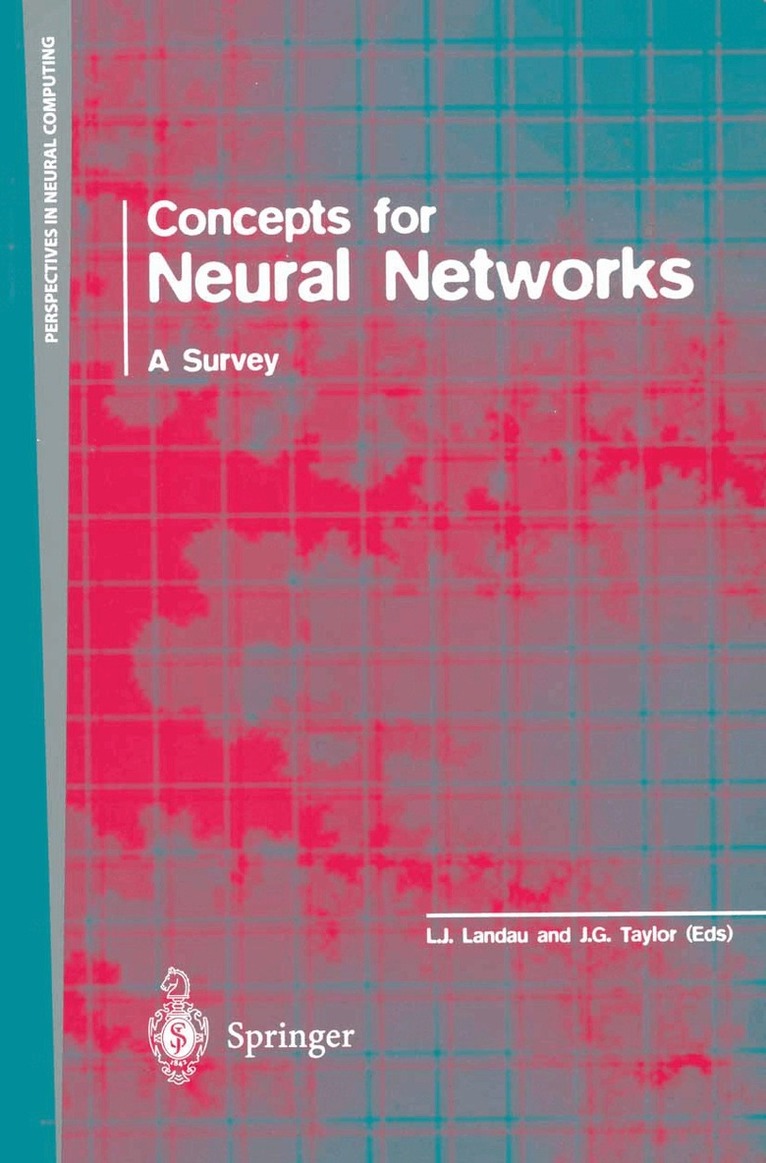
    Concepts for Neural Networks

    A Survey

    AvLawrence J. Landau

    Häftad, Engelska, 1997

    Del i serien Perspectives in Neural Computing

    1 117 kr

    Beställningsvara. Skickas inom 10-15 vardagar. Fri frakt över 249 kr.

    Beskrivning

    Concepts for Neural Networks - A Survey provides a wide-ranging survey of concepts relating to the study of neural networks. It includes chapters explaining the basics of both artificial neural networks and the mathematics of neural networks, as well as chapters covering the more philosophical background to the topic and consciousness. There is also significant emphasis on the practical use of the techniques described in the area of robotics. Containing contributions from some of the world's leading specialists in their fields (including Dr. Ton Coolen and Professor Igor Aleksander), this volume will provide the reader with a good, general introduction to the basic concepts needed to understan d and use neural network technology.

    Produktinformation

    • Utgivningsdatum:1997-11-12
    • Mått:155 x 235 x 18 mm
    • Vikt:493 g
    • Format:Häftad
    • Språk:Engelska
    • Serie:Perspectives in Neural Computing
    • Antal sidor:312
    • Upplaga:97001
    • Förlag:Springer-Verlag Berlin and Heidelberg GmbH & Co. KG
    • ISBN:9783540761631

    Utforska kategorier

    • Systemvetenskap och AI inom Data och IT

    Innehållsförteckning

    • 1 Neural Networks: An Overview.- 1.1 Introduction.- 1.2 What is a Neural Network?.- 1.3 Neural Network Dynamics.- 1.4 Training a Neural Network.- 1.5 Problems for Artificial Neural Networks.- 1.6 Problems for Neurobiologically Realistic Neural Networks.- 1.7 Conclusions.- 1.8 Further Reading.- 1.9 Bibliography.- 2 A Beginner’s Guide to the Mathematics of Neural Networks.- 2.1 Introduction: Neural Information Processing.- 2.2 From Biology to Mathematical Models.- 2.3 Neural Networks as Associative Memories.- 2.4 Creating Maps of the Outside World.- 2.5 Learning a Rule from an Expert.- 2.6 Puzzling Mathematics.- 2.7 Further Reading.- 2.8 Bibliography.- 3 Neurobiological Modelling.- 3.1 Introduction.- 3.2 The Single Nerve Cell.- 3.3 Retinal Processing.- 3.4 The Cortical Streams.- 3.5 The Ventral Stream.- 3.6 The Dorsal Stream.- 3.7 Object Construction.- 3.8 Modelling the Processing Streams.- 3.9 Conclusions.- 3.10 Bibliography.- 4 Neural Network Control of a Simple Mobile Robot.- 4.1 Introduction.- 4.2 The Robot ‘Insects’.- 4.3 Neural Network for Obstacle Avoidance.- 4.4 A Compound Eye.- 4.5 Navigation.- 4.6 Discussion.- 4.7 Bibliography.- 5 A Connectionist Approach to Spatial Memory and Planning.- 5.1 Overview.- 5.2 Introduction.- 5.3 Biological Spatial Memory.- 5.4 Connectionist Implementation.- 5.5 An Experiment with a Robot.- 5.6 Discussion.- 5.7 Conclusion.- 5.8 Appendix: Vision system for letter detection and recognition..- 5.9 Appendix: Vision system for state recognition.- 5.10 Appendix: Notes on a biologically plausible implementation.- 5.11 Bibliography.- 6 Turing’s Philosophical Error?.- 6.1 Turing’s Machine.- 6.2 Digital Problems.- 6.3 Turing’s Thesis.- 6.4 How Turing Built his Universal Machine.- 6.5 Gödel’s Attempt to Break Turing’s Thesis.-6.6 Yes-or-No Questions.- 6.7 Material and Formal Proofs.- 6.8 The Dialectica Lecture.- 6.9 A Calculus of Concepts?.- 6.10 Turing’s Error.- 6.11 Further Reading.- 6.12 Bibliography.- 7 Penrose’s Philosophical Error.- 7.1 Can Computers Think?.- 7.2 Solving Problems in Arithmetic.- 7.3 The Barber Paradox.- 7.4 Gödel’s Theorem.- 7.5 Penrose.- 7.6 A Computational Model for Thought?.- 7.7 Can Computers Think?.- 7.8 Appendix: Filling in Some Details.- 7.9 Bibliography.- 8 Attentional Modulation in Visual Pathways.- 8.1 Introduction.- 8.2 Structural Equation Modelling.- 8.3 Design and Image Acquisition.- 8.4 Image Analysis and Categorical Comparisons.- 8.5 Modelling of the Posterior Visual Pathway.- 8.6 Modelling Modulation by Interaction Terms.- 8.7 Interaction Effects Demonstrated with Regression Analysis.- 8.8 Regional Specificity.- 8.9 Conclusion.- 8.10 Bibliography.- 9 Neural Networks and the Mind.- 9.1 Introduction.- 9.2 The Relational Mind.- 9.3 Exploring the Relational Mind Model.- 9.4 Memory in the Relational Mind Model.- 9.5 A Neural Candidate for Global Control.- 9.6 Consciousness and Sites of Working Memory.- 9.7 Awareness of Words.- 9.8 Activity ‘Bubbles’ in Cortex.- 9.9 The Emergence of Qualia.- 9.10 Discussion.- 9.11 Bibliography.- 10 Confusions about Consciousness.- 10.1 Consciousness Studies.- 10.2 Bibliography.- 11 Round Table Discussion.- 11.1 Presentations.- 11.2 Audience Participation.