• Fri frakt över 249 kr
  • •
  • Snabba leveranser
  • •
  • Billiga böcker
Kundservice

Du är på sajten för privatpersoner.

Företag, bibliotek eller offentlig verksamhet?

Du handlar på classic.bokus.com, där alla dina funktioner finns intakta.
Till classic.bokus.com
Bokus logotyp. Gå till startsidan.
  • Erbjudanden
  • Nyheter
  • Student
  • Topplistor
  • Barn & ungdom
  • Bokus Play
  • E-böcker
  • Pocketböcker
  • Spel & pussel

10% rabatt på allt med kod: NYSTART10 →

Sidfot

Mina sidor

    Hjälp

    • Kundservice
    • Vanliga frågor och svar
    • Frakt och leverans
    • Retur vid ångerrätt
    • Reklamera vara
    • Betalning
    • Köpvillkor
    • Allmänna villkor
    • Information om webbplatsens tillgänglighet

    Om Bokus

    • Om oss
    • Pressrum
    • För studenter
    • För företag
    • För bibliotek och offentlig verksamhet
    • För leverantörer
    • Hållbarhet

    Populärt

    • Aktuella erbjudanden
    • Presentkort
    • Studentlitteratur
    • Nya böcker
    • Topplistor
    • Signerade böcker
    • Engelska böcker

    Inspiration

    • Boktips
    • BookTok
    • Populära bokserier
    • Barnbokskaraktärer
    • Populära författare
    Logotyp för Bokus
    Följ oss på Facebook (extern länk)Följ oss på Instagram (extern länk)Följ oss på YouTube (extern länk)Följ oss på TikTok (extern länk)
    bokus @ CookiesAnpassa cookiesIntegritetspolicyKöpvillkor
    Till Citymail hemsida (extern länk)Till Budbee hemsida (extern länk)Till Postnord hemsida (extern länk)Till Schenker hemsida (extern länk)Till Early Bird hemsida (extern länk)Till Walleys hemsida (extern länk)
    1. Språk och ordböcker
    2. Språkvetenskap och lingvistik

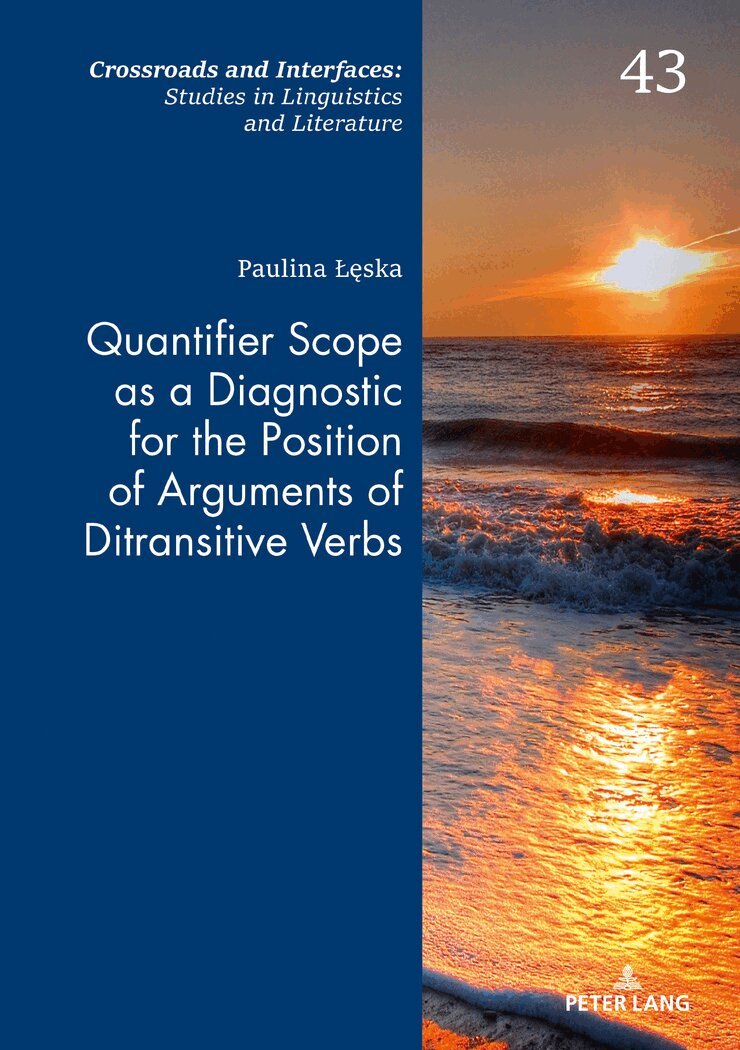
    Quantifier Scope as a Diagnostic for the Position of Arguments of Ditransitive Verbs

    AvPaulina Łęska,Jacek Witkoś

    Inbunden, Engelska, 2020

    Del 43 i serien Crossroads and Interfaces: Studies in Linguistics and Literature

    794 kr

    Beställningsvara. Skickas inom 5-8 vardagar. Fri frakt över 249 kr.

    Beskrivning

    The study presented in this book aimed to test the argument structure of ditransitive verbs in Polish with the use of quantifier scope interpretation. Since these verbs typically allow for relatively free object order, it is not clear whether any of the object orders is basic or if they constitute separate underlying structures. The study reports the results of five experiments testing acceptability of scope interpretation of Polish quantified objects in two object orders, using variables such as coordination, to reveal which scope changing mechanism is responsible for ambiguity. The results showed that only the DO-IO order allowed for scope ambiguity, however, to a different degree depending on the semantic class of the verb. This indicates that the merge position of objects is contingent upon that factor.

    Produktinformation

    • Utgivningsdatum:2020-02-28
    • Mått:148 x 210 x 30 mm
    • Vikt:536 g
    • Format:Inbunden
    • Språk:Engelska
    • Serie:Crossroads and Interfaces: Studies in Linguistics and Literature
    • Antal sidor:362
    • Förlag:Peter Lang AG
    • ISBN:9783631802861

    Utforska kategorier

    • Språkvetenskap och lingvistik inom Språk och ordböcker

    Mer om författaren

    Paulina Łęska is a PhD candidate at the Faculty of English of Adam Mickiewicz University, Poznań. She was involved in two research projects funded by the Polish National Science Centre, one investigating Polish nominal phrases (2014-2017) and the other examining the properties of dative arguments (2015-). She was awarded Adam Mickiewicz University Vice-Chancellor's scholarship in years 2015/2016, 2016/2017, 2017/2018, 2018/2019, and Adam Mickiewicz University Foundation Scholarship for best PhD students in 2018/2019.

    Innehållsförteckning

    • The English dative alternation debate – Object order in Slavic ditransitive verbs – Quantifier scope and its correlation with scrambling – Scope changing mechanisms: Quantifier Raising and scope reconstruction – Testing scope interpretation in experiments – Ditransitive verb classes and two merge positions of the indirect object –